

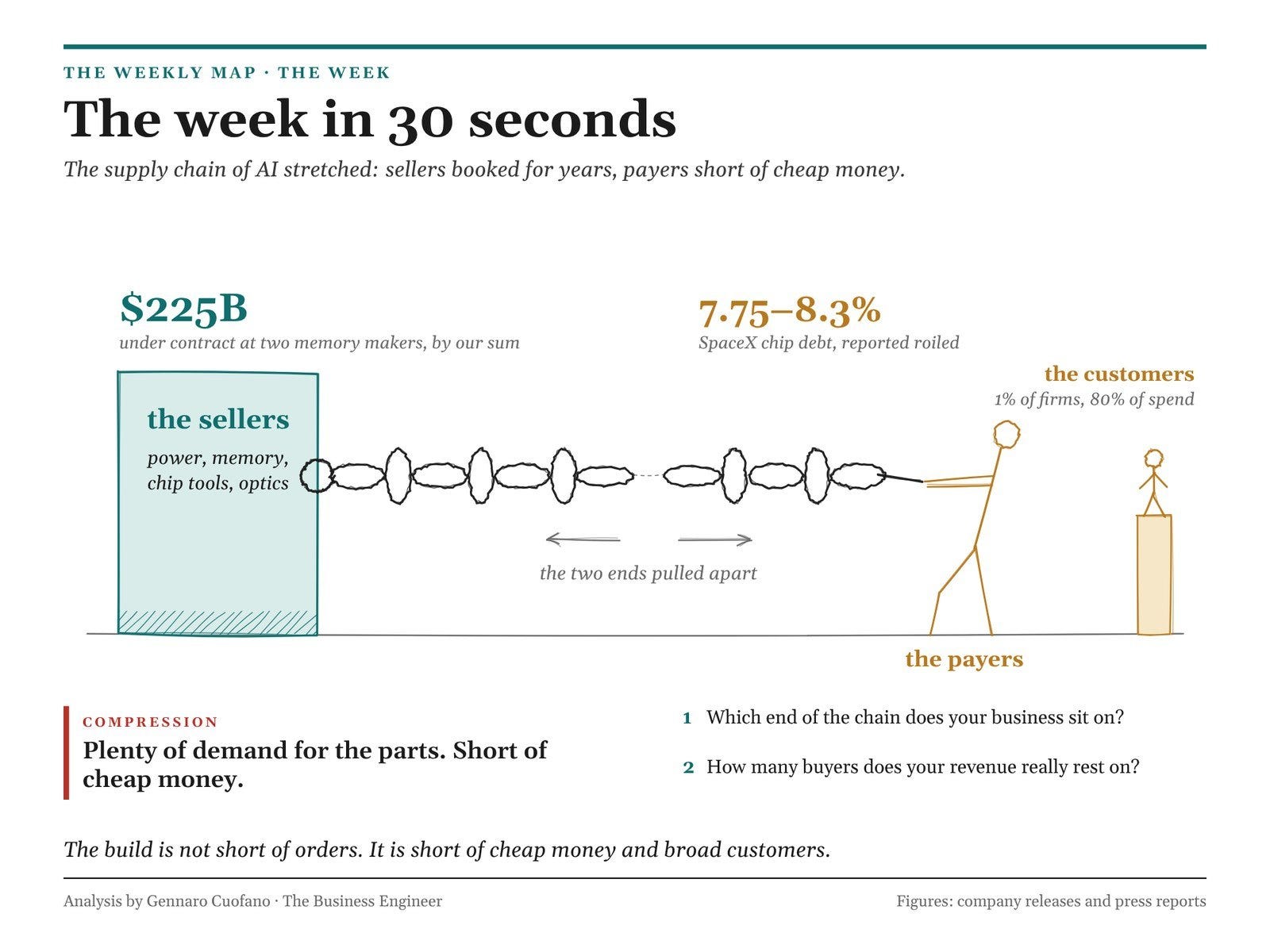
Think of the AI build-out as one long supply chain. At one end sit the companies that sell the inputs: electricity, memory chips, chipmaking tools, optical parts, and servers. At the other end sit the companies that pay for it all, and behind them the customers whose spending is supposed to pay it back.
This week the two ends pulled apart.
The sellers are booked for years. Amazon’s chief executive Andy Jassy said “2027 is largely sold out” for AWS capacity, Reuters reported. Two US memory makers, Micron and Sandisk, carry about $225 billion of sales already under contract, by our arithmetic from their filings.
The payers found money dearer. SpaceX’s $40 billion chip debt was set to price at about 7.75% to 8.3%, then Bloomberg reported the deal “roiled” by market turmoil. Meta’s interest bill rose 330% in a year, and its quarterly free cash flow turned negative.
The customers are fewer than they look. On data from Ramp, a corporate card company, 1% of firms drive 80% of business spend on OpenAI and Anthropic. Much of that spend comes from companies funded by venture capital.
Prices for the product kept falling. A Chinese lab, Moonshot, priced a frontier-class model at half of Anthropic’s top model. Token prices fell about 50% in a year in one data firm’s panels.
Equity stayed cheap while debt got dear. OpenAI is reportedly close to raising up to $30 billion at a $1.25 trillion valuation, and DeepSeek reportedly raised about $15 billion. In the same week, SpaceX’s chip debt snagged, even as its AI business passed half of its revenue.
AI pushed back into the wider world. It showed up in central-bank talk about inflation, in a national budget’s largest AI heading (security), and in an attack run by AI agents. That two-way pressure is what we mean by a supercycle.
The short version: the build isn't short on demand for its parts. It is short of cheap money, and its end revenue rests on a narrow base of large, often venture-funded buyers.
How to read this issue
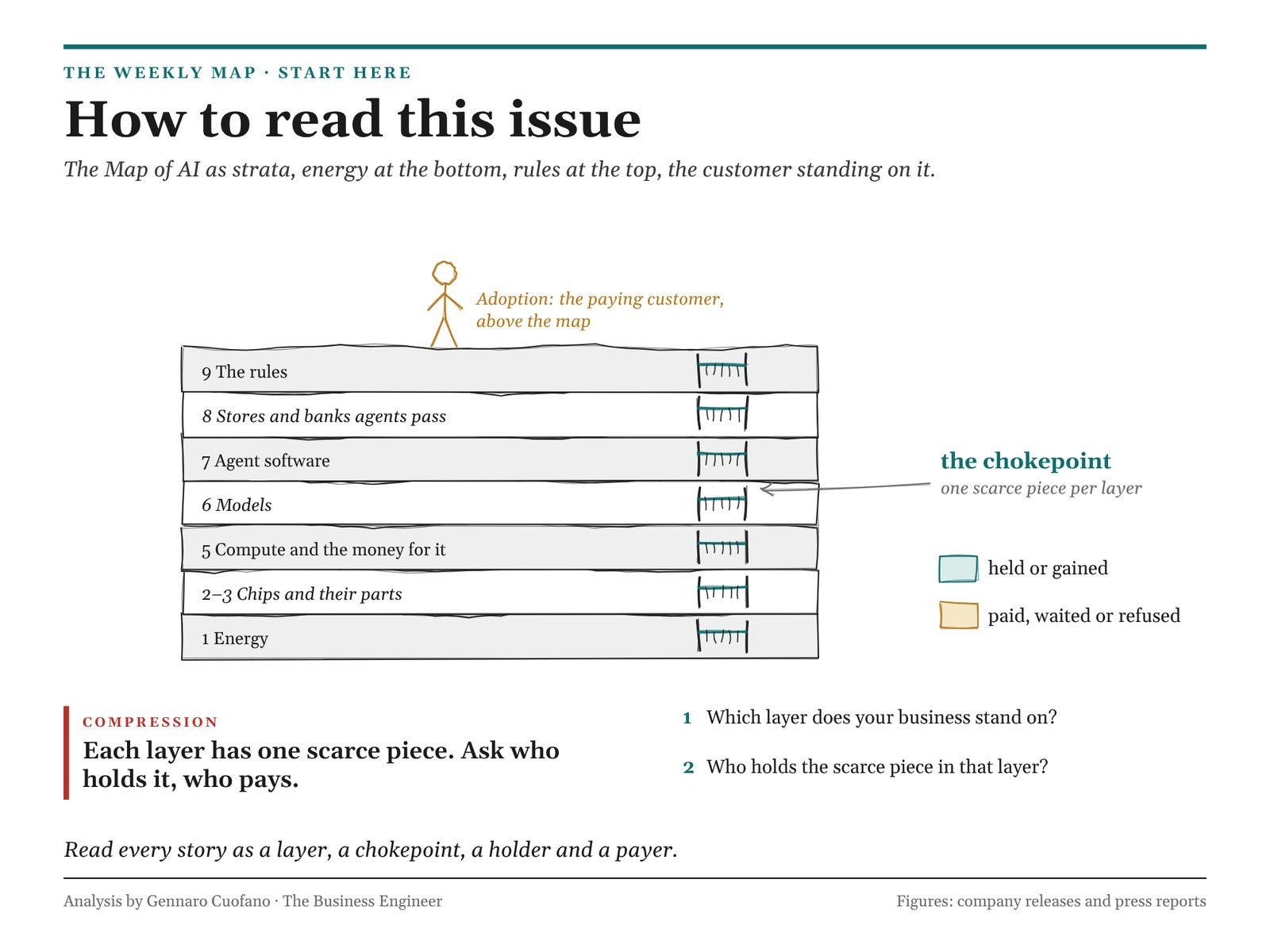
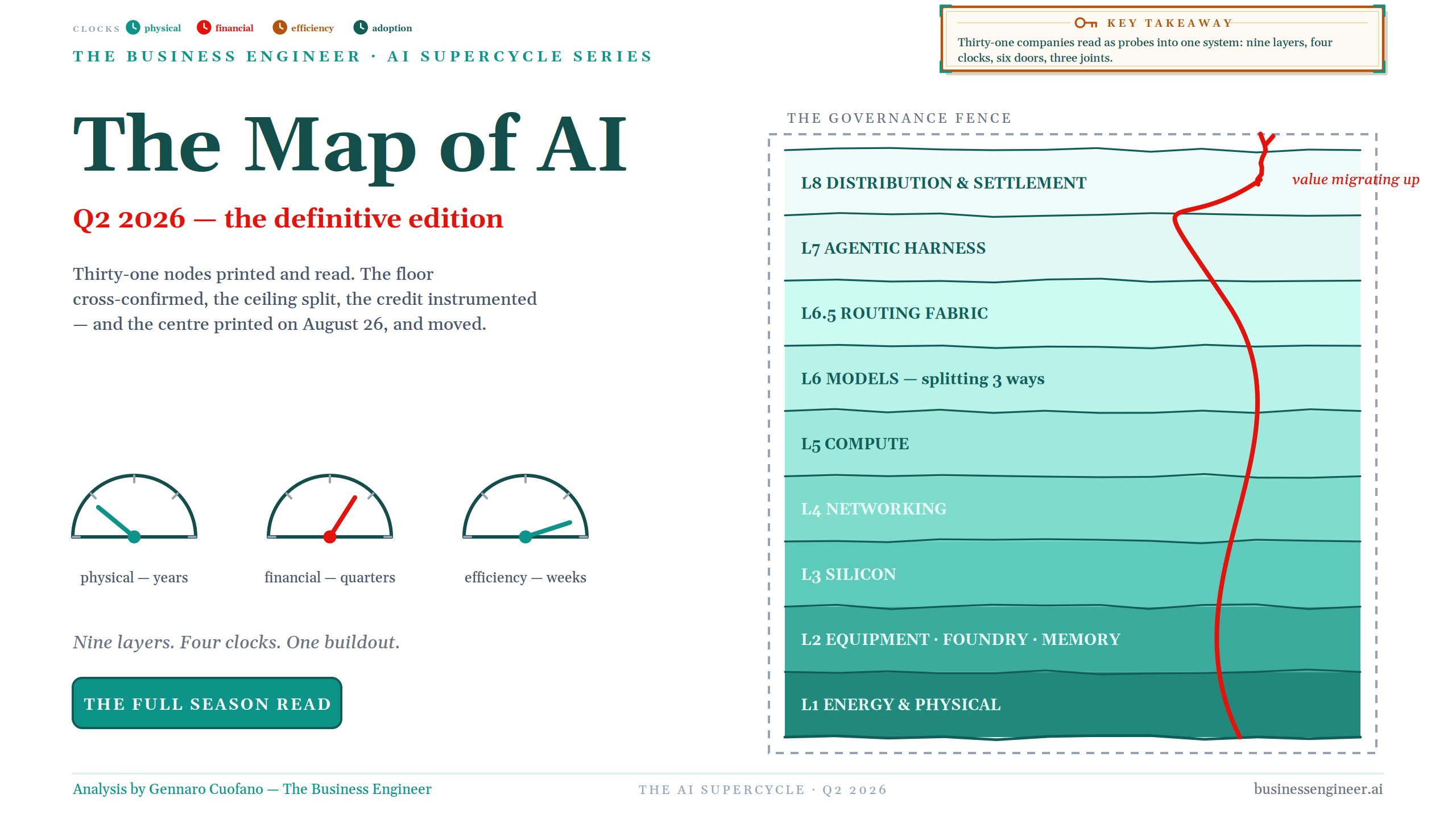
The layers. Energy is Layer 1, and chips and their parts are Layers 2 and 3. Compute and the money that pays for it are Layer 5, models Layer 6 and the agent software around them Layer 7. The stores and banks agents must pass are Layer 8, and the rules are Layer 9. The paying customer sits above the map as Adoption.
The chokepoint. Each layer has one scarce piece this week. For each, we name who holds it and who pays to use it.
The colours. In the pictures, teal marks the side that held or gained. Ochre marks the side that paid, waited or was refused.
The cascade and the loop. World politics shapes the economy, and the economy shapes technology. In a supercycle the arrows also run back: AI moves the economy and politics in return.
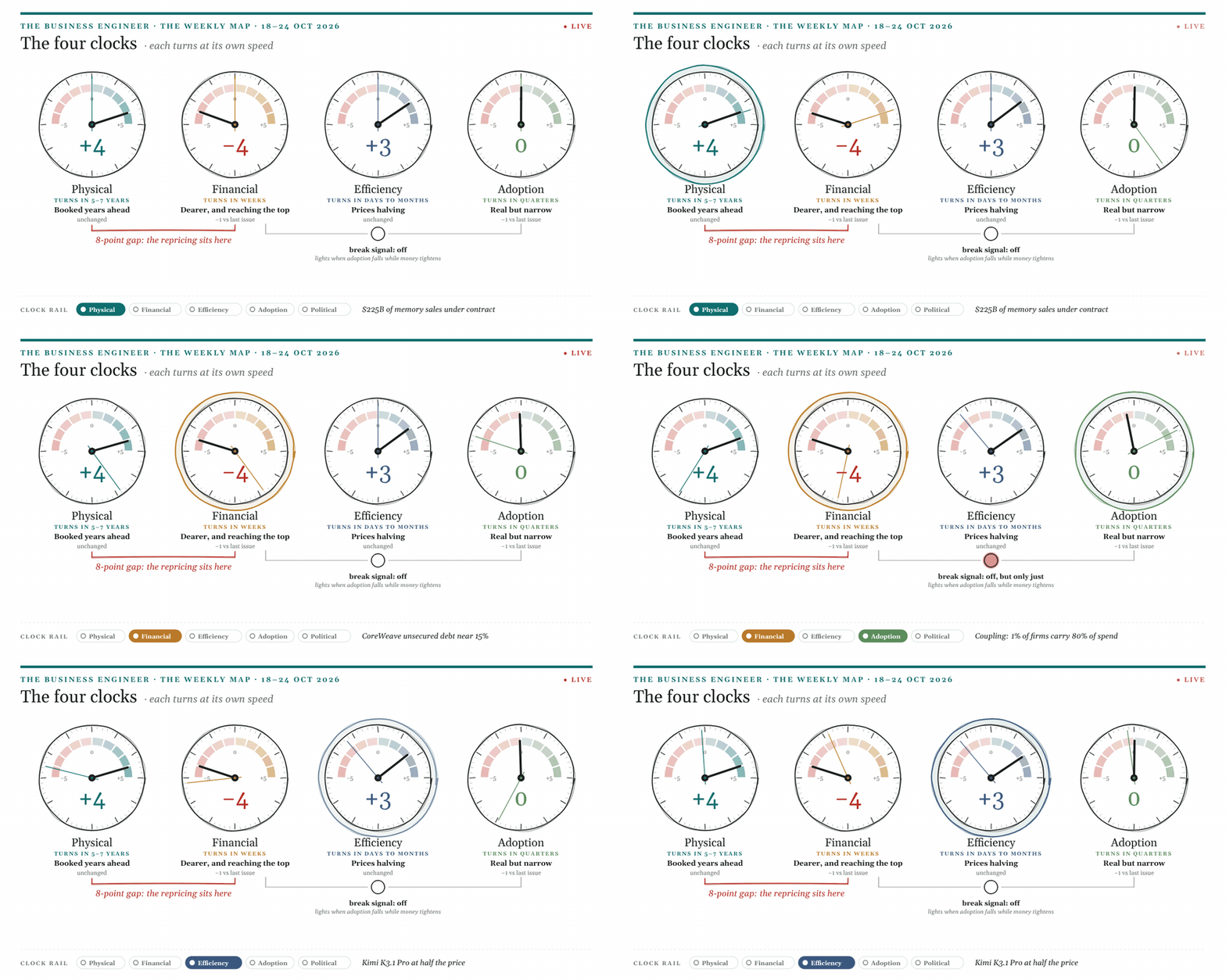
The four clocks. Each part of the build runs on its own clock: factories over years, money over weeks, efficiency over months, customers over quarters. Trouble starts when two clocks disagree.
Two habits to note. “Reported” marks figures from news outlets that the companies have not confirmed. “By our arithmetic” marks a sum or ratio we worked out from published figures.
Who Pays for the Build
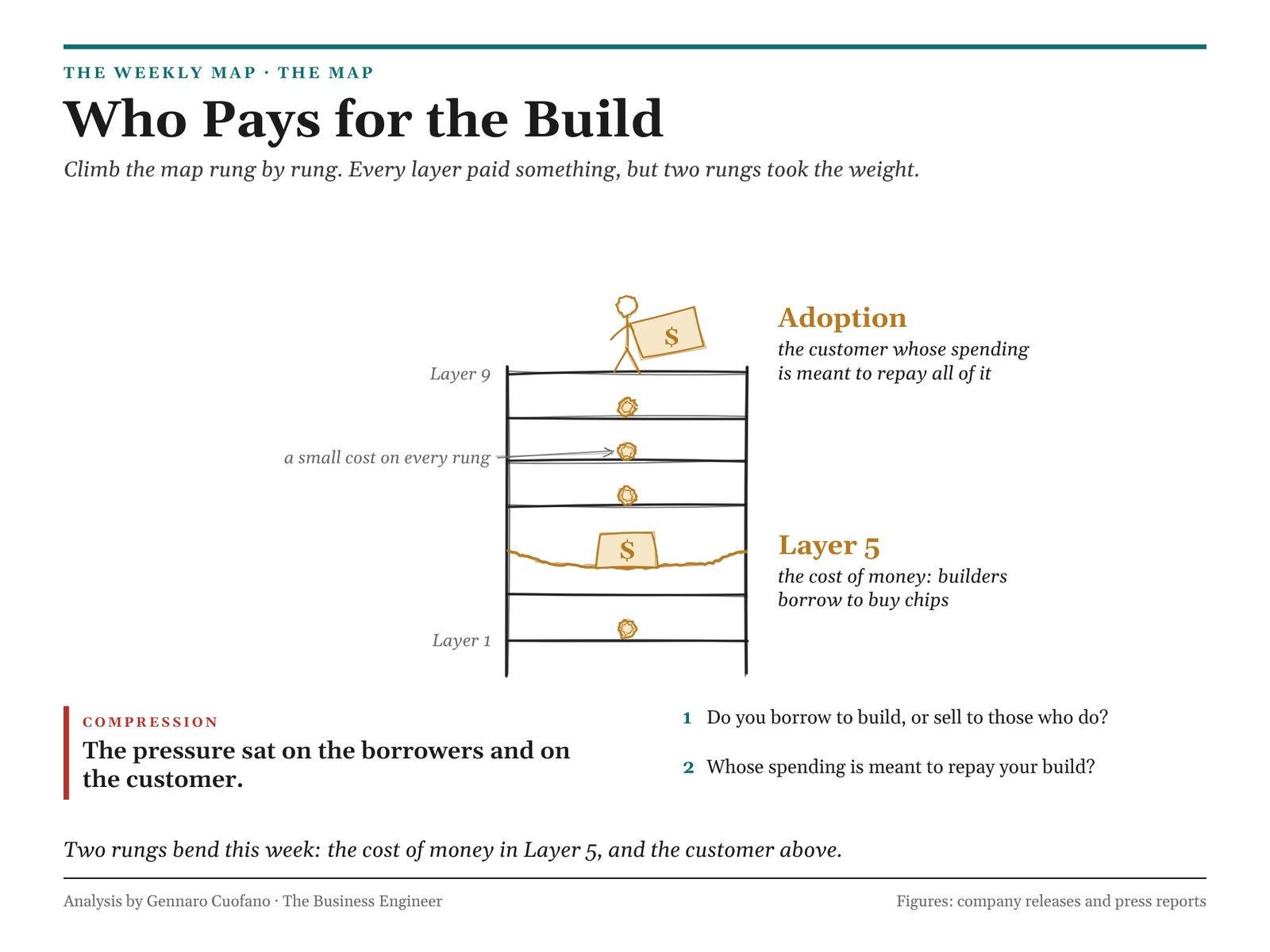
Start at the bottom of the map and climb. Every layer had a side that paid this week. The pressure, though, gathered on two of them.
The first was the cost of money, in Layer 5, where builders borrow to buy chips and switch on data centers. The second was the customer, above the map, whose spending is meant to repay it all.