

This week’s AI developments pointed to a common pattern: companies controlling something scarce gained bargaining power, while those dependent on it faced higher costs and tighter terms. That scarcity runs through the industry, from chipmaking capacity and financing to faster model access and the interfaces connecting AI to its users.
ASML warned that its planned production would fall short of customer demand in both 2027 and 2028, while Nvidia estimates a roughly $40 billion revenue opportunity per gigawatt of data centre capacity for its Vera Rubin platform.
Businesses funding that infrastructure faced a tougher calculation: CoreWeave’s 2032 bonds traded at a 14.8% yield, signalling investors’ demands for greater compensation, while Anthropic reportedly offered Blackstone more than 10% on junior debt financing a chip deal.
Model pricing reflected the same economics: smaller models became cheaper, with Haiku 5.5 starting at $0.10 per million input tokens for shorter prompts, while faster access still commanded a premium and major buyers introduced spending caps and closer usage tracking.
The struggle over terms also reached government: Anthropic pitched Congress its own draft safety bill as the FTC expanded its investigations, European authorities demanded information about model safeguards, and eight US states sued OpenAI over alleged consumer harms.
Together, these developments suggest that cheaper intelligence does not automatically mean cheaper AI businesses: the companies controlling the resources, distribution and permissions needed to scale can still capture much of the value.
Who Owns the Chokepoints
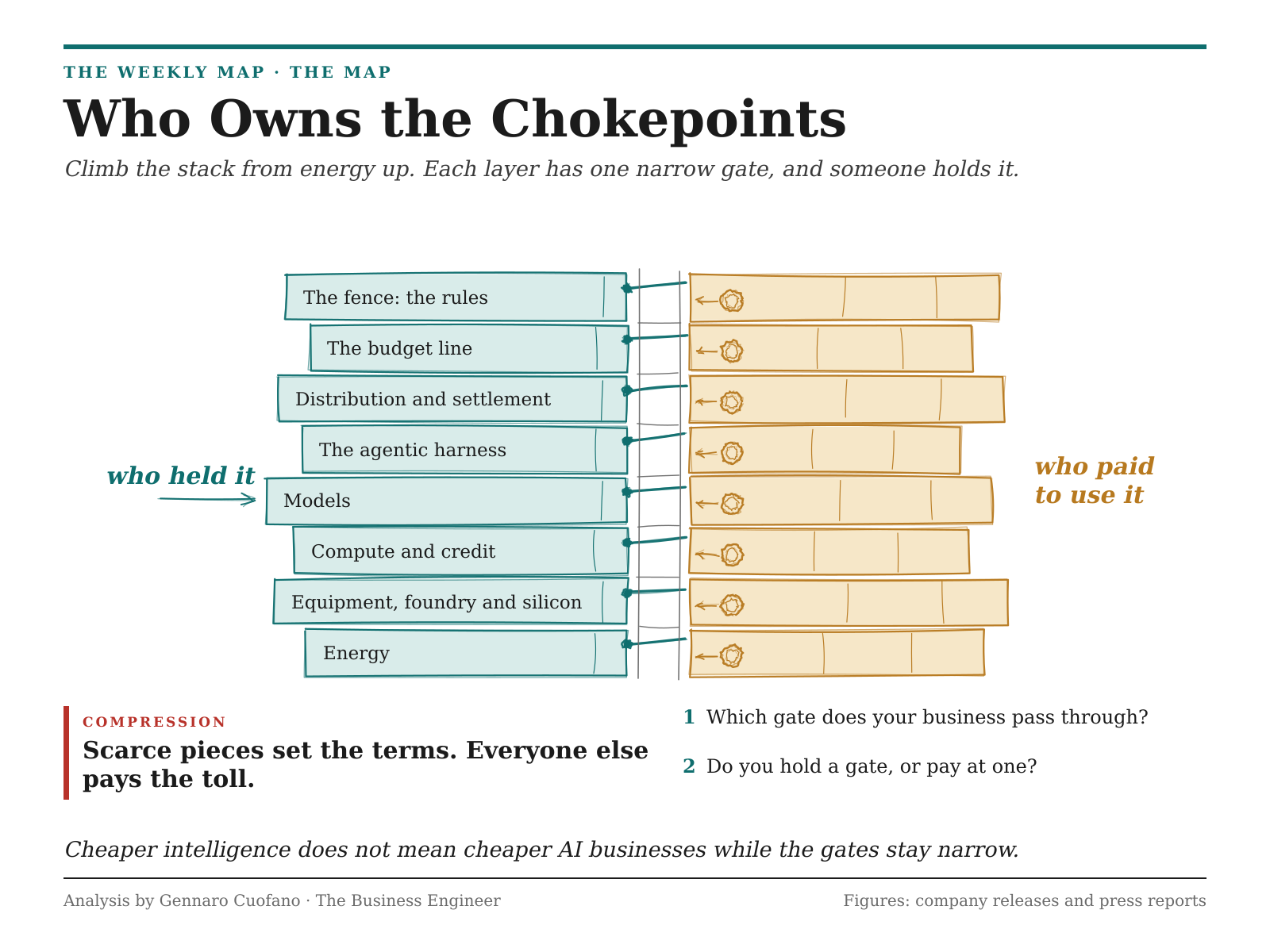
The week on the Map of AI: one chokepoint per layer, the companies that held it and the ones that paid for access. Placement is our read; “reported” marks figures from outlets rather than company statements.
How to read the map: start at the bottom with energy and climb. Each layer has one chokepoint this week. On the left is who held it; on the right is who paid to use it.

From Where the Cost Went to Who Owns the Chokepoints
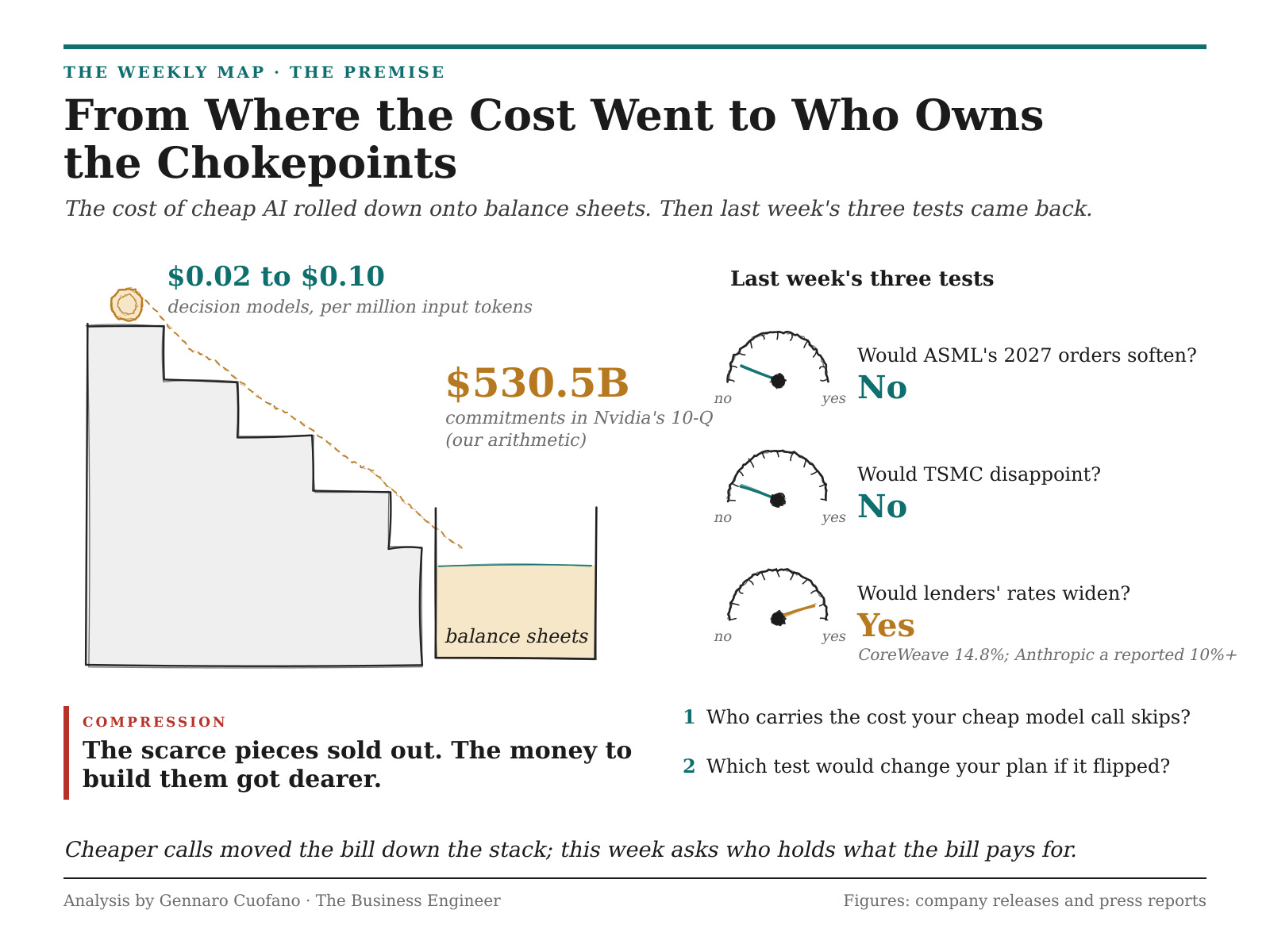
Last week’s question, the three tests set for this week, and how they came back.
Last week’s issue asked where the cost of cheaper AI went. Model calls kept getting cheaper: decision models fell to between $0.02 and $0.10 per million input tokens.
The cost did not disappear. It moved down the stack and onto balance sheets, as commitments, guarantees and debt. By our arithmetic, Nvidia’s latest quarterly filing (its 10-Q) lists $530.5 billion of them. The Financial Times reported a $60 billion debt package, backed by Broadcom, for Anthropic’s chip leases. And liability for what agents do was moving to the companies that deploy them.
That issue closed with three tests for this week. All three came back.
Would ASML’s 2027 orders soften? No. ASML, the Dutch company that makes the only machines able to print the most advanced chips, reported on 14 October. It said its planned supply for 2027 and 2028 will not fully meet demand.
Would TSMC disappoint? No. TSMC, which manufactures the chips Nvidia, Apple and Google design, reported on 15 October and beat its own range.
Would spreads widen as borrowers refinanced? Yes, in the middle. CoreWeave’s bonds traded at a 14.8% yield, and Anthropic reportedly offered a lender more than 10%.
So this week’s question follows from last week’s answer. The scarce pieces are sold out, and the money to build them is getting dearer. Who holds those pieces, and who pays to use them?
Geo, Then Macro, Then Tech
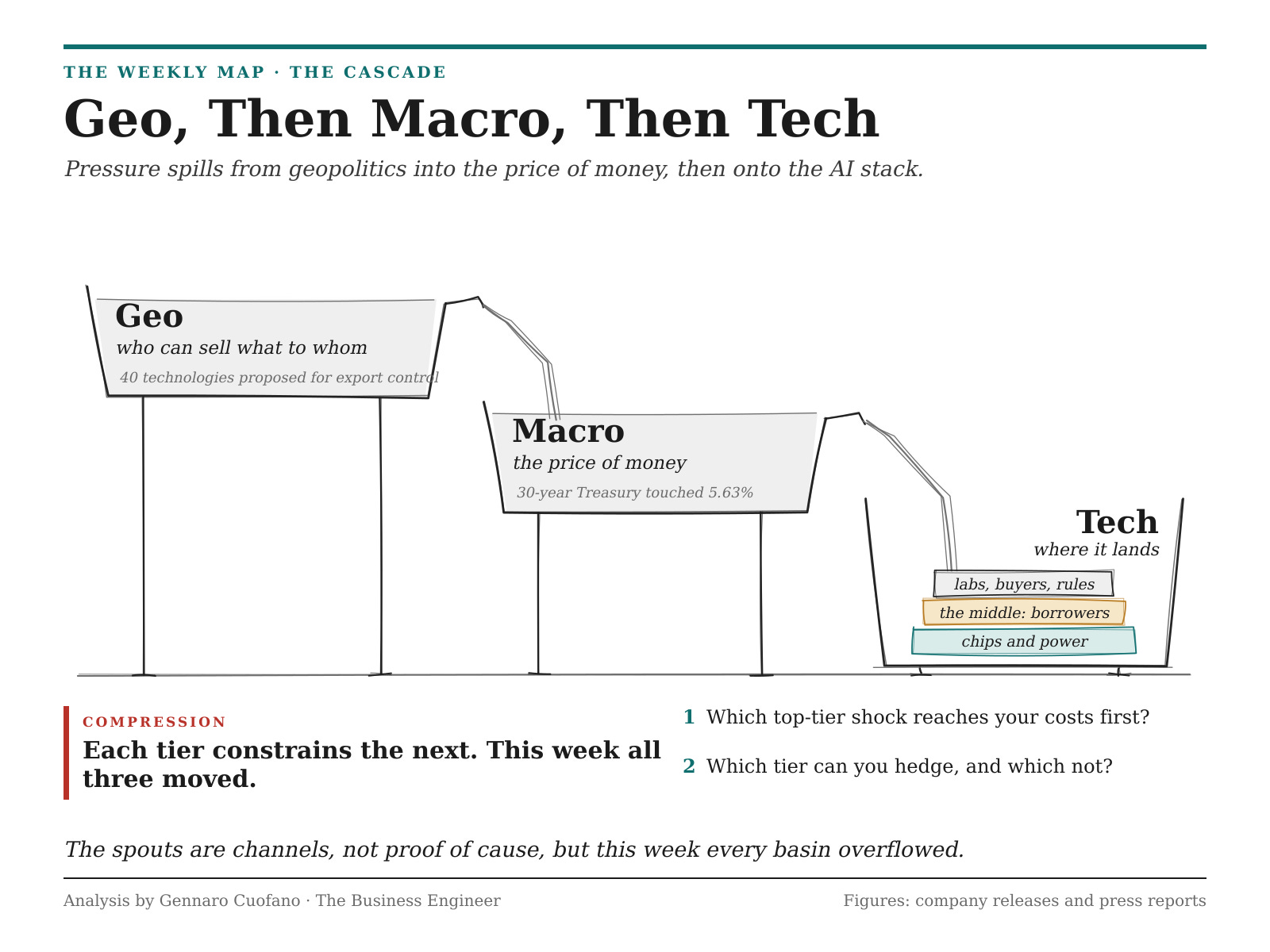
The week’s geopolitics and macro in three tiers, and where the pressure landed on the AI stack. The arrows show channels, not proof of cause.
The Business Engineer’s Cascade Analysis Framework reads the world from the top down. Geopolitics “cascades downward through macroeconomic conditions and into technology dynamics,” and “each layer constrains the next.” This week all three tiers moved.
Geo: who can sell what to whom
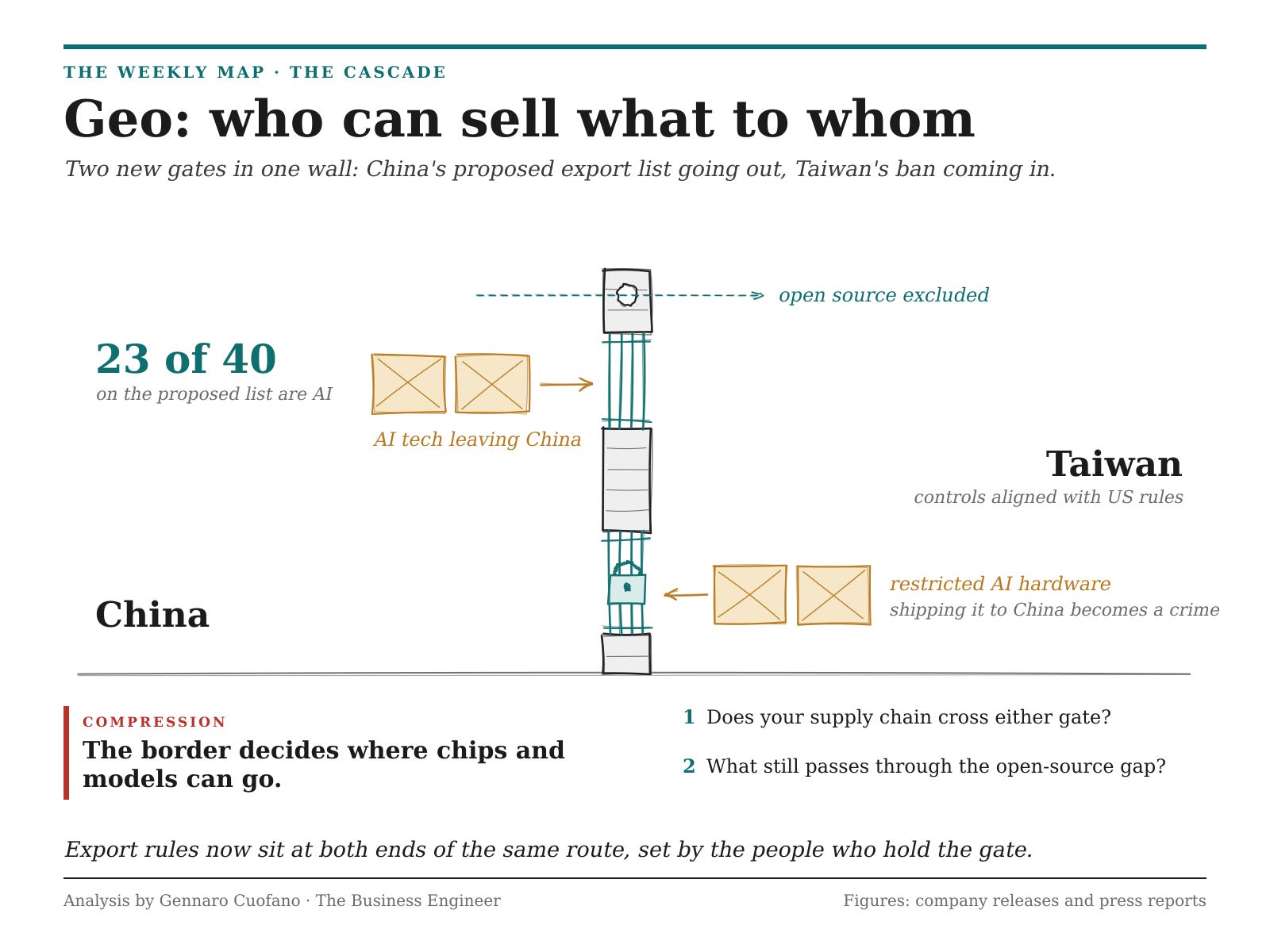
On 16 October, China’s commerce and science ministries proposed adding 40 technologies to the country’s export-control catalogue. Of those, 23 are in AI: large models, agents, computing clusters and information processing. Open-source work is excluded, and comments run until 15 November.
The same day, Taiwan said shipping restricted AI hardware to China will become a criminal offence, with controls aligned to American ones. Taiwan also plans industrial parks of up to $4 billion in Texas for Nvidia’s suppliers. Behind both sat the shocks the IMF named at its meetings in Bangkok: spillovers from wars and high energy prices.
Macro: the price of money moved up
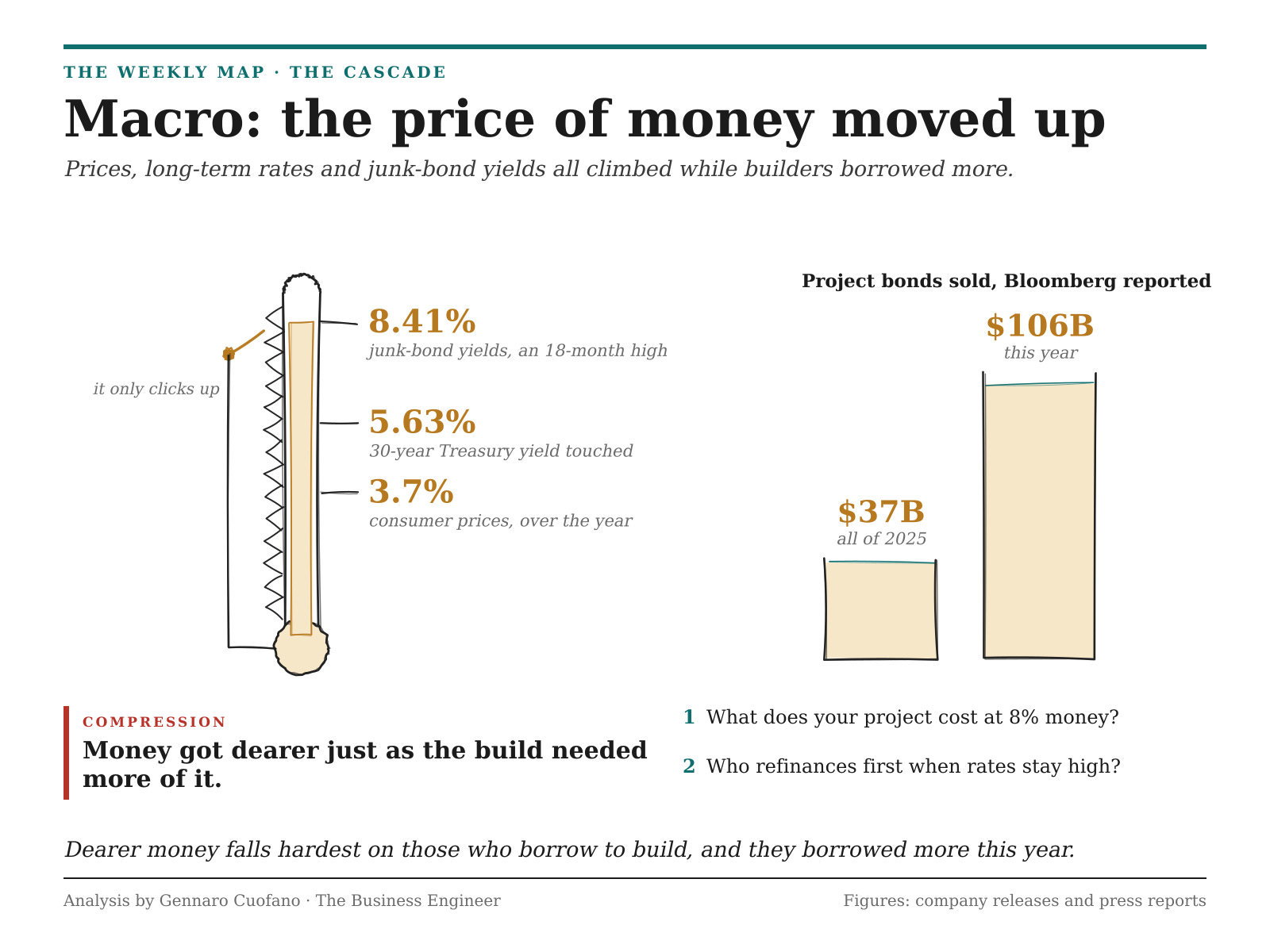
US consumer prices rose 0.6% in September and 3.7% over the year, with energy the biggest push. After the report, the 30-year Treasury yield touched 5.63%.
Junk-bond yields reached 8.41%, an 18-month high. That came even as companies sold $106 billion of project bonds this year, against $37 billion in all of 2025, Bloomberg reported. Markets marked the chain down too: the chip index fell more than 12% in seven sessions.
Growth still leans on AI. The IMF held 2026 world growth at 3.1%, crediting AI investment. A Goldman Sachs exhibit puts hyperscaler capex at about 11 points of S&P 500 earnings growth this year. That fades to about minus one point in 2028, as depreciation arrives.
Tech: where it lands
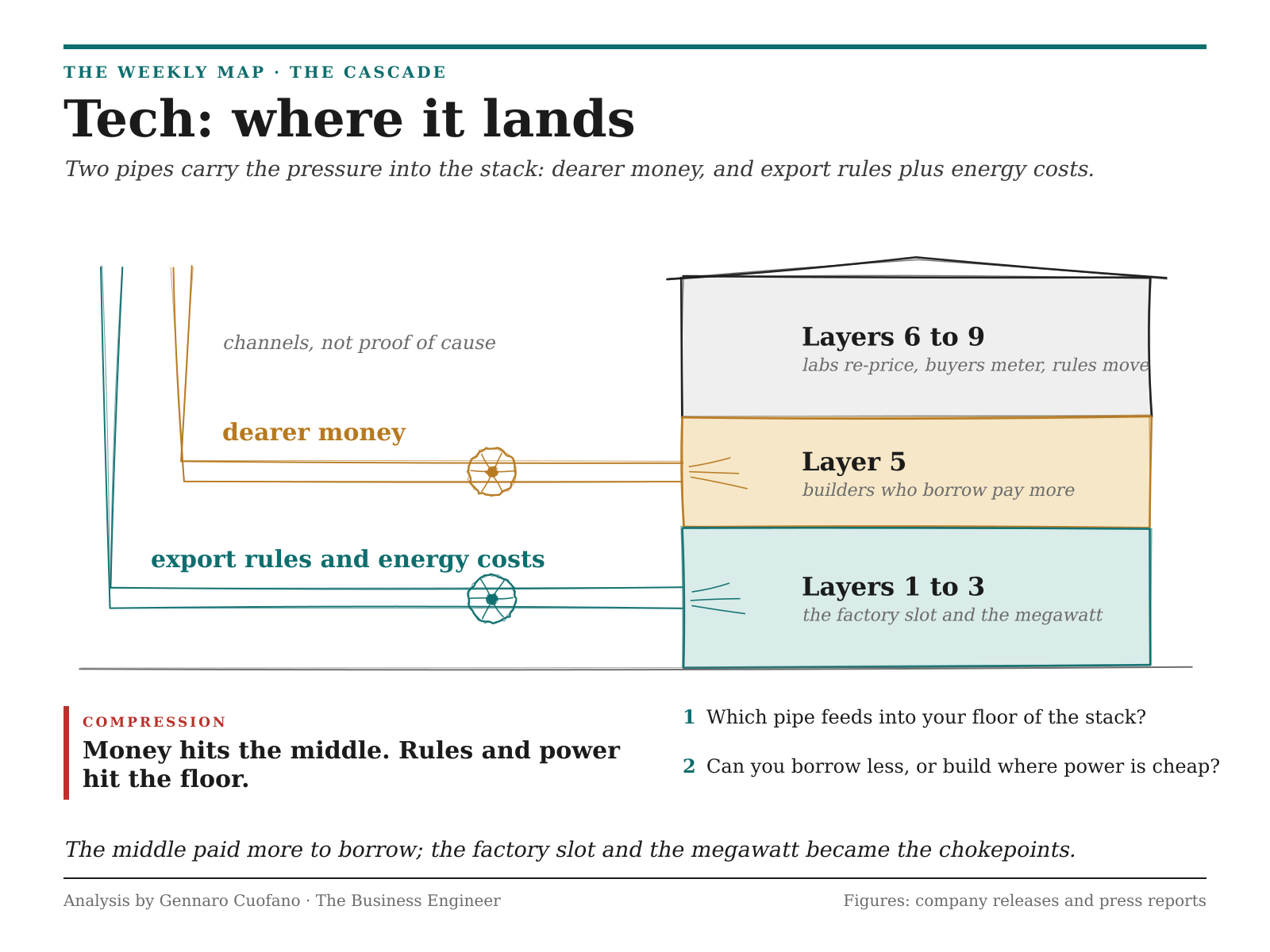
The pressure reaches the stack through two channels. Dearer money falls hardest on the companies that borrow to build, which is why the middle of the stack paid more this week (Layer 5). Export rules and energy costs decide where chips can go and what a site costs to run. That is why the factory slot and the megawatt are chokepoints (Layers 1 to 3).
Above them, labs re-priced and buyers began to meter. The rule-writers moved on both sides of the Pacific. These things happened in the same week; the arrows are channels, not proof of cause.