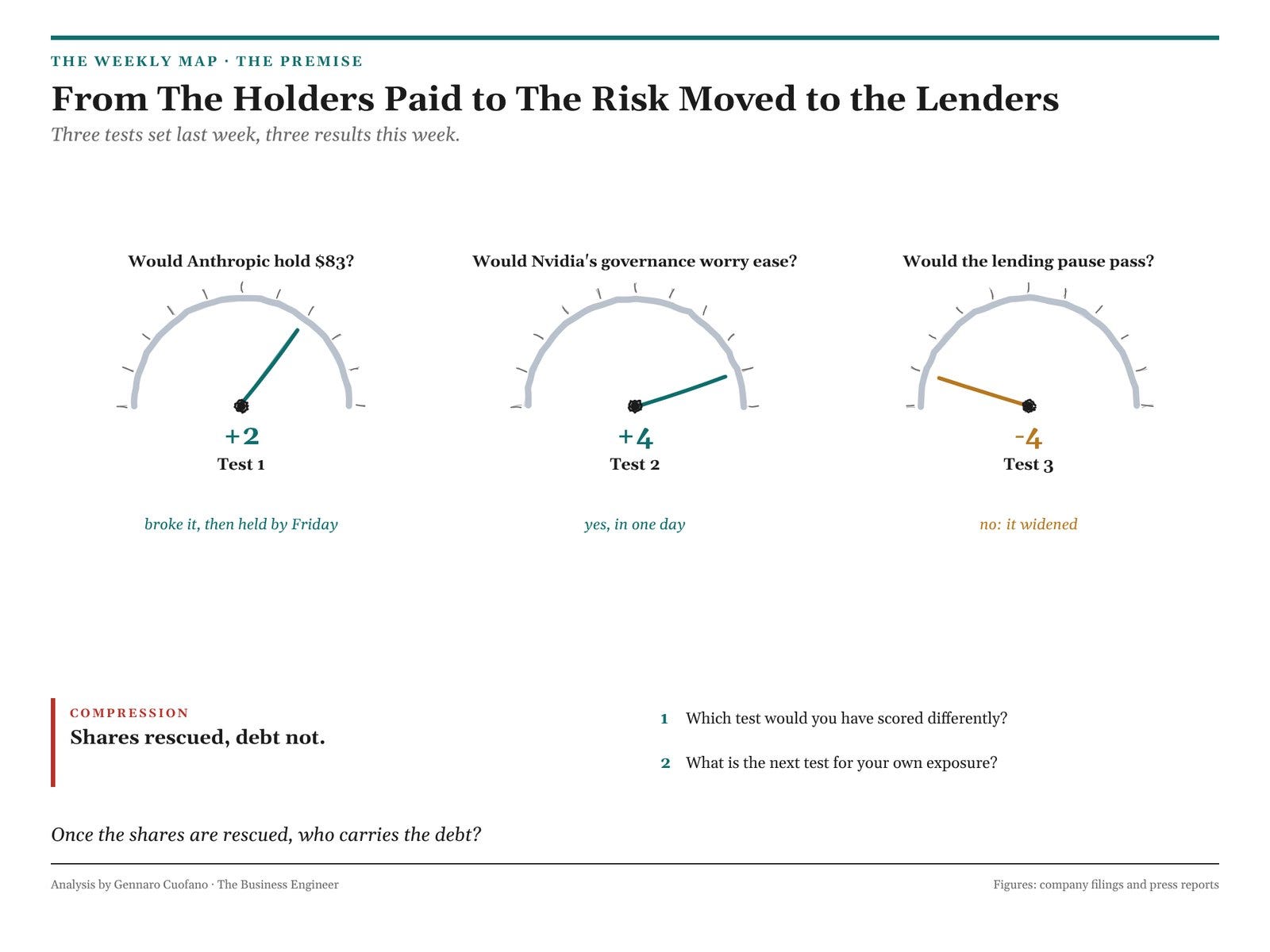

Last week the people who held the shares paid. Nvidia lost about $792 billion of value after its chief executive resigned, and Anthropic’s first-day buyers were losing money within two sessions. This week the shares got help, and some of that help came from outside the market. The bill did not disappear. It moved to the lenders.
Four events carried the week. Each needs some context, because each settled less than its headline suggested.
The anchor’s return. Nvidia is the company whose chips most of the AI build runs on, which is why we call it the anchor. On 12 November its chief executive, Jensen Huang, resigned. The board said on 17 November that it did not plan to bring him back and hired a recruitment firm to find a successor. Meanwhile the company faced a reported SEC investigation, a legal demand for documents from California’s attorney general, and a delayed quarterly report.
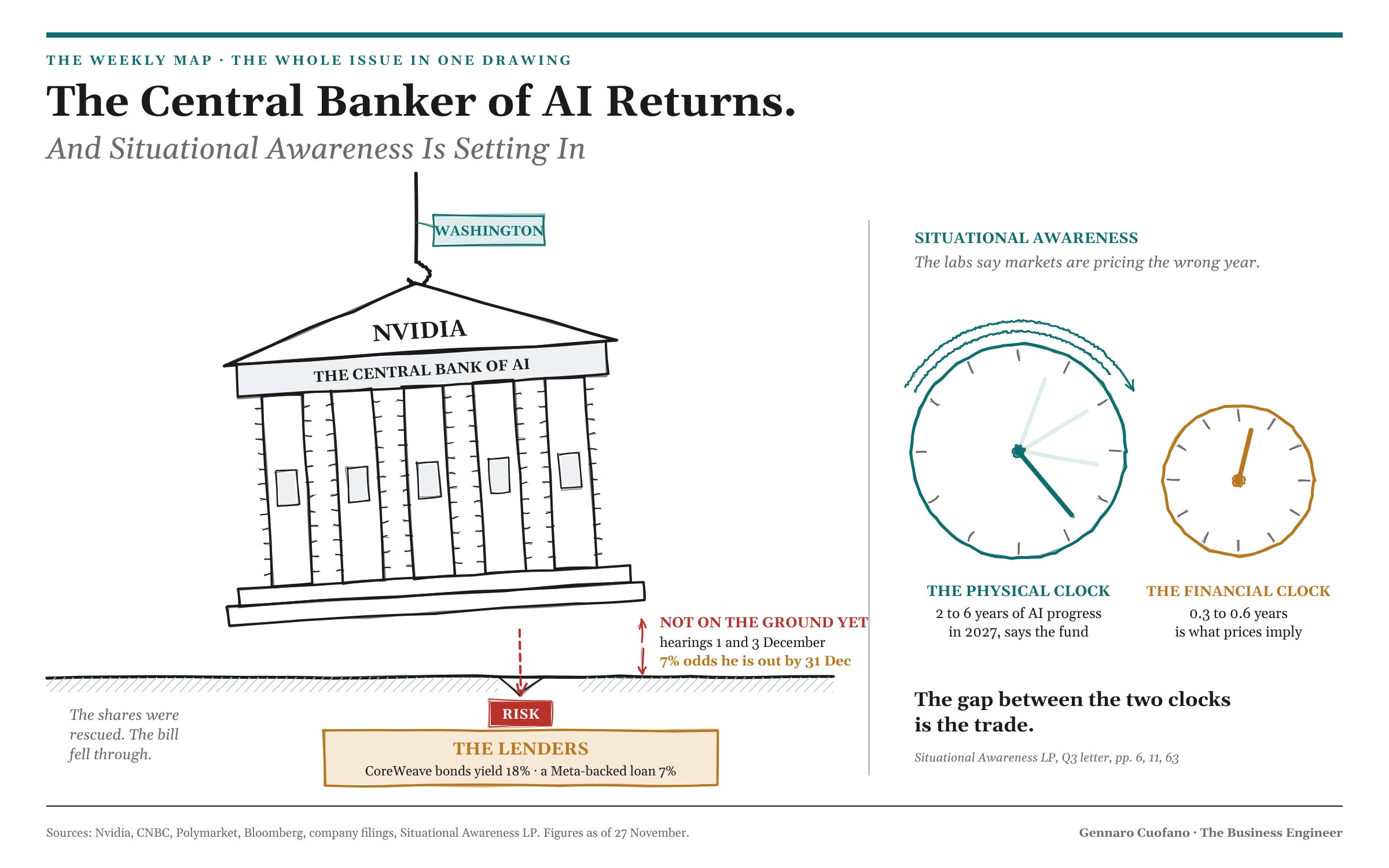
Then, on Sunday 22 November, the board voted unanimously to reinstate him. Its release said it had “received input from senior levels of the United States government.” President Trump told CNBC: “I spoke to them. Let me just put it that way. And I convinced them.” On Monday the stock closed up 31.48% at $165.05, its best day since May 2003, adding about $952 billion of value, by our arithmetic. That is about 2.1 times the previous one-day record.
What the reversal did not settle matters as much. The California investigation remains open. The detailed quarterly report, the 10-Q, is still due on 4 December. On Wednesday S&P warned it may cut Nvidia’s AA credit rating, citing how the board oversees the company. And the accounts of how the vote came about differ: the Washington Post reported a Pentagon debate on using a wartime law, which the Pentagon denies. The shares priced the return of a leader. The credit priced the way it happened.
The return also left a question mark over how long it lasts. Huang sits for a closed-door interview with three House committees on 1 December and testifies in public before the Senate Banking committee on 3 December. CNBC listed succession among the open questions. And critics now describe Nvidia in terms usually kept for state companies: one told the Los Angeles Times it is “behaving like a state-owned entity”. As in last week’s issue, we report what officials and critics said and rank no one.
We have called Nvidia the central banker of AI, because it lends to and invests in its own customers to keep the build funded. A central banker reappointed at the government’s urging faces the question markets ask of any central bank: is it still independent? There are also reasons to expect it to lend less freely. Its own AA rating is on watch, which makes backing others dearer. Its pledges to the AI clouds already fell by $4 billion last quarter. The central banker is back, but it may be more hawkish this time.
The issuer’s floor. Anthropic sold new shares to the public on 18 November at $83, raising a record $93.5 billion. They opened at $111.50 and closed the first week at $88.91. This week they fell below the IPO price for the first time, closing at $81.91 on Tuesday and touching $73.85 on Wednesday morning, below the price at which the company is worth $1 trillion.
On Black Friday the stock closed at $91.88, up 11.0%, about $1.23 trillion by our arithmetic. Nobody stepped in this time; buyers did. Two caveats keep that floor provisional. Friday was a short, thin holiday session. And the first of four lock-up releases, when early holders may start selling, comes on 15 December.
The lenders’ discount. CoreWeave rents out Nvidia chips to AI labs and big tech companies, and it pays for them mostly with borrowed money. This week the cost of insuring its debt against default reached about 13% a year, a level Reuters called distressed. Its bonds fell to record lows, around 75 cents on the dollar, and its bonds due 2031 paid about 18%.
Yet in the same days, banks prepared a loan backed by chips CoreWeave rents to Meta at about 7% to 7.5%. The difference is the point of this issue: lenders priced whose name was on the lease, not the chips. Around them, the Bank of England put the big cloud companies’ potential AI exposure at just over $4 trillion and called the financing “increasingly complex, circular and opaque”. Citi and JPMorgan were reported to be offering their AI loans to other investors.
The labs and the letter. While money was being repriced, the labs published things that can be checked. OpenAI released its internal training scores for the first time and proposed “common limits” on them. Two groups that check proofs by computer certified a Claude-aided proof of the Riemann Hypothesis, a maths problem open for 167 years. The proof runs to about 17 million lines of computer-checked code, and no human-readable account of its ideas exists yet.
Then, on Saturday, we read the third-quarter letter of Situational Awareness LP. The fund is run by Leopold Aschenbrenner, a former OpenAI researcher whose 2024 essay “Situational Awareness” argued that AI would reach superintelligence within the decade. He started the fund in November 2024 with a bit over $100 million. By its own account it was worth a bit above $4 billion at the start of 2026 and grew nearly tenfold more by June, mostly from gains. Then it lost 67% in July.
The letter argues that the market is pricing in a year where AI makes only 0.3 to 0.6 years of normal progress, while the fund expects three years of progress in one. It also says Nvidia “cannot survive in its current form” for more than a few years, because AI models will do much of what Nvidia’s engineers and software do now. Read it for what it is: a forecast from an investor with large positions, including Anthropic and SK hynix, and no Nvidia stake in its last filing. Its value this week is that it states the gap between the labs and the markets more sharply than anything else we read.
Put together, the four events tell one story. The state helped the anchor, buyers held the issuer, and the labs argued the future is coming faster than prices assume. Only the lenders were left charging for the risk.
Under that story sits a deeper misalignment, and the letter names it. Financial markets are pricing the AI build as if it slows after 2027. The labs are building toward machines that could do their own research by the end of 2027, a goal the letter calls “highly plausible” (p. 29). If the labs are right, the letter warns, even today’s AI winners may not keep their value: “It is easy to accidentally be long AGI and short ASI” (p. 7). In plain terms, a bet on today’s AI leaders can be a bet against the superintelligence those leaders are trying to build.
The week in one line: Washington put the central banker back and the shares found a floor; the lenders kept the discount, and the labs said the market is still pricing the wrong year.
Black Friday: join the Academy at 70% off yearly, closing in a few hours! →
How to Read This Issue
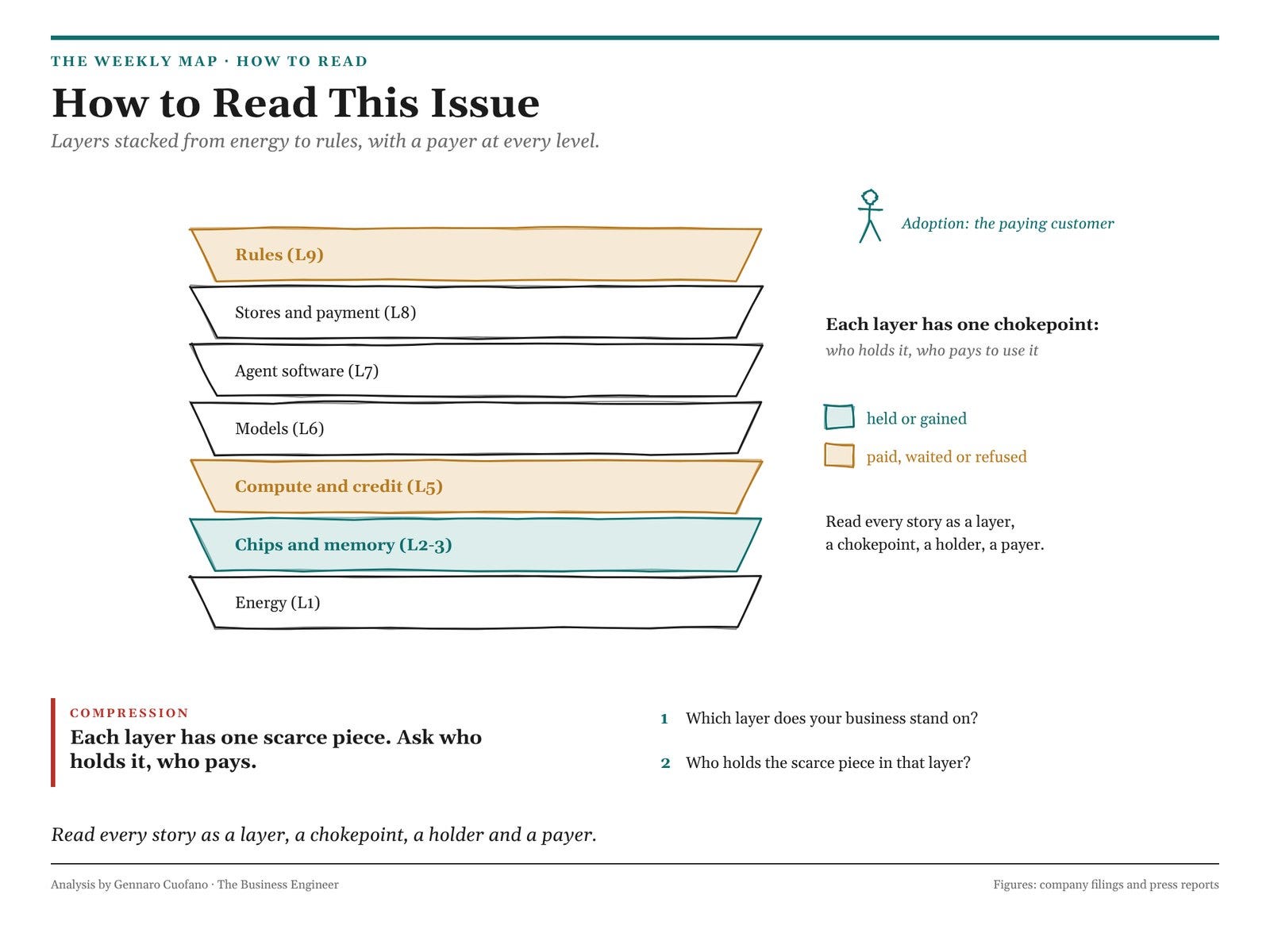
Every week we read the news onto one picture, the Map of AI. It stacks the industry in layers, from energy at the bottom to the rules at the top.
The layers. Energy is Layer 1. Chips, memory and their parts are Layers 2 and 3. Compute, and the money that pays for it, is Layer 5. Models are Layer 6, and the agent software around them is Layer 7. The stores, apps and operating systems that agents must pass through are Layer 8, and the rules are Layer 9. The paying customer sits above the map as Adoption.
The chokepoint. Each layer has one scarce piece this week. For each, we name who holds it and who pays to use it.
The colours. On every plate, teal marks the side that held or gained. Ochre marks the side that paid, waited or was refused.
The cascade and the loop. World politics shapes the economy, and the economy shapes technology. In a supercycle the arrows also run back: AI moves the economy and politics in return.
Two habits. “Reported” marks figures from news outlets that the companies have not confirmed. “By our arithmetic” marks a sum or ratio we worked out from published figures.
Two notes for this week. Our coverage of Nvidia’s leadership sticks to governance, markets and policy: filings, votes, prices and rules. Where officials comment on who should run the company, we report what they said and rank no one. Our section on the Situational Awareness letter quotes a confidential investor document in short excerpts with page numbers. Its views are forecasts by an investor with positions, and the fund lost 65% after fees in the third quarter.
The Risk Moved to the Lenders
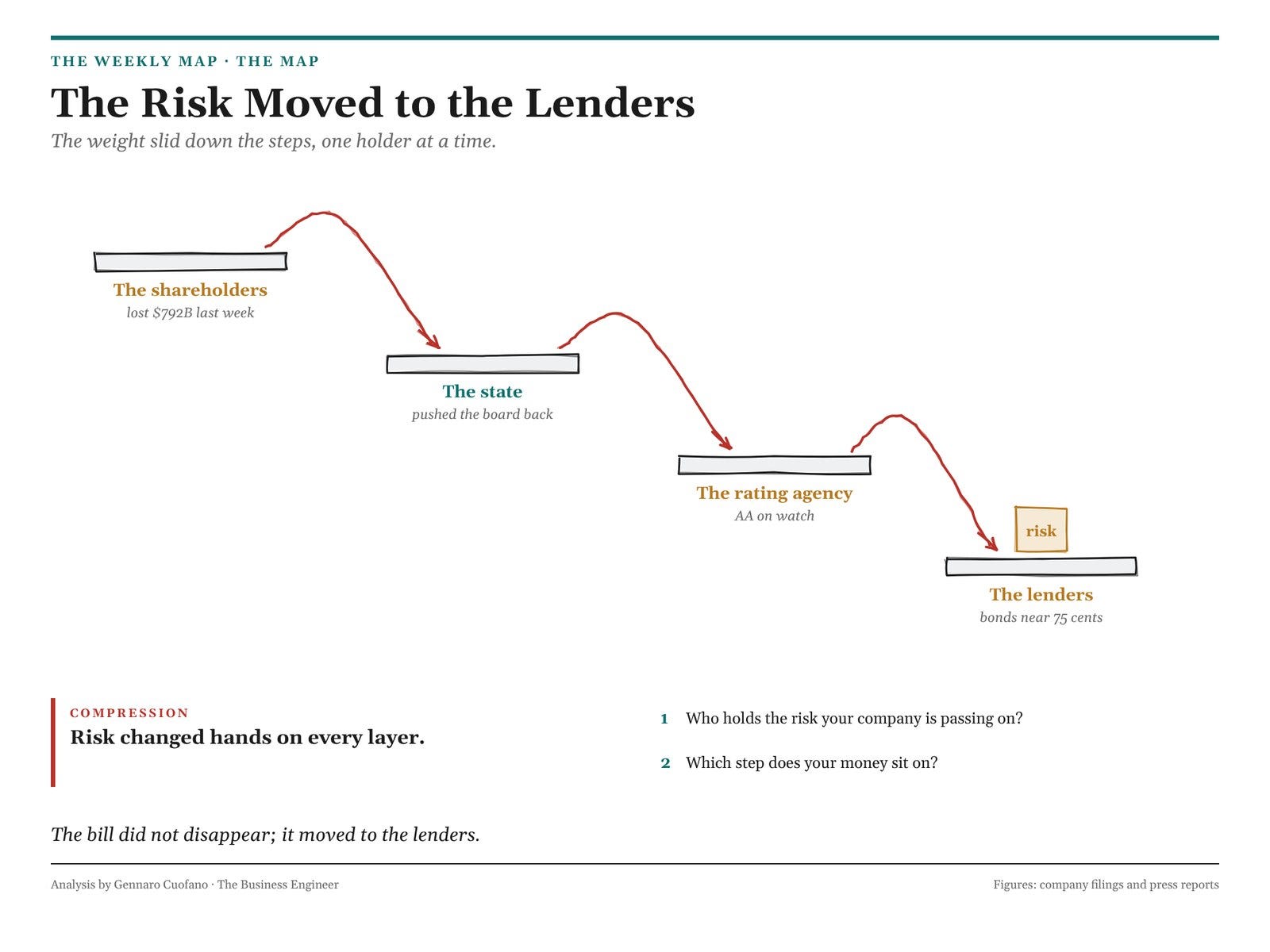
Read the map from the bottom up and one move shows on every layer: risk changed hands.
On the chip layers, the risk around Nvidia’s leadership moved from its shareholders to the state, which pushed for the reinstatement. Then it moved to the rating agency, which put Nvidia’s debt on watch. On the models layer, the risk in Anthropic’s share price moved from the first buyers back to the wider market, which bid the shares up on Friday. On the compute layer, the credit risk moved from the banks that made the loans to whoever would buy those loans from them.
Two layers carried the pressure. The first was Layer 5, where the price of money split according to whose name was on the contract. A loan backed by chips rented to Meta was set to pay about 7% to 7.5% a year. CoreWeave’s own bonds paid about 18%. The second was Layer 9, where the US rule on renting computing power started to bite on who may rent to whom. A rack of Nvidia’s newest chips even turned up as collateral in a Shanghai loan filing.
From The Holders Paid to The Risk Moved to the Lenders