

The AI industry has discovered a powerful truth: what can be benchmarked can be automated. This principle is reshaping how businesses think about which tasks AI can take over and which remain fundamentally human.
For business leaders, understanding AI benchmarks isn’t about technical curiosity—it’s about strategic foresight into which parts of your operations will be automated next. This guide provides a comprehensive overview of the AI benchmarking landscape, explains why benchmarks matter for business strategy, and offers a framework for identifying which business processes are ripe for AI automation based on their “benchmarkability.”
This analysis is inspired by the great work done by the Epoch AI team on AI benchmarks, to help understand how hard it is to evolve this paradigm, as it is critical to move from AI as pure human augmentation to real automation and autonomy.
The Core Insight — Benchmarks as Automation Roadmaps
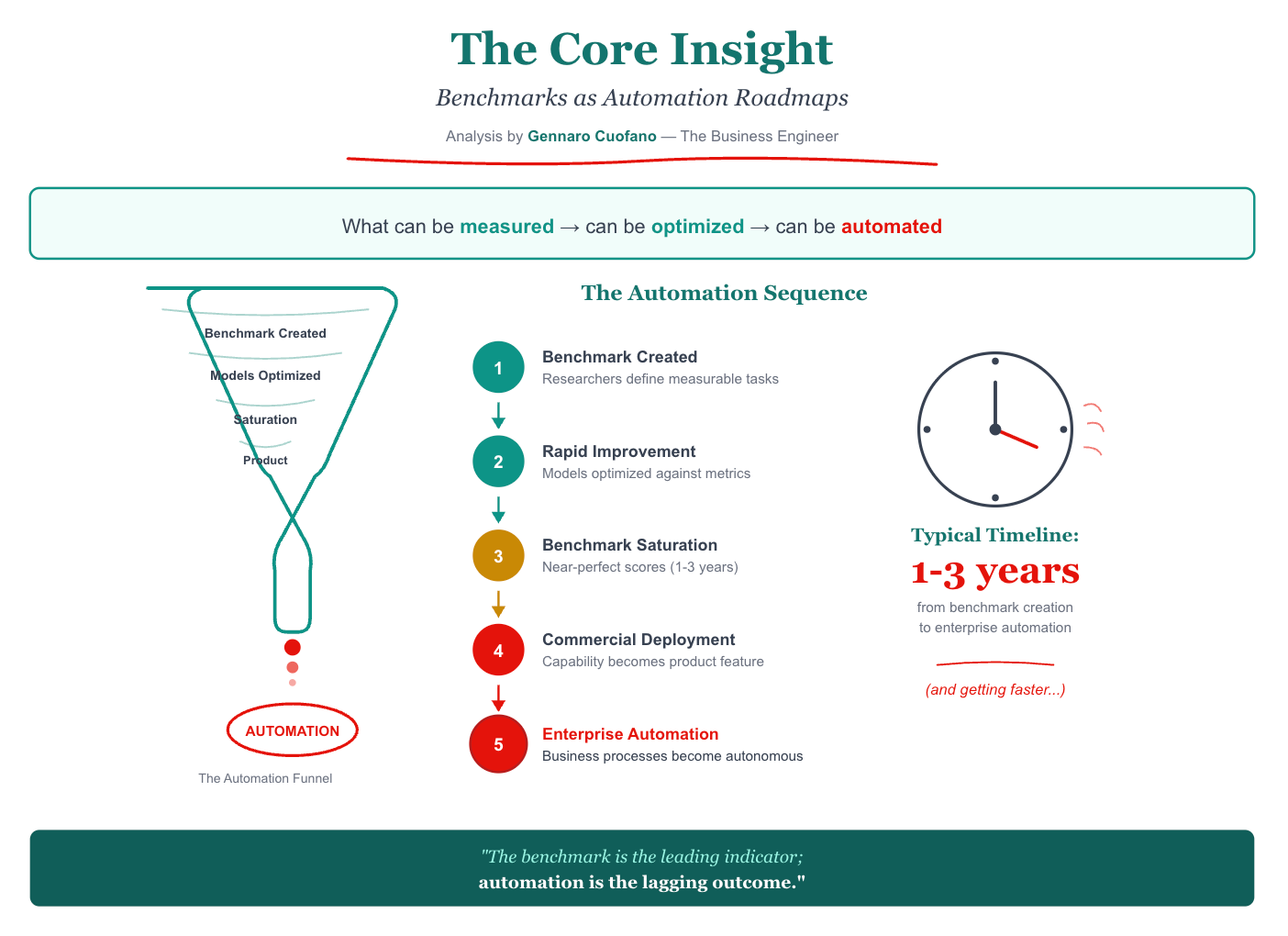
The relationship between benchmarking and automation follows a predictable pattern. Once researchers can measure AI performance on a task, they can optimize for it. Once they can optimize, they can achieve human-level performance. Once AI matches humans, automation follows.
The Automation Sequence unfolds in five stages. First, researchers create benchmarks by defining measurable tasks with clear success criteria. Second, AI models are rapidly improved by optimizing against these metrics. Third, benchmark saturation occurs as top models achieve near-perfect scores—often within just 1-3 years. Fourth, the capability becomes a commercial product feature. Finally, business processes built on this capability become autonomous.
This sequence has played out repeatedly across language understanding, code generation, mathematical reasoning, and now agentic tasks. The benchmark is the leading indicator; automation is the lagging outcome.
The pattern is so reliable that tracking benchmark progress has become one of the most effective ways to forecast which business capabilities will be disrupted next. When a benchmark moves from “impossible” to “solved,” the clock starts ticking on enterprise automation.