

Within that system, I believe Anthropic has become the most consequential company to emerge from the AI race.
It was born out of a not-so-friendly split within OpenAI. The roots of that split reach back to disagreements over how increasingly powerful models should be developed and released. As early as GPT-2 in 2019, Dario Amodei was urging caution about releasing the full model, and OpenAI initially adopted a staged approach. The broader disagreements over safety, commercialization and leadership eventually helped drive Amodei and his colleagues to build something of their own.
Fast forward a few years, and that internal diaspora has produced a company that, in my view, is now the axis around which much of the AI industry turns.
Until 2025, I largely looked at OpenAI to understand where AI would go next. Starting in 2026, that changed. Increasingly, I look at Anthropic. Not simply because of its models, but because of how its choices shape the ecosystem around them.
Having followed Anthropic since its early days, and having been convinced from the outset that it could become the next OpenAI, I’ve been particularly eager to read its S-1. Not just to understand the company’s numbers, but to see what they reveal about the economics of the entire AI stack.
Now it’s out.
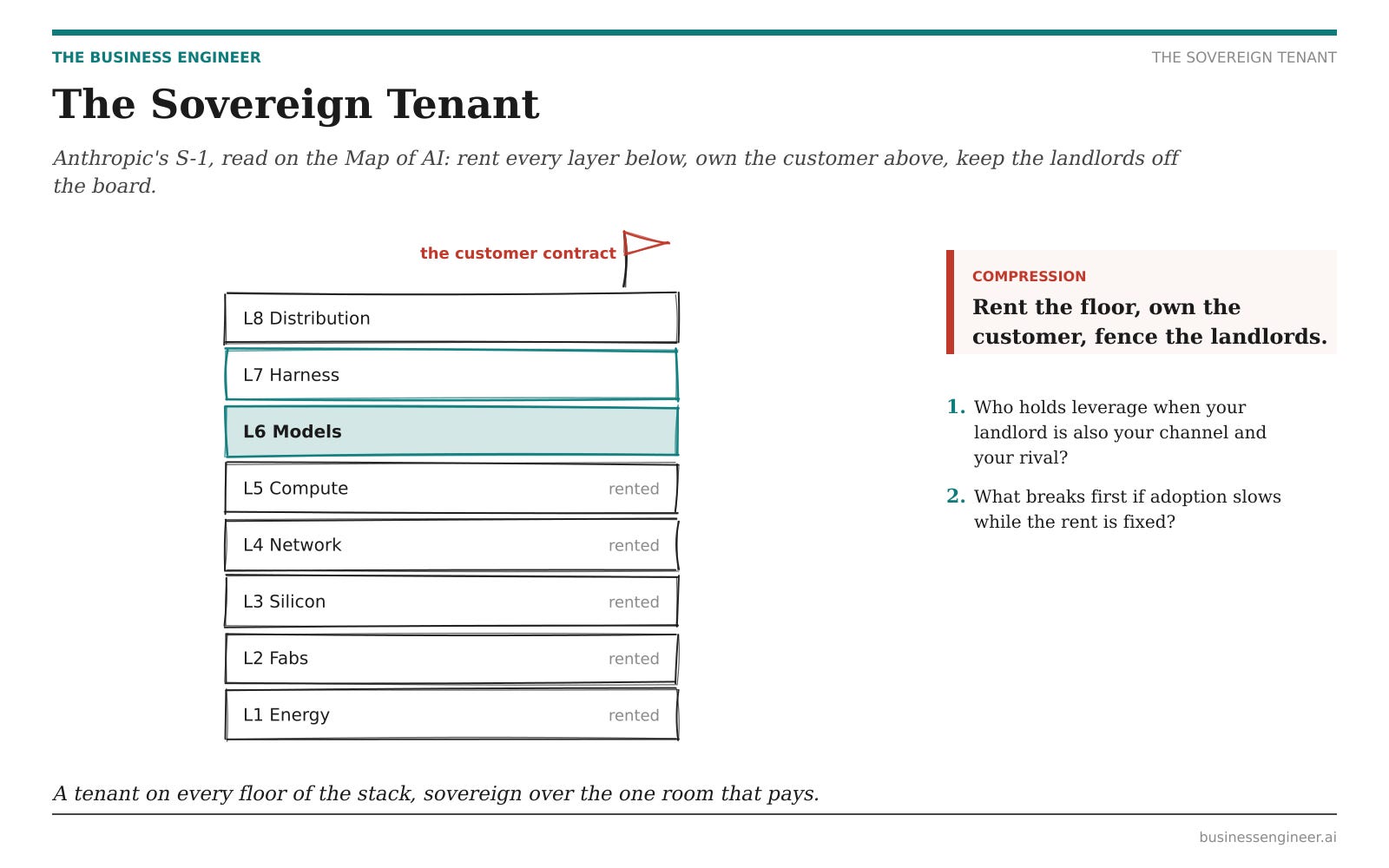
Anthropic’s S-1 shows a company that rents almost every layer of the AI stack and owns the one that matters most to it: the customer. It has signed compute deals with seven named counterparties on terms that run to 2045. It sells through three clouds that are also its shareholders and its competitors. Yet it signs the customer contract itself, sets the price, and keeps voting control away from every landlord.
The filing is the first audited look inside a frontier lab. It also tests a claim the Q2 2026 Map of AI made: models get rented, and the routing junction gets owned. Anthropic’s numbers show a model maker climbing into the junction, and paying a visible toll to stay there. Because a frontier lab touches every layer, the filing is also a reading of the whole ecosystem, and of where it moves next.
Compression: rent the floor, own the customer, fence the landlords.

Read Also
This Week In The AI Supercycle: Execution Fault Lines, Concentrated Demand, and Geopolitical Firewalls

Think of the AI build-out as one long supply chain. At one end sit the companies that sell the inputs: electricity, memory chips, chipmaking tools, optical parts, and servers. At the other end sit the companies that pay for it all, and behind them the customers whose spending is supposed to pay it back.