
If you’ve been following The Business Engineer, you’ll know this moment didn’t come out of nowhere. I’ve been pointing to this shift for a while. As early as August 2025, which in AI terms feels like a different era, I wrote:
Claude Code is probably the only comparable tool, in terms of success, to ChatGPT.
Yet, while ChatGPT opened up the Generative AI race, Claude Code, to me, it’s opening up the Agentic AI race.
Indeed, Claude Code is right now “trapped in your terminal,” and yet, from a business perspective, it’s ready to get unleashed and turn into something else: Claude Agent!
This transition will mark the most critical moment for the AI industry in the last three years, and it might shape the market for the coming 3-5 years.
Claude Agent Is Coming To Eat The Agentic Web

Claude Code is probably the only comparable tool, in terms of success, to ChatGPT.
To understand Claude Code, understand the problem it solved — and why it solved it differently from everything that came before.
By 2024, the AI industry had produced a generation of “code assistants.” GitHub Copilot suggested the next line. ChatGPT answered questions about syntax. Cursor autocompleted functions. All shared the same fundamental constraint: they saw one file at a time. They were sophisticated autocomplete engines — brilliant at suggesting the next token, blind to the system.
Real software development is not about writing individual lines. It is about understanding a system: thousands of files, their relationships, their history, the conventions a team has established over months, the tests that define what correct means. No human developer joins a codebase and immediately starts writing without first reading. AI tools that skipped the reading step produced code that worked in isolation and broke the system.
Whole-project context versus single-file suggestion is the architectural foundation of Claude Code. It is not a better autocomplete. It is a different category of tool.
The third stage of LLM maturity: moving from rigid code-driven workflows to autonomous model-driven loops. In traditional workflows, code decides what the LLM does next. In agents, the model decides. The runtime is a “dumb loop,” and all intelligence lives in the model.
The practical result: ~4% of all public GitHub commits are now authored by Claude Code, projected to reach 20%+ by the end of 2026. These are not productivity improvements at the margin. There are categorical changes in what a team of a given size can execute.
You can also read our technical guide on OpenClaw.
OpenClaw: A Technical Guide for the Business Executive

On the stage at GTC 2026, NVIDIA’s Jensen Huang highlighted the historical moment that OpenClaw represented:
The Anthropic Thesis: Claude Code Is Becoming the Full-Stack Agent OS
Here is the strategic thread that most technical comparisons miss.
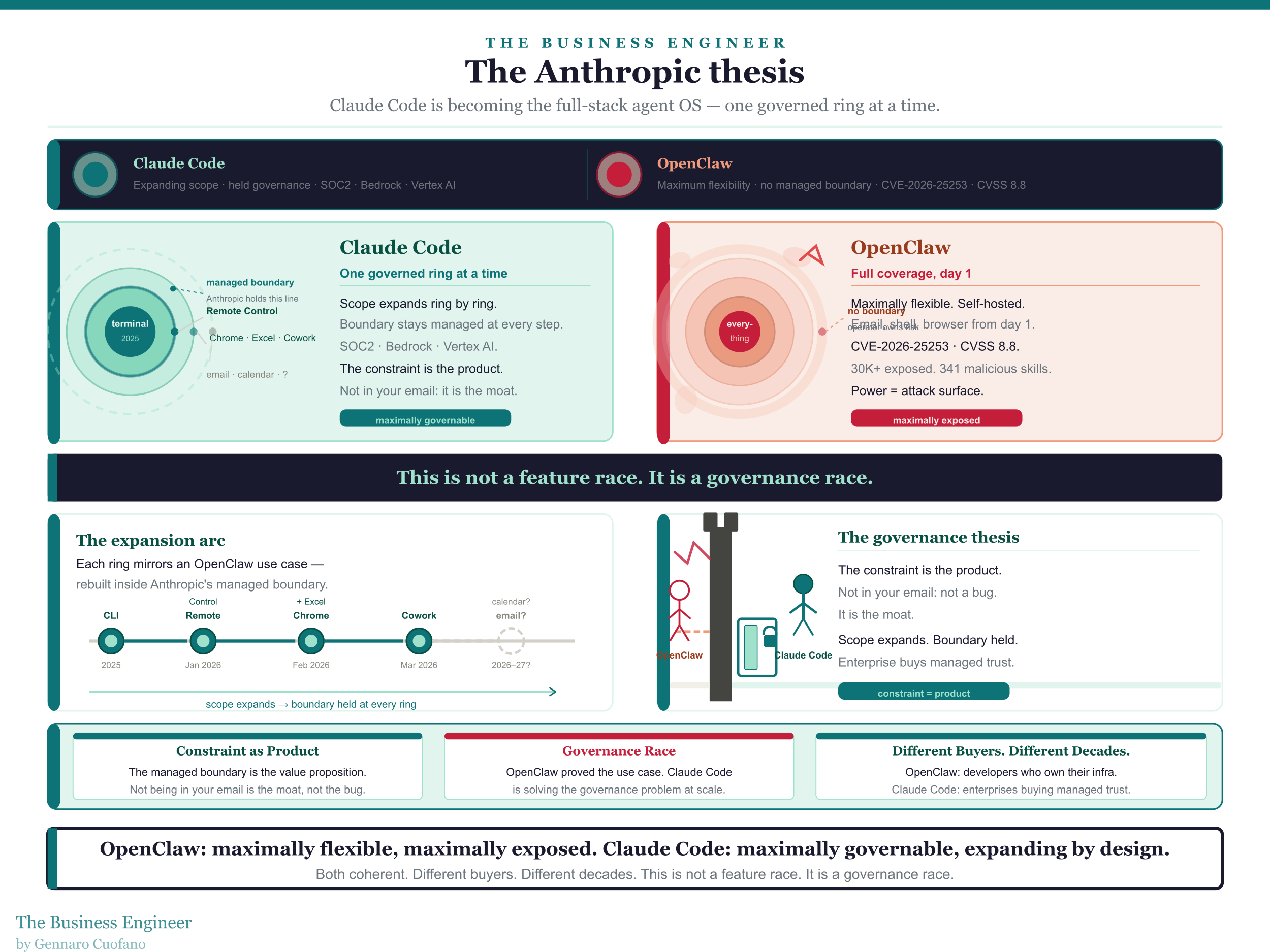
Anthropic is not building a coding tool. They are building a managed, enterprise-grade version of what OpenClaw proved is possible — but solving the security problem at the architectural level.
The problem OpenClaw could not solve alone was trust. System-level access with no managed security boundary, 30,000+ internet-exposed instances, CVE-2026-25253 at CVSS 8.8, 341 malicious skills on ClawHub. Power and risk as the same architectural fact.
Anthropic’s response is not to add features to Claude Code. It is to steadily expand Claude Code’s scope until it covers the same functional territory as OpenClaw — but with Anthropic holding the trust boundary.
Look at the evidence in the architecture:
Remote Control. Native mobile access to local sessions without exposing inbound ports. This is OpenClaw’s WhatsApp interface, rebuilt as a managed Anthropic product with no CVE surface.
Claude in Chrome. A browsing agent. OpenClaw skills do browser automation. Claude Code now does it natively, inside Anthropic’s security model.
Claude in Excel, PowerPoint. Knowledge worker automation. Not coding. The scope has left the terminal.
Cowork. A desktop tool for non-developers to automate file and task management. This is OpenClaw’s target user, served through Anthropic’s managed infrastructure.
Hooks, skills, MCP. The same extensibility architecture as OpenClaw — but with a verified publisher model that addresses the ClawHub supply chain problem.
The Agent SDK. Makes the same loop that powers Claude Code embeddable in any application. OpenClaw’s daemon architecture becomes a library call.
The convergence thesis: Claude Code started as a developer tool with bounded scope — codebase and terminal only. It is becoming a full-spectrum agentic OS — email, browser, files, desktop applications, mobile interfaces — that covers every domain OpenClaw covers, under a single managed security and compliance framework. The difference is not capability. The difference is who holds the trust boundary.
This is Anthropic’s answer to the OpenClaw moment. Not competition in the open-source market. Managed infrastructure for organisations that cannot accept the security posture of a self-hosted system.
Before the Architecture: Understanding the Primitives
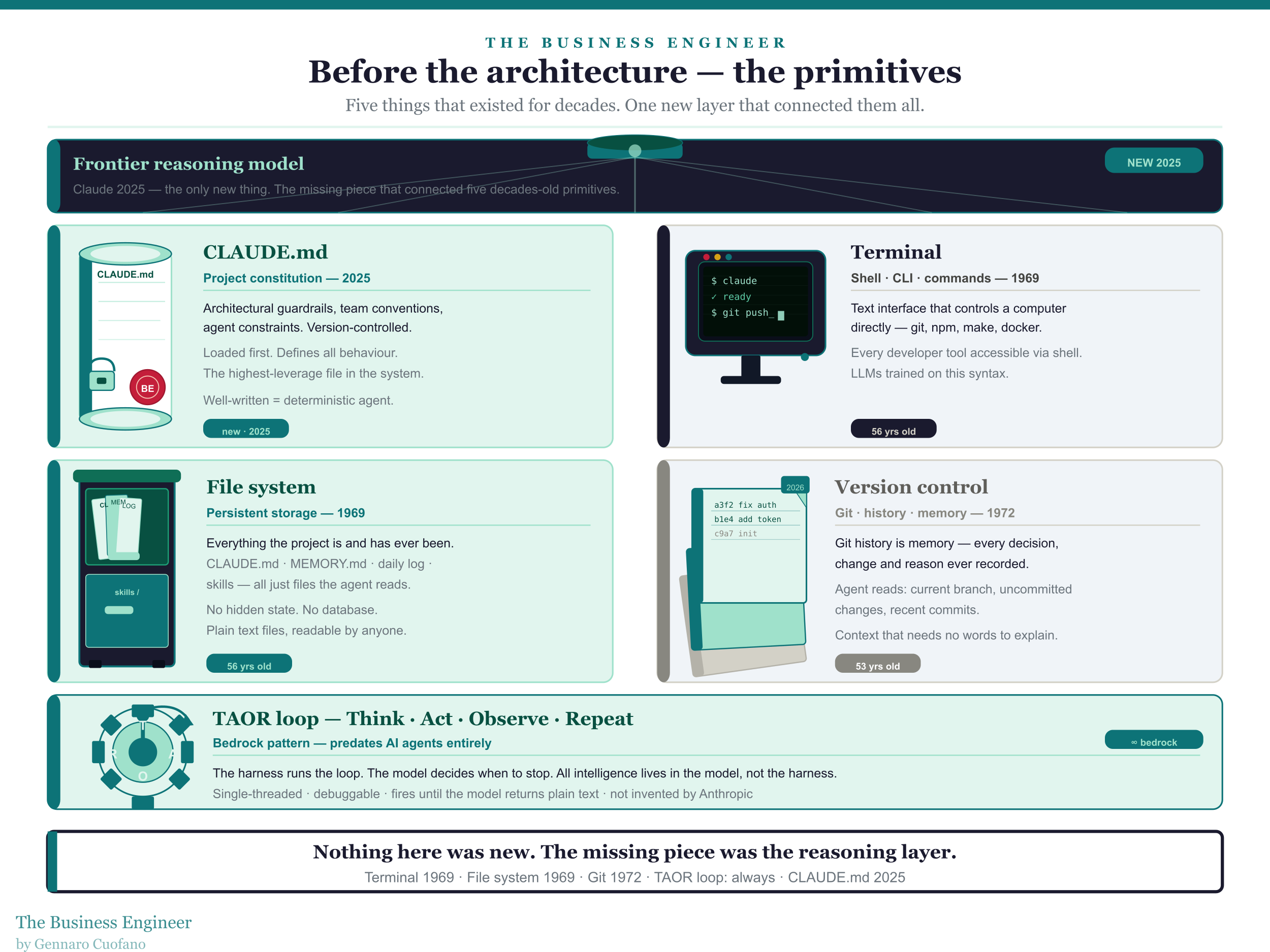
The terminal. Claude Code lives in the terminal — the text interface through which software can control a computer directly. Every tool in a developer’s stack — git, npm, cargo, pytest, docker — is accessible from it. The terminal is where software development actually happens.
The file system. A project is not a conversation. It is a collection of files with relationships between them. The file system is the persistent representation of everything a project is and has been. Claude Code reads it to understand context and writes to it to make changes.
Version control (git). When you run Claude in a directory, Claude Code gains access to your project files, your terminal, any command you could run, and your git state — current branch, uncommitted changes, and recent commit history. Git history is not decoration. It is memory. It records every decision, every change, every commit message.
The TAOR loop. Think–Act–Observe–Repeat. The orchestrator does not know about code or files; it just runs the loop and lets the model decide when to stop. The loop runs: model reasons → calls a tool → receives result → reasons again → calls another tool → repeat until task complete. Every agentic system runs some version of this loop. What differs is the domain and the available tools.
CLAUDE.md. The project constitution. Successful implementations include: architectural guardrails (explicit instructions on which design patterns to use), verification protocols (commands for running specific test suites that agents must execute before considering a task complete), and dependency management (guidance on preferred libraries and version constraints). CLAUDE.md is to Claude Code what SOUL.md is to OpenClaw: the document that defines who the agent is, what it knows, and how it should behave.
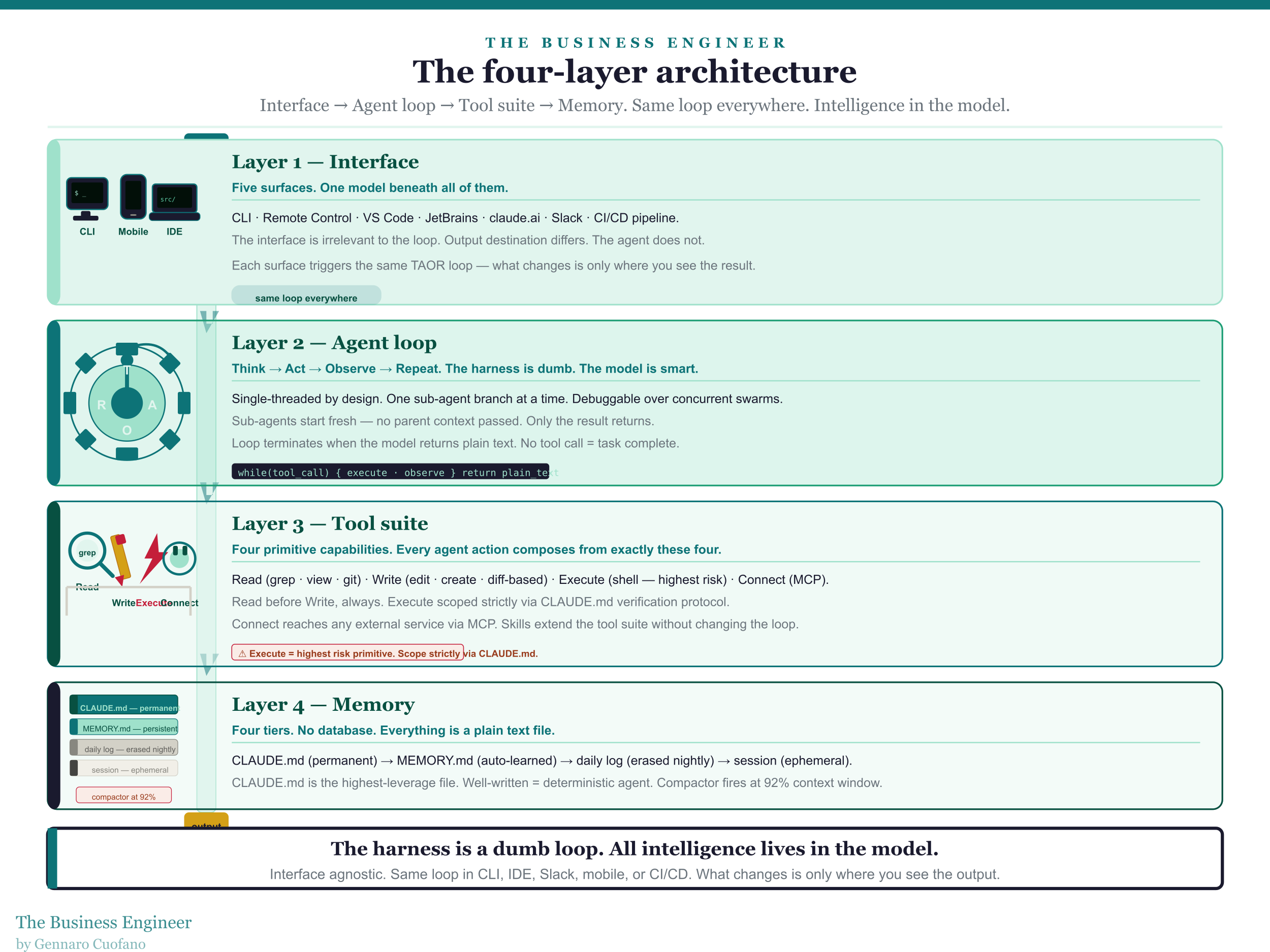
The Four-Layer Architecture