

In 1494, a Franciscan friar named Luca Pacioli published a mathematics textbook in Venice. Twenty-seven of its pages described a method Venetian merchants had used for generations: recording every transaction twice, once as a debit and once as a credit, so that the books always balanced.
Pacioli did not invent double-entry bookkeeping. He wrote it down, named its parts, and explained them so that someone who had never sat in a Venetian counting house could learn them. That is how a practice becomes a discipline. After the writing down, the practice can be taught, compared, audited and improved by people who never met its originators.
Embedding AI into the core of a company is at that stage now. A small number of companies have learned to move an AI system that makes decisions from a pilot into work the business relies on. Their methods converge. But they live mostly in practitioners’ heads and in vendors’ slides, and the same idea goes by five names in five companies.
There is a deeper reason to write it down. The machines now entering companies are the latest step in a very old project: writing down how thinking works, so that something other than a person can do it. That project has two traditions, and the most capable systems now combine them. A company that embeds AI is building such a combination, whether it knows it or not. It can buy one half. It has to write the other.
A body of knowledge for embedding AI is, in a precise sense, the written half of the company.
What follows is the whole body of knowledge in one sitting. It runs from the foundations, through the core method and the nine areas of knowledge, to the measures, the people, the evidence and a library of mental models organised by type of loop. It ends with how the rest of the discipline follows from it.
The Work Loop Canvas

Back in 2014, as I was redefining my own career, I was trying to figure out what discipline could help me abstract and compress the business world as quickly and effectively as possible, by combining insights from multiple fields.
Thus, if in the previous part of this series I focused on what I called “the work loop.” On this part, we’ll look at the body of knowledge, or the foundation of it all.

The Body of Knowledge is Part of The Enterprise Embedding Series!
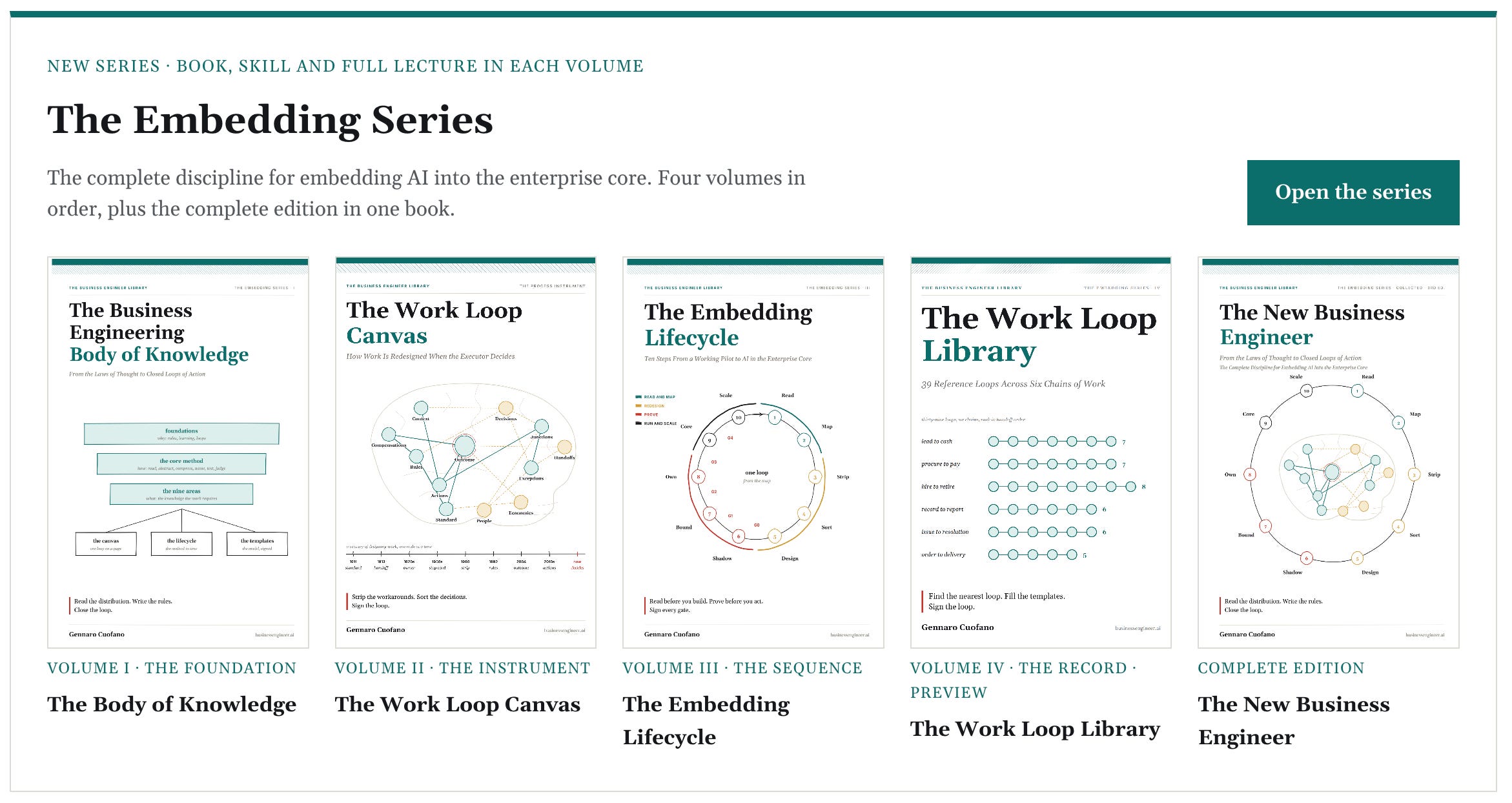

If you’re an existing paid annual subscriber, you already have access to the library (if you don’t, just request it). To unlock the full video lectures, skills, and all additional resources, upgrade to the Executive Plan.