

Yesterday, I explained and dissected for you why a coalition is forming in Enterprise AI, based on the manifesto that Microsoft’s CEO, Satya Nadella, had published.
The Enterprise AI Tenant Boundary Doctrine

When the CEO of the world’s most valuable enterprise software company writes a manifesto and quotes the CEO of the industry’s most controversial data platform inside it, that is not decoration. That is a coalition forming in public.
Now, I’ll take a step beyond it to explain which coalitions these are, why they are developing, and why this potentially matters to you, especially if you work, advise, or build for Enterprise AI.
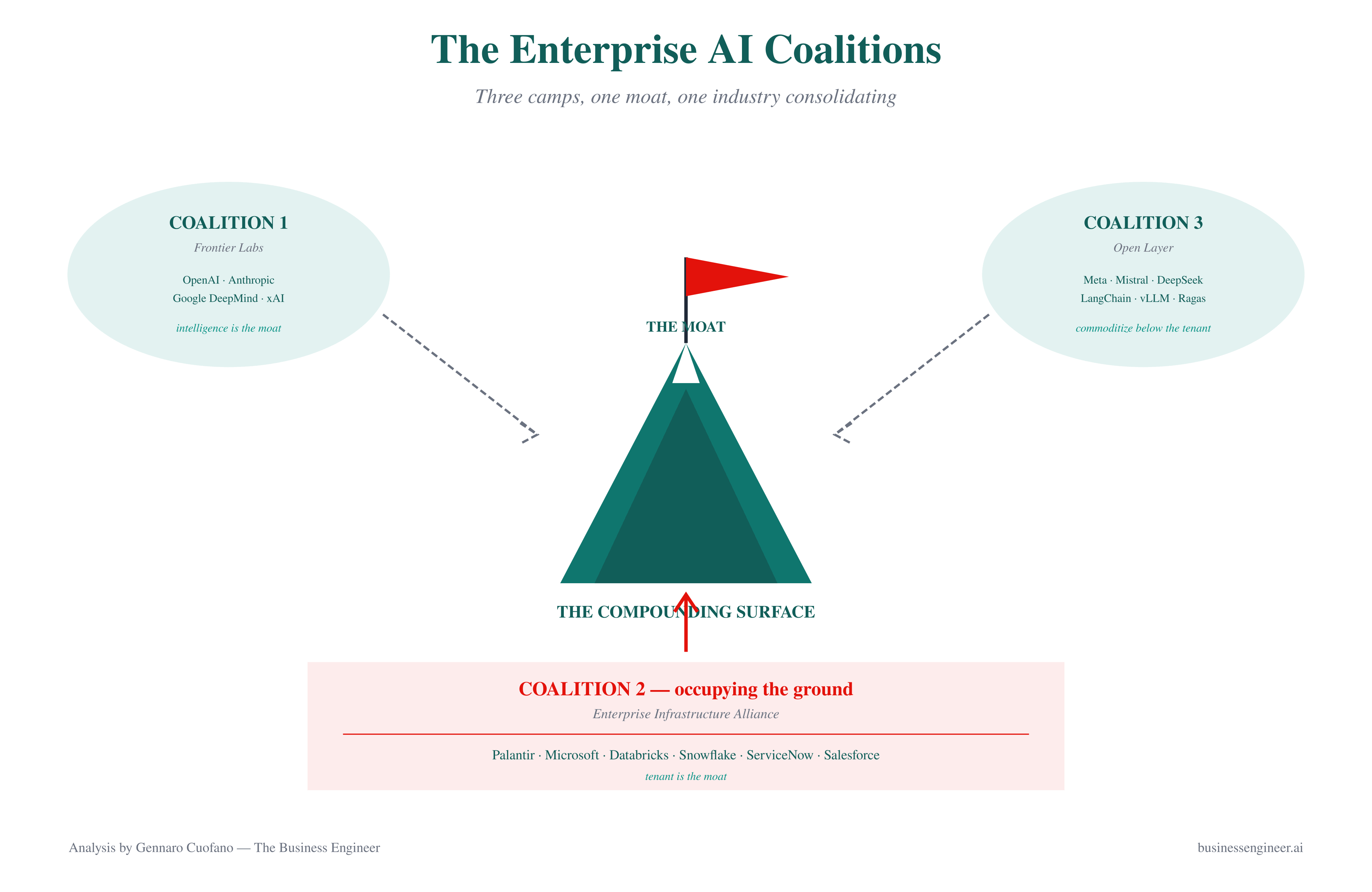
The enterprise AI market is not a diffuse competition of hundreds of vendors. It is a three-way alignment problem in which the industry is quietly resolving into three distinct coalitions, each with a coherent theory of where the moat should live, each with a shipping product signature, each with a structural incentive that makes its argument non-negotiable to its participants.
This is what markets do when a new infrastructure platform matures. In every prior enterprise IT era — mainframe, PC, internet, mobile, cloud — the same pattern emerged: an initial period of vendor proliferation, then a coalition-formation phase in which the market consolidates around two or three structurally opposed theses about where value lives, then a settling phase in which one coalition captures the majority of enterprise budget and the others compress to niche.
Enterprise AI is now in the coalition-formation phase. The vendor proliferation is largely over. The signaling of coalition alignments has begun. The settling has not started.
This piece dissects the three coalitions structurally. For each: who is in it, what its underlying thesis is, what product signature it is shipping, what structural incentive keeps its members aligned, and what vulnerability could fracture it.
The goal is to make the industry’s organization legible — because enterprises architecting AI investments in 2026-2027 are implicitly picking a coalition, and the pick will define what their AI stack looks like for the decade after.
Why Coalitions Are Forming Now
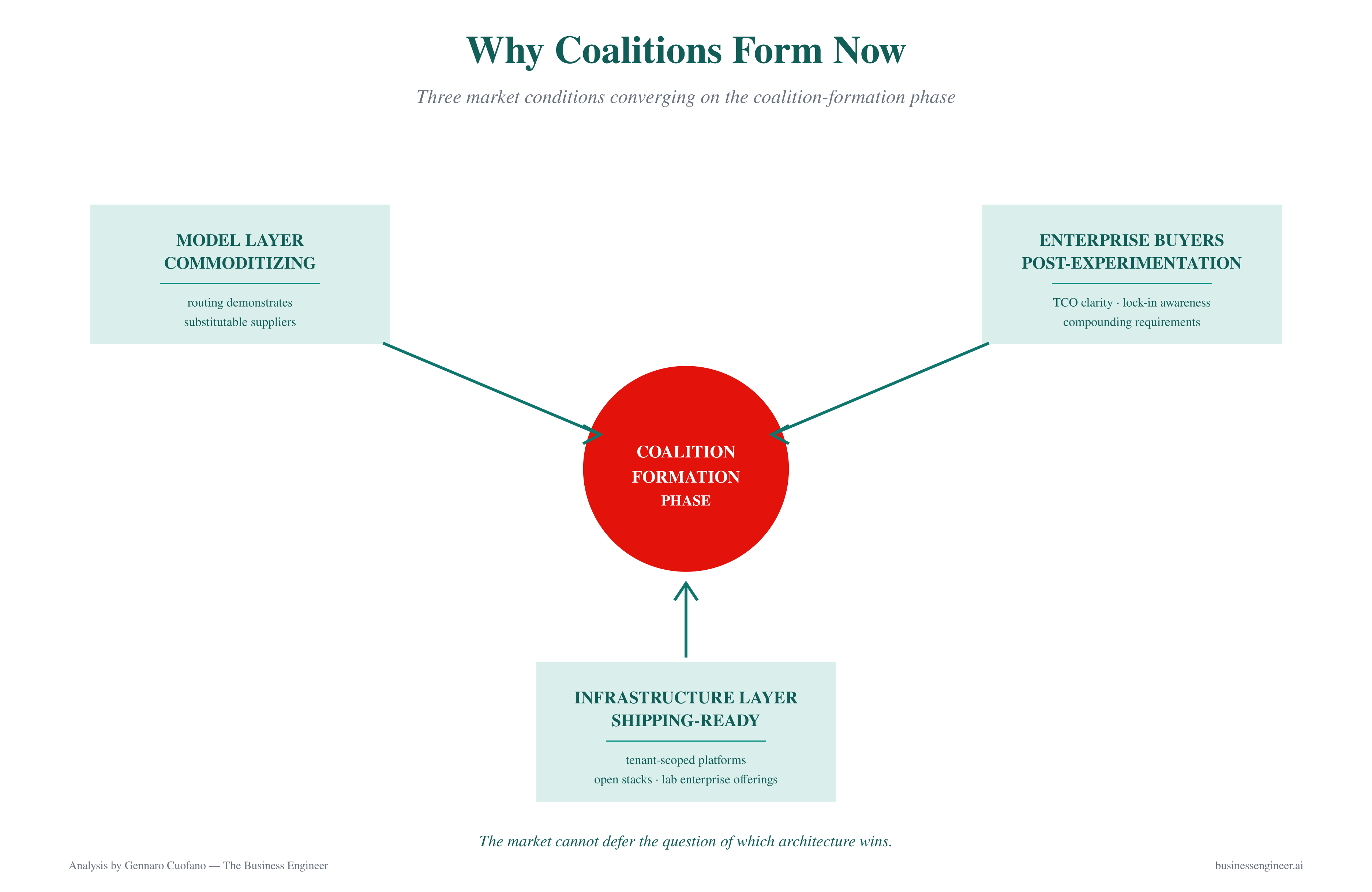
Three market conditions have converged to trigger the coalition phase.
The model layer is commoditizing. Frontier capabilities that cost $100M+ to train in 2023 are being replicated by open-source labs at a fraction of the cost within 6-12 months. Router systems are demonstrating that a large fraction of enterprise workloads can be handled by models a tenth or a hundredth of the flagship price. The Routing Paradigm analysis established that price discovery is now systematic — models are becoming substitutable suppliers on the buy side, whether or not the labs prefer them to be.
Enterprise buyers are past the experimentation phase. Two years of pilot deployments have taught procurement teams that:
Model quality varies less across providers on most tasks than initial marketing suggested
Total cost of ownership on AI applications is dominated by inference spend, not model licenses
Vendor lock-in in AI is silent and expensive — it hides in SDK depth, prompt formats, and evaluation dependencies
Compounding value requires infrastructure the buyer controls, not consumes
The infrastructure layer has enough maturity for real architectural choice. Tenant-scoped platforms (Palantir Foundry, Microsoft Foundry, Databricks Unity Catalog, Snowflake Cortex, ServiceNow AI Control Tower) can now credibly host multi-model deployments with governance, evaluation, and adaptation runtime.
Open-source stacks (Llama + vLLM + LangChain + open evals) can be assembled into production-grade tenant boundaries. Frontier labs can package their models with workspace, memory, and enterprise controls.
All three coalition postures now have shippable products. The market can no longer defer the question of which architecture wins.
Given these conditions, coalitions consolidate. The industry organizes around whichever combinations of vendors share a coherent structural incentive — because vendors with aligned incentives cooperate on interoperability, standards, and joint sales motions, while vendors with opposing incentives compete, restrict, and lock out.
Coalition 1: The Frontier Labs Vertical Integration
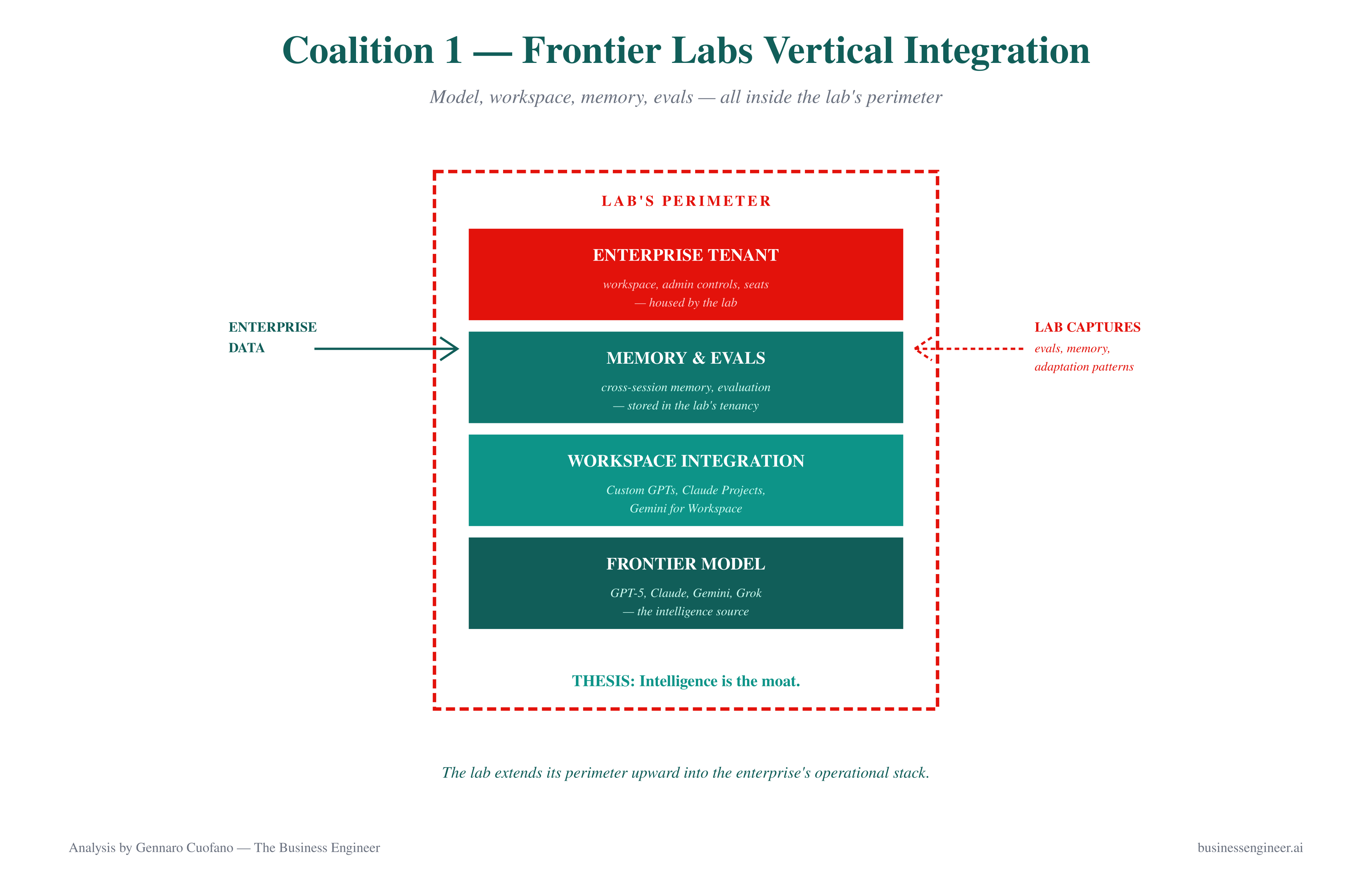
Core thesis: Intelligence itself is the moat. If frontier capabilities remain scarce and the labs ship them faster than commoditization can catch up, buyers will pay a premium to consume them — and the labs can extend that premium upward into the enterprise stack by shipping their own tenant boundary offerings.
Members:
OpenAI — ChatGPT Enterprise, Team, and Business tiers; Custom GPTs; API with enterprise controls
Anthropic — Claude Enterprise; expanded context; admin controls; enterprise-tier compliance
Google DeepMind — Gemini for Workspace; Gemini Enterprise; deep Workspace integration
xAI — Grok Enterprise (nascent); platform integration via X and Tesla
Product signature. The coalition’s shipping products share a distinctive shape. Model, workspace, memory, evaluation, and admin — all housed inside the lab’s tenancy, not the customer’s. ChatGPT Enterprise ships with team workspaces, custom instructions, cross-session memory, admin controls, and audit.
Claude Enterprise ships with an expanded context window, project persistence, admin visibility, and compliance certifications. Gemini for Workspace ships deep integration into Google’s productivity graph. Each product tries to be the tenant — the place where enterprise evals, memory, and adapted context accumulate.
Structural incentive keeping the coalition aligned. Model commoditization is existential for these players. The tokenomics of the frontier labs assume their models are worth meaningfully more than the next model. When routing systematically demonstrates that lower-tier models handle 30-70% of workloads adequately, the premium envelope compresses.
Vertical integration into the tenant is the coalition’s structural answer: if pricing power at the model layer erodes, defend the tenant surface where the model runs, and capture margin on the whole envelope.
Revenue model. Per-seat enterprise pricing tied to workspace features and model usage, with margin protected by (i) the frontier capability gap, (ii) integrated productivity features that raise switching costs, and (iii) the workspace becoming the enterprise’s institutional memory location.
Vulnerabilities:
Buyer resistance to supplier vertical integration. Every prior enterprise IT era saw the same pattern — SAP tried it, Oracle tried it, IBM tried it. Enterprises historically prefer a platform layer between them and any single supplier. Coalition 1’s product signature is the same vertical-supplier shape that has historically triggered platform coalition responses.
Hyperscaler-lab partnership fractures. Every major lab depends on a hyperscaler for compute and distribution. Every hyperscaler is simultaneously building a Coalition 2 posture. The partnerships that made Coalition 1’s growth possible are structurally incompatible with the partners’ own long-term plays.
The frontier gap is shrinking. Anthropic’s moat analysis argues that frontier lead times are compressing generation-over-generation. If open-source and Chinese labs continue to close the gap, the “intelligence is the moat” thesis erodes when the frontier stops being materially better on the enterprise’s actual workloads.
How to spot Coalition 1 winning. Enterprise contracts consolidate around one lab per buyer. Model brand loyalty holds. Router adoption stalls or reverses. Labs successfully restrict routing intermediaries via terms of service or pricing. Enterprise buyers report satisfaction with vertical lab offerings and reduced procurement complexity.
Coalition 2: The Enterprise Infrastructure Alliance
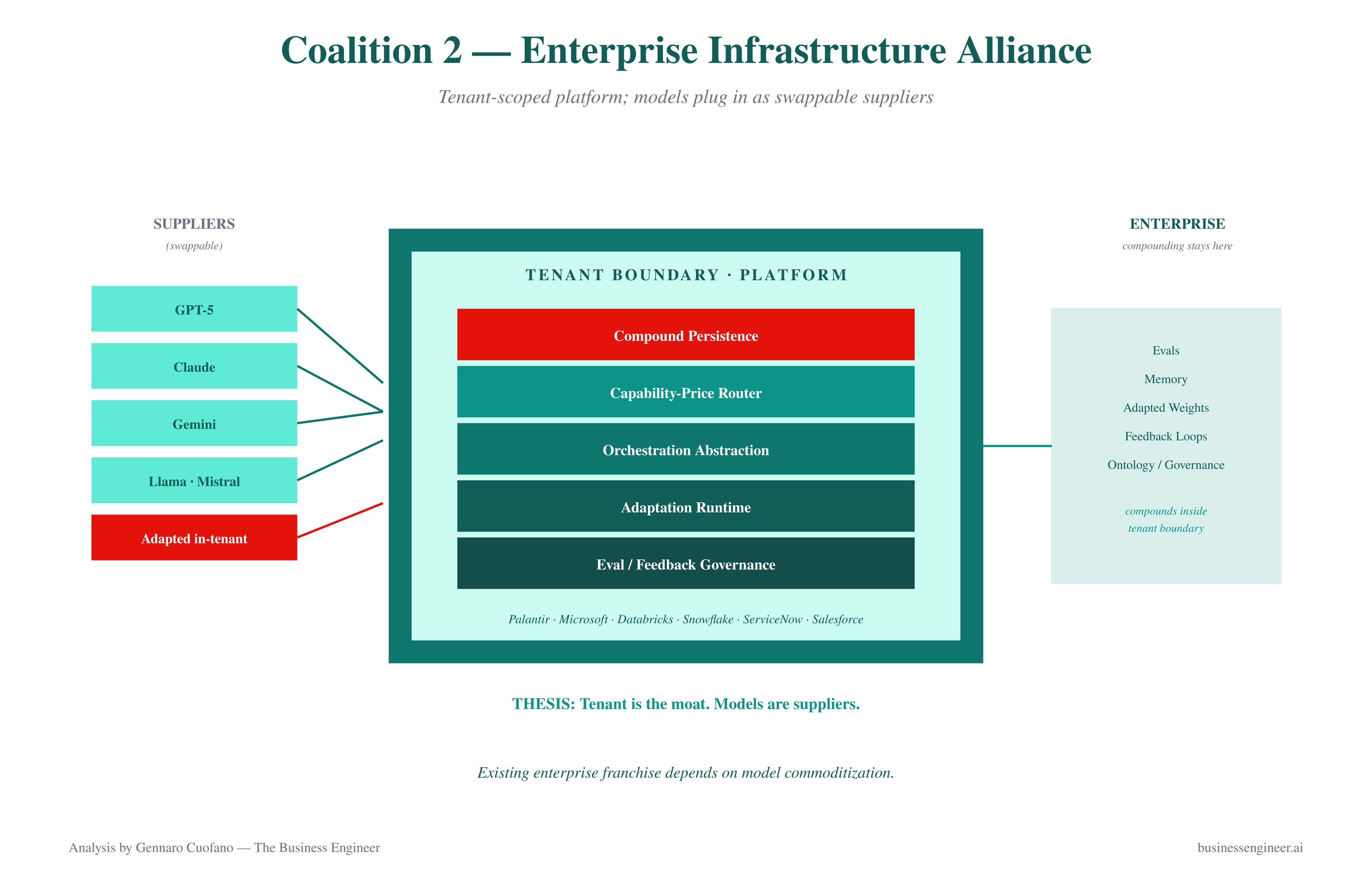
Core thesis: The tenant boundary is the moat. Models are suppliers. The enterprise’s compounding surface — evals, memory, adapted weights, feedback loops — must live inside a tenant scoped to the buyer, and whoever owns that tenant owns the AI-era moat. Models are line items on a procurement sheet, priced through a router, dispatched based on capability and cost.
Members:
Palantir — Ontology + AIP + Evolve, the reference implementation of the coalition’s architecture
Microsoft — Foundry, Azure AI Foundry, Copilot Studio; a structurally aggressive posture despite the OpenAI investment tension
Databricks — Unity Catalog + Mosaic AI + AI Gateway
Snowflake — Cortex + Horizon governance layer
ServiceNow — Now Assist + AI Control Tower + workflow-scoped AI
Salesforce — Agentforce + Data Cloud + tenant-scoped agent architecture
Product signature. The coalition ships a consistent five-layer stack, mapped to the Five C’s architecture:
Ontology or data-governance layer — the semantic model of the enterprise; the substrate for Control
LLM interface layer — Capability-C proprietary adaptation runtime
Orchestration abstraction — Choice-C provider-agnostic switching
Router with capability-price map — Cost-C dispatch
Adapted weights and memory persistence — Compound-C loop closure
Vendors in this coalition ship all five layers coherently inside their tenant boundary. The Palantir Ontology Endgame analysis dissected the reference implementation; Microsoft, Databricks, Snowflake, and ServiceNow are shipping variants of the same architecture, at different levels of completeness.
Structural incentive keeping the coalition aligned. Every vendor in this coalition has an existing enterprise franchise that only remains defensible in the AI era if models commoditize into suppliers. Palantir Foundry is only a platform if the models it orchestrates are interchangeable — otherwise it’s a reseller channel. Same for Microsoft Foundry, Databricks Unity, Snowflake Cortex, ServiceNow Now Assist, Salesforce Agentforce. All coalition members have the same structural imperative to argue for tenant-scoped compounding, because tenant-scoped compounding is the only structure in which their existing franchises retain platform-layer margin.
This is why coalition members can speak with a nearly identical voice about architecture — the alignment is not tactical, it’s economic. Different companies, same structural imperative.
Revenue model. Platform-tier enterprise contracts priced on data volumes, compute usage, and tenant seats, with margin protected by (i) accumulated tenant lock-in through data governance and identity graphs, (ii) compounding value inside the tenant that increases with usage duration, (iii) high switching costs once evals, memory, and adapted weights are established.
Vulnerabilities:
Lab supply dependency. The coalition depends on frontier labs continuing to supply models under commercially viable terms. If labs restrict API access, reprice against tenant-boundary intermediaries, or ship exclusive enterprise offerings, Coalition 2’s economics compress from the supply side.
Cannot build frontier intelligence. When the frontier moves faster than routing can smooth out, tenant-boundary users feel the gap first. Coalition 2 members are routing to the frontier, not shipping it — which means they inherit the frontier’s release cadence rather than controlling it.
Internal competition. Coalition members compete with each other for the same enterprise seats. Microsoft Foundry and Palantir Foundry (the shared name is not coincidence) target overlapping accounts. The coalition’s coherence in messaging masks a fragmented commercial reality where members do not co-sell and often actively displace one another.
How to spot Coalition 2 winning. Enterprises architect for model-agnostic orchestration by default. Router adoption accelerates. Vendors formalize interoperability (Foundry-to-Foundry alliances, common eval standards, shared identity graphs). Model contracts become supplier contracts. Enterprise buyers report vendor lock-in migrating one layer up — from labs to platforms.
Coalition 3: The Open Layer Consortium
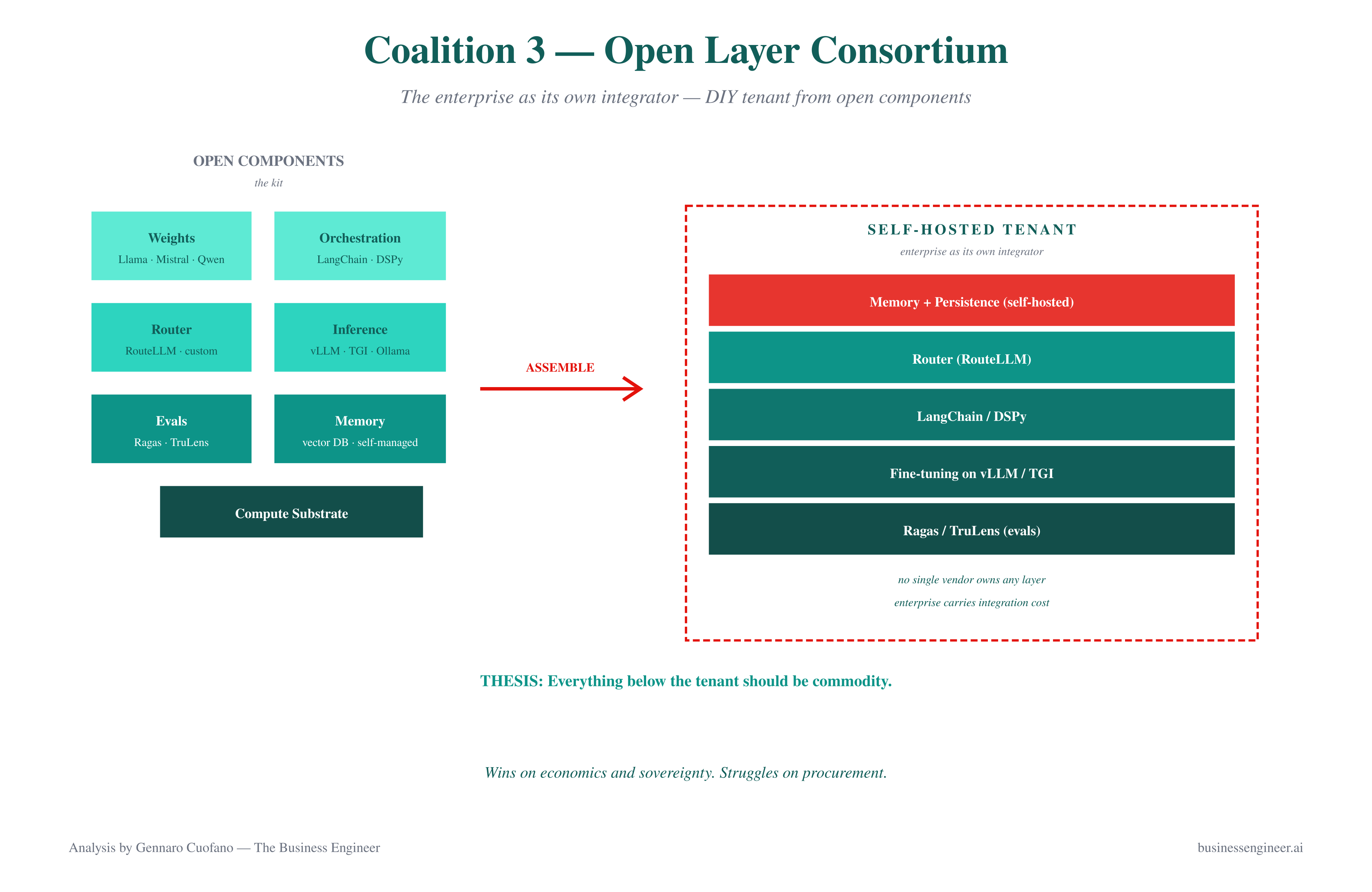
Core thesis: Everything below the tenant boundary should be commodity. Enterprises should be able to assemble their own tenant boundary from open components — open weights, open orchestration, open routing, open evaluation, self-hosted infrastructure — without depending on any single platform vendor. If Coalition 1 wants to own the tenant top-to-bottom and Coalition 2 wants to own it at the platform layer, Coalition 3 wants the tenant to be a self-hosted assembly with the enterprise as its own integrator.
Members:
Meta — Llama family (weights); PyTorch, FAIR research; the largest well-resourced open-model publisher
Mistral — European open-weight labs with sovereign-adjacent positioning
DeepSeek, Qwen (Alibaba) — Chinese open labs releasing frontier-competitive weights with permissive licensing
Open orchestration — LangChain, LlamaIndex, Haystack, DSPy
Open routing — RouteLLM, BladeLLM, open router projects gaining traction
Open evaluation — Ragas, TruLens, DeepEval, open eval frameworks
Self-hosting infrastructure — vLLM, TGI, Ollama, LiteLLM, KServe
Sovereign initiatives — French AI infrastructure funding, Indian public AI stack (BharatGPT, Krutrim), EU AI sovereignty efforts
Product signature. No single product — a component ecosystem. An enterprise adopting Coalition 3 assembles:
Weights from Llama, Mistral, DeepSeek, or similar
Inference on vLLM, TGI, or Ollama, hosted on any compute substrate
Orchestration via LangChain, LlamaIndex, or DSPy
Routing via RouteLLM or self-built dispatch
Evaluation via Ragas, TruLens, or self-managed
Memory persistence via self-managed vector databases
The tenant is a build, not a buy. No single vendor owns any layer, which is simultaneously the coalition’s strength and its vulnerability.
Structural incentive keeping the coalition aligned. Coalition 3 is heterogeneous in motivation but unified in structural outcome:
Meta publishes open models to devalue proprietary AI moats of competitors (Google, Microsoft, Apple) that might otherwise use closed AI to disintermediate Meta’s advertising business. Open models are strategically defensive, not commercial.
Mistral, DeepSeek, Qwen offer open weights as a differentiation strategy against US frontier labs — sovereignty and licensing become the moat.
Open orchestration and routing projects benefit from ecosystem centrality — dominant open standards attract commercial support and enterprise sales.
Sovereign initiatives align with Coalition 3 because national AI infrastructure requires independence from US-headquartered vendor coalitions.
Different players, one structural outcome: every layer of the AI stack becomes a competitive commodity market instead of a proprietary product. The Open vs Closed Meta-Framework analysis and the Open Source & the Bifurcated AI Frontier piece dissected why this coalition’s economics work even when its individual components look weaker than proprietary alternatives — the aggregate stack becomes defensible through composability.
Revenue model. The coalition has no single revenue model, which is part of its structural character. Value accrues to compute infrastructure providers (hyperscalers selling raw inference, specialized inference providers like Together AI and Anyscale), to systems integrators who assemble the stacks (an emerging category), and to open-source foundations who capture ecosystem influence but limited direct revenue. Meta captures no direct AI revenue — its return is competitive weakening of proprietary alternatives.
Vulnerabilities:
Fragmentation. No single vendor is accountable for the whole stack. Enterprise procurement processes struggle with distributed accountability. When something breaks, there is no single-throat-to-choke.
DIY overhead. Most enterprises are not staffed to assemble and maintain a full Coalition 3 stack. Labor costs of integration, upgrades, and operations can exceed the license savings.
Enterprise trust deficit. Coalition 3 ships components without SLAs, without unified sales motion, without the vendor accountability enterprise buyers expect. Coalition 3 wins on economics; it struggles on procurement.
Missing integrator category. The coalition needs an integrator layer — vendors who assemble the stack, package it with SLAs, and sell it as a supported product — but no dominant integrator has emerged. Kubernetes had Red Hat, VMware, and hyperscalers as integrators. Coalition 3’s Red Hat equivalent has not appeared yet.
Where Coalition 3 wins today:
Sovereign and regulated markets where independence from US vendors is a policy requirement
Academic and research users
Cost-sensitive high-scale deployments where DIY overhead pays for itself
Mid-market enterprises with strong engineering teams
Any market where a Coalition 2 vendor has not yet established
Where Coalition 3 struggles:
Fortune 500 median buyers who prioritize procurement simplicity
Regulated industries requiring vendor-level accountability
Enterprises without dedicated ML platform teams
How to spot Coalition 3 winning. An open-source router with production-grade evaluation infrastructure achieves broad adoption. A dominant integrator emerges (a “Coalition 3 Red Hat”) that packages the stack with enterprise support. Sovereign initiatives formalize national coalitions. Open-model releases begin materially matching frontier releases on enterprise-relevant benchmarks. Enterprise buyers report successful full-stack DIY deployments at scale.
The Hyperscaler Confusion
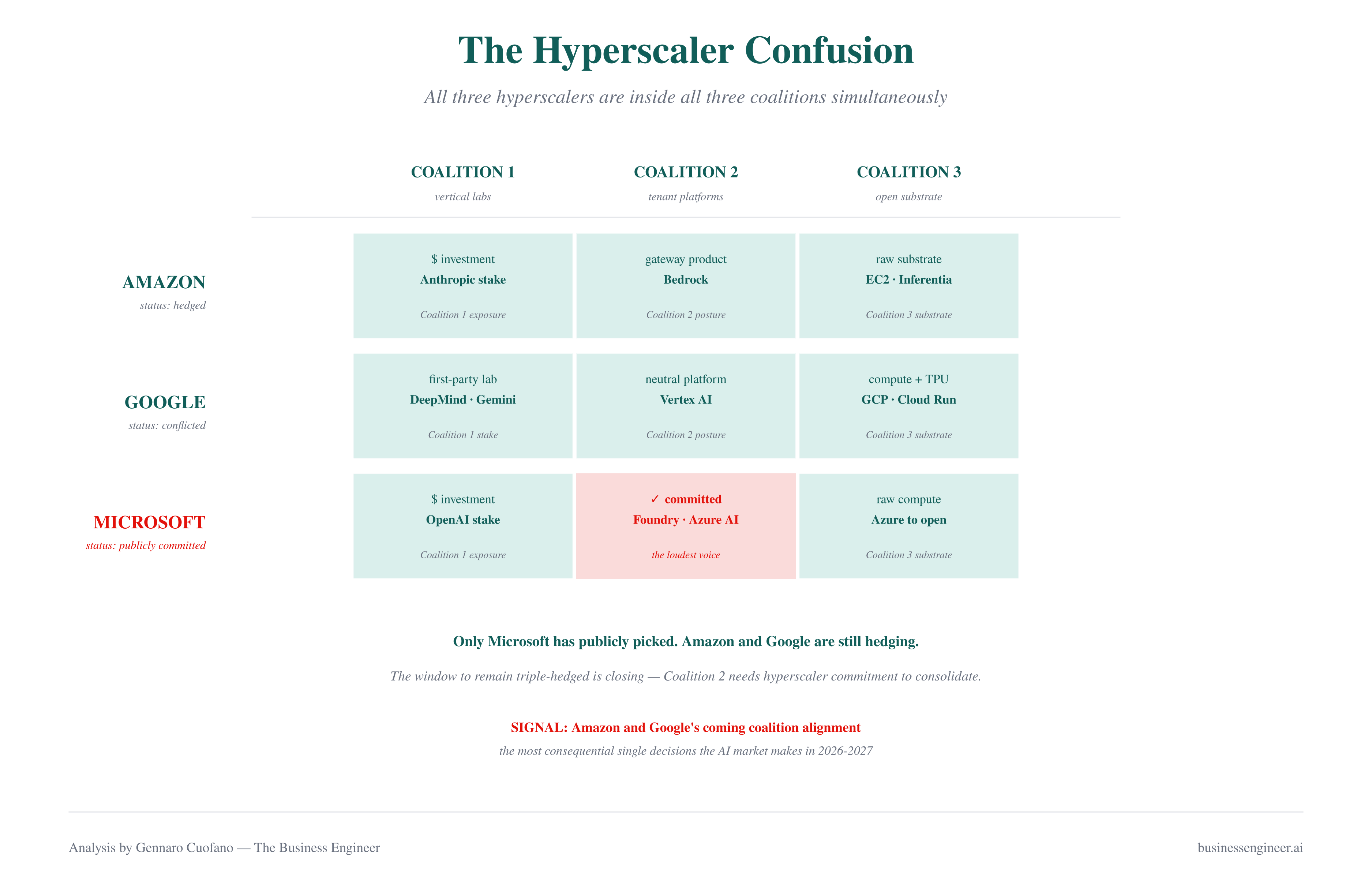
The three hyperscalers — Amazon, Google, Microsoft — are structurally in all three coalitions simultaneously, and this is one of the most underanalyzed dynamics in the market.
Amazon.
Coalition 1 stake: Substantial investment in Anthropic
Coalition 2 posture: AWS Bedrock as a model-agnostic gateway with tenant-boundary features
Coalition 3 substrate: EC2, EKS, and Inferentia inference infrastructure sold to any deployer
Public alignment: None declared. Amazon has said less about its strategic AI positioning than either of the other hyperscalers, and the silence is analytically significant.
Google.
Coalition 1 stake: DeepMind and Gemini for Workspace as first-party lab offerings
Coalition 2 posture: Vertex AI as a neutral multi-model platform
Coalition 3 substrate: Google Cloud Compute and Cloud Run for open-source deployers; TPU compute arbitrage strategy supporting all three
Public alignment: Internally conflicted. DeepMind and Vertex compete for internal resources and external positioning. Product-level messaging is Coalition 1 leaning; infrastructure investment tilts Coalition 3.
Microsoft.
Coalition 1 stake: OpenAI investment relationship
Coalition 2 posture: Foundry / Azure AI Foundry / Copilot Studio — the loudest voice for tenant-boundary architecture
Coalition 3 substrate: Raw Azure compute selling to Anthropic customers, Mistral deployments, and open-source teams
Public alignment: Coalition 2 has won internally. Microsoft’s public messaging and product roadmap prioritize the enterprise infrastructure position over the lab-investor position.
The hyperscaler confusion is the coalitions’ most important complicating factor. In a world where each hyperscaler has one foot in each coalition, no coalition is stable. The moment a hyperscaler formalizes a coalition preference publicly, the other two coalitions lose a critical revenue and infrastructure partner.
Microsoft has now formalized around Coalition 2. Amazon and Google have not. The window in which they can remain triple-hedged is closing, because Coalition 2’s coherence requires hyperscaler commitment — and Coalition 2’s largest scale is Microsoft’s.
The signal to watch: Which coalition Amazon and Google publicly commit to next. AWS’s likely path is Coalition 2 (given Bedrock’s shape), but a Coalition 3 tilt is possible if AWS decides to lean fully into open substrate. Google will pick last, because Google’s internal conflict is deepest.
Why the Three Coalitions Are Mutually Exclusive
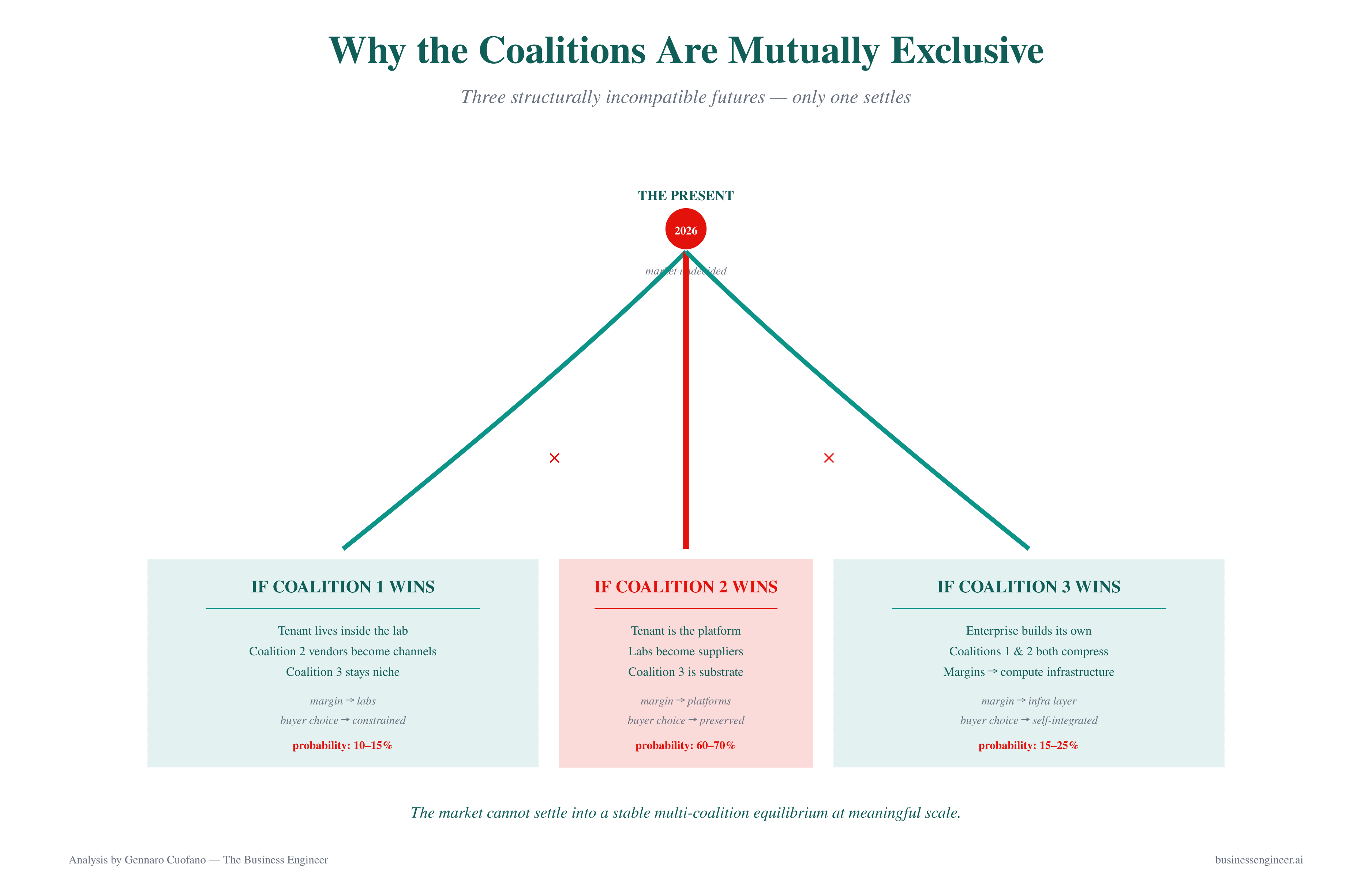
Each coalition wants a structurally different AI economy. These are not compatible outcomes.
Coalition 1’s preferred structure: A small number of frontier labs, each shipping complete enterprise verticals. Buyers choose a lab. Model pricing stays premium. Margins accrue to the labs.
Coalition 2’s preferred structure: A commoditized model layer plus tenant-scoped platforms. Buyers choose a platform. Model pricing compresses. Margins accrue to the platform layer.
Coalition 3’s preferred structure: A distributed open ecosystem. Buyers assemble their own stack. Both model pricing and platform pricing compress. Margins accrue to compute infrastructure.
If Coalition 1 wins, the tenant is inside the lab, and there is no meaningful platform-layer independence for Coalition 2 to defend. Coalition 2 vendors become reseller channels for the labs. Coalition 3 stays a niche for sovereignty and cost-driven deployments.
If Coalition 2 wins, the labs become suppliers, and their tenant-boundary offerings fail commercially. Coalition 1 members either refocus on supplying frontier capabilities (Anthropic model, potentially) or attempt to disintermediate through direct enterprise sales, which Coalition 2 blocks with lock-in. Coalition 3 becomes the alternative for buyers who reject platform lock-in.
If Coalition 3 wins, both Coalition 1’s vertical integration and Coalition 2’s platform lock-in fail against enterprises building their own. Coalition 1 sells intelligence to Coalition 3 assemblers. Coalition 2 vendors compress to niche platform tools or transition into Coalition 3 integrators.
The market cannot resolve into a stable state where all three coexist at meaningful scale. The moat lands in one place — and the other two coalitions compress to niche.
Historical Precedent: Every Enterprise IT Era Has Resolved a Three-Way Fight
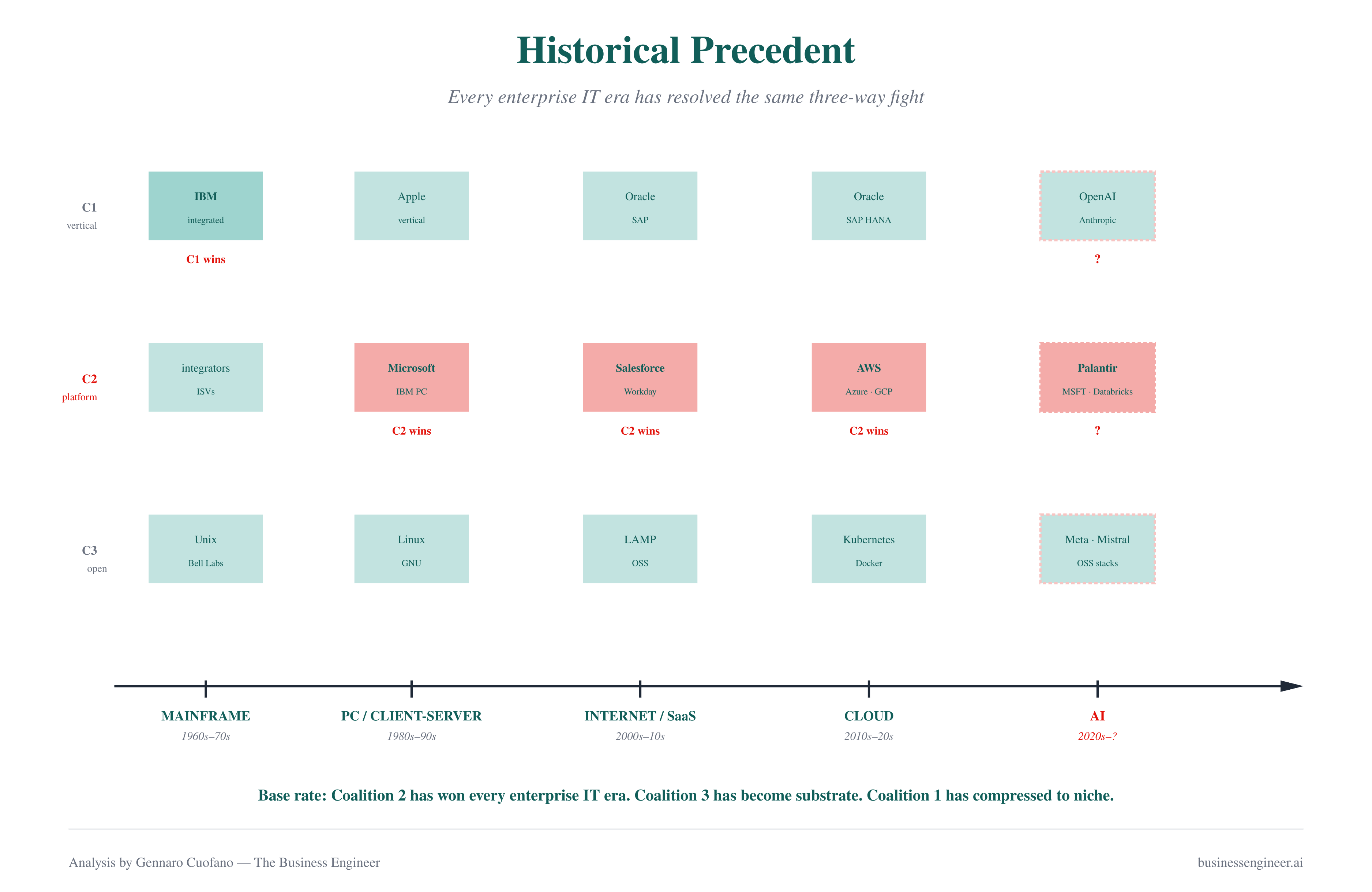
This is the pattern. It has happened before. Every enterprise IT platform transition has produced roughly the same three coalitions and resolved through the same dynamics.
Mainframe era (1960s-1970s):
Coalition 1 (vertical): IBM, offering complete stacks from hardware through applications
Coalition 2 (platform): System integrators and independent software vendors abstracting the mainframe
Coalition 3 (open/standards): Unix, Bell Labs, academic infrastructure
Result: Coalition 1 dominated the era, then Coalition 3 (Unix) captured the subsequent transition
PC / Client-Server era (1980s-1990s):
Coalition 1 (vertical): Apple, offering integrated hardware-software-application stacks
Coalition 2 (platform): Microsoft plus IBM PC ecosystem, an open hardware standard with a platform layer
Coalition 3 (open): Linux, GNU, open-source Unix derivatives
Result: Coalition 2 dominated enterprise; Coalition 1 held premium consumer; Coalition 3 captured server infrastructure
Internet / SaaS era (2000s-2010s):
Coalition 1 (vertical): Oracle, SAP, integrated enterprise application suites
Coalition 2 (platform): Salesforce, ServiceNow, Workday — tenant-scoped SaaS platforms
Coalition 3 (open): Open-source LAMP stack, self-hosted alternatives
Result: Coalition 2 dominated; Coalition 1 defended installed base; Coalition 3 captured infrastructure and internet-scale deployment
Cloud era (2010s-2020s):
Coalition 1 (vertical): Oracle Cloud, SAP HANA Cloud — legacy vendors extending vertically
Coalition 2 (platform): AWS, Azure, GCP — hyperscaler platforms with abstracted infrastructure
Coalition 3 (open): Kubernetes, Docker, open-source cloud-native infrastructure
Result: Coalition 2 dominated. Coalition 3 became the substrate on which Coalition 2 platforms ran. Coalition 1 defended installed base.
The pattern is consistent. In every era, Coalition 2 (platform) has captured the majority of enterprise budget when the platform layer had:
Existing tenant-scoped enterprise franchises to leverage
Structural incentive to argue for supplier-layer commoditization
Buyer trust and procurement pathways established
Coalition 3 (open) has consistently captured infrastructure substrate underneath Coalition 2, becoming the layer that Coalition 2 platforms run on top of. Kubernetes underneath AWS, Linux underneath cloud, Unix underneath enterprise SaaS.
Coalition 1 (vertical) has consistently compressed to niche and installed base — profitable, but not the market’s growth vector.
The AI market is now walking the same road. Coalition 2 vendors have existing tenant-scoped enterprise infrastructure (Palantir Foundry, Microsoft Foundry, Databricks Unity, Snowflake Cortex, ServiceNow AI Control Tower). Coalition 3 open components are becoming the substrate. Coalition 1 labs are attempting a vertical play that history has repeatedly seen platform coalitions defeat.
None of this guarantees the same outcome — AI may resolve differently. But the base rate is that Coalition 2 wins the median-buyer enterprise market, Coalition 3 becomes infrastructure substrate, and Coalition 1 compresses to premium niche and platform-supplier roles.
Where the Moat Actually Lands
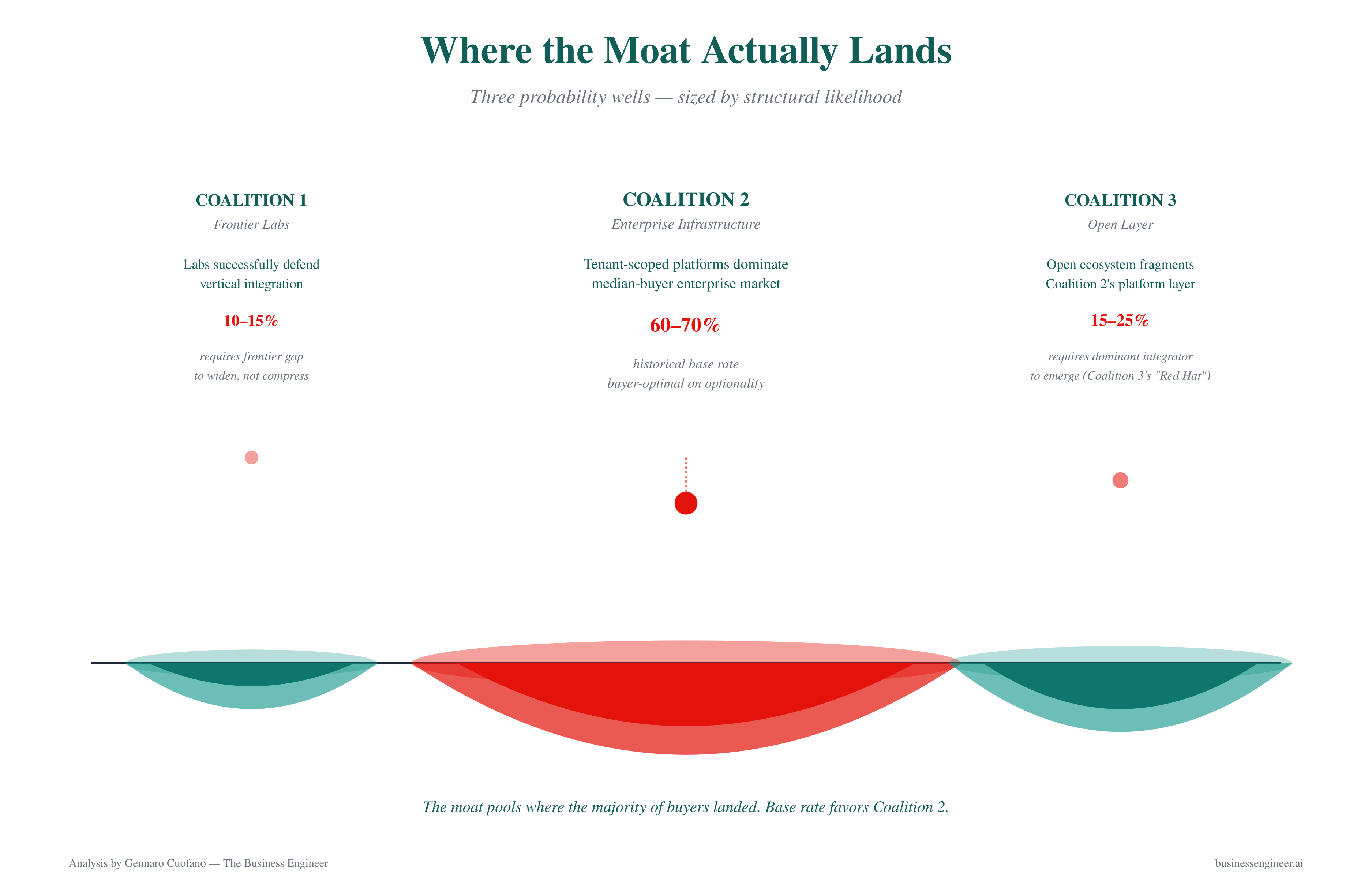
Combining the structural analysis with the historical base rate:
Most likely outcome: Coalition 2 dominates the median-buyer enterprise market. Tenant-scoped platforms — Palantir AIP, Microsoft Foundry, Databricks Mosaic, Snowflake Cortex, ServiceNow Now Assist, Salesforce Agentforce — become where enterprises house their AI compounding. Frontier labs become high-margin suppliers to these platforms. Open components become the substrate on which the platforms run.
Second most likely outcome: Coalition 3 fragments Coalition 2 by successfully commoditizing the platform layer itself. A dominant open integrator emerges. Enterprises increasingly deploy DIY tenant boundaries at scale. Coalition 2 vendors retain premium buyers but lose the mid-market to open alternatives.
Least likely outcome: Coalition 1 successfully defends vertical integration. Frontier lead times widen or a lab produces breakthrough capability that resists commoditization for years. Enterprises accept vertical lock-in in exchange for capability advantage. Coalition 2 vendors reduce to reseller channels.
The probabilities matter less than the structural logic: the market will resolve to one of these three states, not to some hybrid equilibrium.
Where the moat actually lands is where the compounding pools. The Tenant Boundary Doctrine argued that compounding — evals, memory, adapted weights, feedback loops — is the AI-era moat. Whichever coalition ends up housing that compounding for the majority of enterprise buyers captures the market. Coalition 1’s bid is to house it inside the lab. Coalition 2’s bid is to house it inside the platform. Coalition 3’s bid is to house it inside the enterprise’s own self-hosted infrastructure.
The bid that wins is the bid that maximally serves buyer interests. Coalition 2 wins on that metric because it preserves buyer optionality across Coalitions 1 and 3 — a tenant-scoped platform can integrate labs as suppliers and open components as backstop, without committing the enterprise to either. Coalition 1 requires the enterprise to bet on a specific lab. Coalition 3 requires the enterprise to become its own integrator. Coalition 2 is the buyer-optimal position on optionality preservation, which is why the base rate favors it.
Signals to Watch
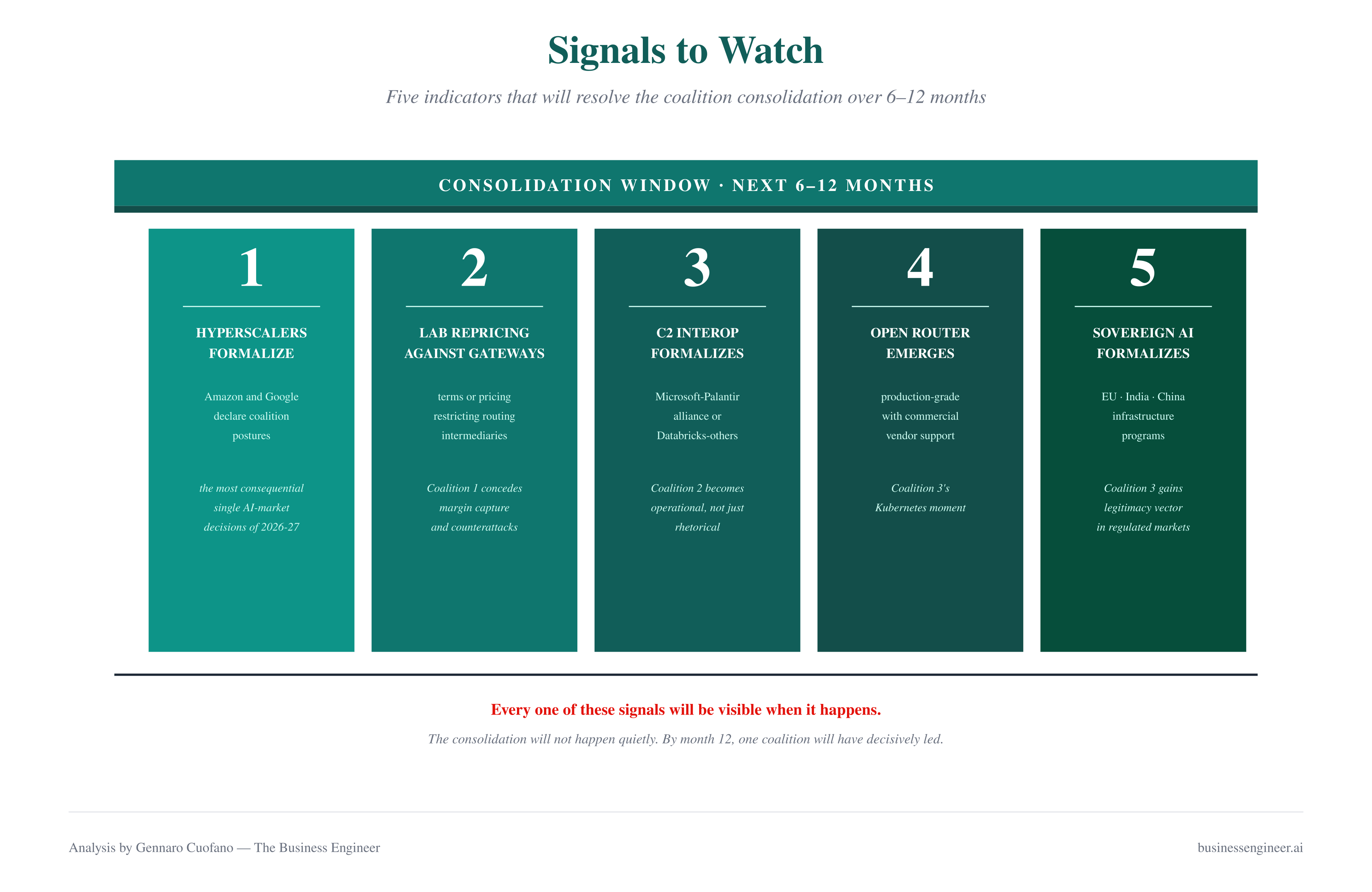
Five signals over the next 6-12 months will indicate which coalition is consolidating.
Signal 1 — Amazon and Google formalize their coalition postures. Both hyperscalers are currently triple-hedged. Formal AWS commitment to a Bedrock-forward tenant architecture (or an open-substrate positioning) would consolidate Coalition 2 (or accelerate Coalition 3). Google Vertex AI’s positioning relative to DeepMind’s enterprise offerings will indicate which internal faction has won.
Signal 2 — Frontier lab pricing and terms against tenant-boundary intermediaries. If OpenAI, Anthropic, or Google reprice enterprise API tiers or introduce terms that restrict routing gateways and enterprise harness platforms, that is Coalition 1 conceding that Coalition 2 captures its margin and fighting back to reclaim it.
Signal 3 — Coalition 2 interoperability formalization. A formal alliance between Microsoft Foundry and Palantir Foundry (or between Databricks Unity and either) would consolidate Coalition 2’s coherence. Continued fragmented commercial motion — vendors competing for the same accounts without co-sell — indicates the coalition remains rhetorical rather than operational.
Signal 4 — An open-source router with production-grade evaluation emerges. Coalition 3 needs a center of gravity. A dominant open router project that attracts commercial vendor participation without capture would be Coalition 3’s Kubernetes moment — the standard that consolidates the ecosystem.
Signal 5 — Sovereign AI initiatives formalize. Explicit EU AI infrastructure funding, national sovereign coalitions in Europe or India, or Chinese labs formalizing enterprise offerings under national infrastructure programs would give Coalition 3 legitimacy in regulated markets that Coalitions 1 and 2 cannot match.
The consolidation is not going to happen quietly. Every one of these signals will be visible when it occurs. The next 6-12 months are the market’s coalition-formation window. After that, buyers will have architected for one of the three, and the moat will settle where the plurality of buyers decided it lives.
The Enterprise Question
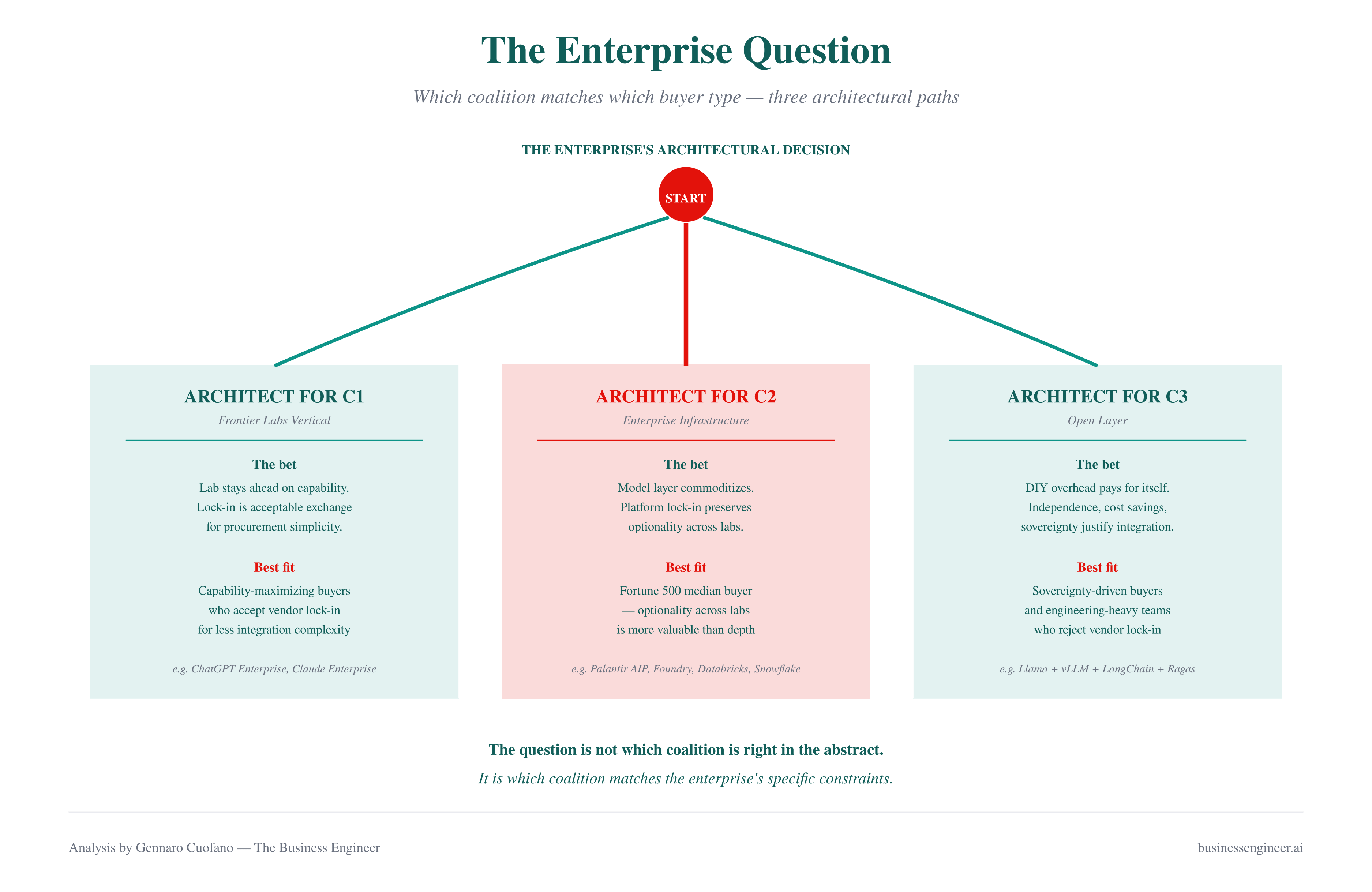
For enterprises architecting AI investments in this window, the coalition analysis converts an abstract strategic decision into a concrete architectural one.
Architecting for Coalition 1 means buying a lab’s complete enterprise offering (ChatGPT Enterprise, Claude Enterprise, Gemini for Workspace) and accepting that the tenant, memory, and evals live inside the lab. Bet: the lab stays ahead on capability, and the buyer-facing lock-in is acceptable in exchange for less procurement complexity.
Architecting for Coalition 2 means investing in a tenant-scoped platform (Palantir AIP, Microsoft Foundry, Databricks, Snowflake Cortex, ServiceNow, Salesforce) and using labs as swappable suppliers underneath. Bet: model layer commoditizes, and platform lock-in is preferable to lab lock-in because it preserves optionality across labs.
Architecting for Coalition 3 means assembling a self-hosted tenant boundary from open components. Bet: DIY overhead pays for itself through vendor independence, cost savings, and sovereignty; the enterprise has the technical staffing to operate its own stack.
None of these is wrong for every enterprise. All three are internally coherent strategies for the buyers who fit them. But they are not compatible — an enterprise cannot architect for all three simultaneously, because the C1 vertical stack, the C2 platform stack, and the C3 assembly stack look nothing alike in practice.
The question is not which coalition is right in the abstract. The question is which coalition matches the enterprise’s specific constraints — its procurement culture, its staffing model, its regulatory posture, its risk appetite for vendor lock-in, and its priorities on capability versus optionality versus cost.
The base-rate answer for the Fortune 500 median is Coalition 2. The tail-market answers are Coalition 1 (for capability-maximizing buyers who accept lock-in) and Coalition 3 (for sovereignty-driven or engineering-heavy buyers who reject lock-in). The market will settle where the plurality of buyers lands — and it is landing in Coalition 2.
Key Takeaways & Mental Models
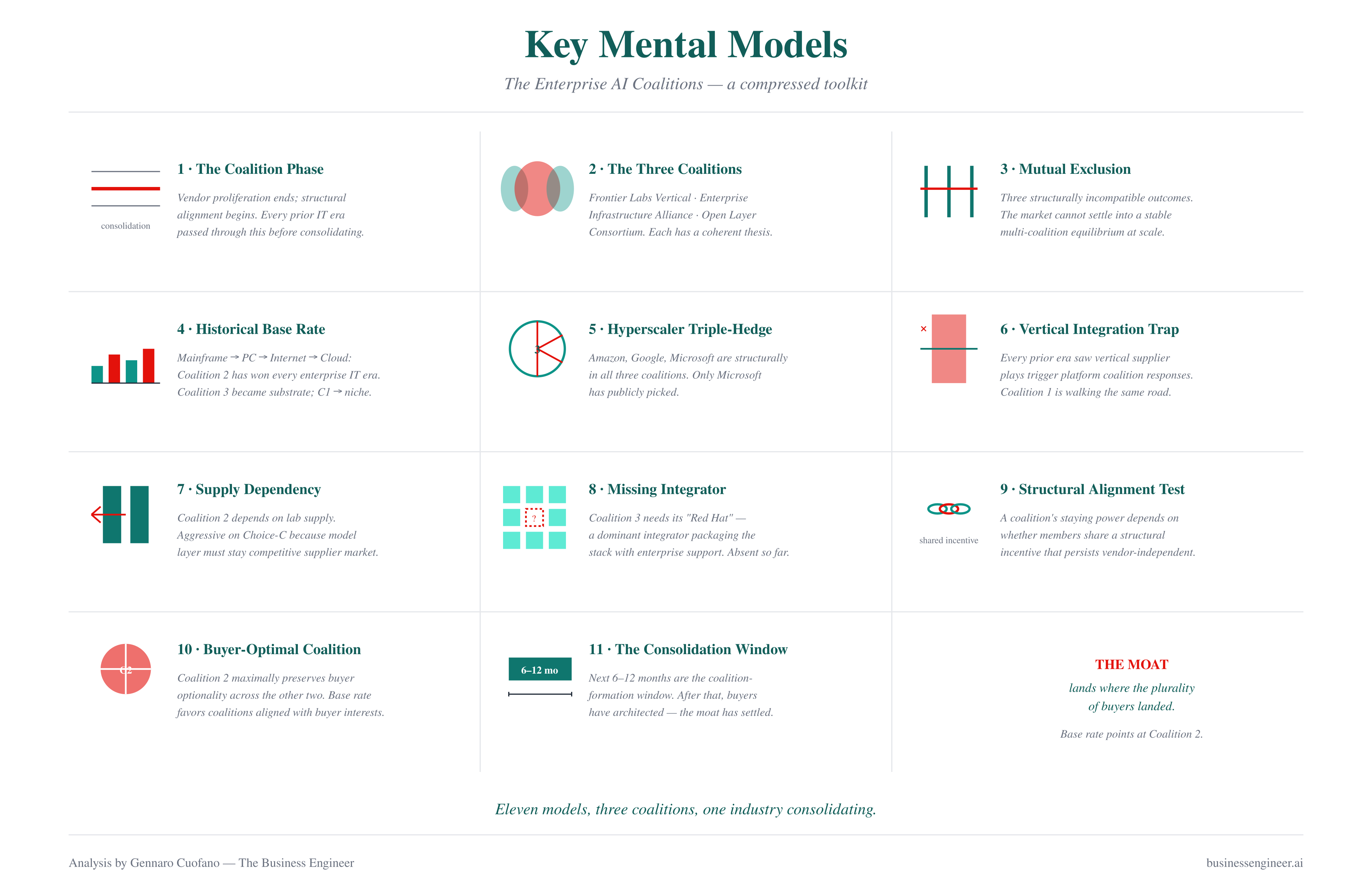
The Coalition Phase. Enterprise AI is in the coalition-formation phase — the market period when vendor proliferation ends and structural alignment begins. Every prior enterprise IT era has passed through this phase before consolidating around one dominant coalition.
The Three Coalitions. Frontier Labs Vertical Integration (intelligence is the moat), Enterprise Infrastructure Alliance (tenant is the moat), Open Layer Consortium (commoditize below the tenant). Each has coherent players, product signature, structural incentive, and vulnerability.
Mutual Exclusion. The three coalitions want structurally incompatible outcomes. The AI market cannot settle into a stable multi-coalition equilibrium. One structure prevails; the other two compress to niche and infrastructure substrate.
The Historical Base Rate. In every prior enterprise IT era — mainframe, PC, internet, cloud — Coalition 2 (platform) has captured the majority of enterprise budget. Coalition 3 (open) has become the substrate. Coalition 1 (vertical) has compressed to premium niche.
The Hyperscaler Triple-Hedge. Amazon, Google, and Microsoft are structurally inside all three coalitions. Only Microsoft has publicly committed. Amazon and Google’s coming coalition alignments are the most consequential single decisions the AI market makes in 2026-2027.
Coalition 1’s Vertical Integration Trap. Every prior enterprise IT era saw vertical supplier plays trigger platform coalition responses. Coalition 1’s product signature is the same shape that has historically been defeated by platform coalitions.
Coalition 2’s Supply Dependency. Enterprise infrastructure vendors depend on lab supply. Coalition 2 is aggressive on Choice-C because their coalition only holds if the model layer remains a competitive supplier market.
Coalition 3’s Missing Integrator. Open Layer wins on economics and sovereignty; struggles on enterprise procurement. Coalition 3’s Kubernetes moment requires a dominant integrator to package the stack with enterprise support. That integrator has not yet emerged.
The Structural Alignment Test. The most reliable indicator of a coalition’s staying power is whether its members share a structural incentive that persists independent of any single vendor’s strategy. Coalition 2’s alignment holds because every member’s franchise requires model commoditization. Coalition 1’s alignment is looser because labs compete more than they cooperate. Coalition 3’s alignment is heterogeneous but structurally durable because members’ interests are different but non-conflicting.
The Buyer-Optimal Coalition. From the buyer’s perspective, Coalition 2 maximally preserves optionality across Coalitions 1 and 3 as suppliers. This is why the base rate favors it — coalitions that consolidate are the ones that are both useful to specific vendors and structurally aligned with buyer interests.
The Consolidation Window. The next 6-12 months are the market’s coalition-formation window. After that, buyers will have architected for one of the three, and the moat will settle where the plurality decided it lives.
With massive ♥️ Gennaro Cuofano, The Business Engineer
Related reading from The Business Engineer
The Routing Paradigm for Enterprise AI — how price discovery entered the AI stack at the harness layer.
The Nine Layers of AI — the full-stack map the coalitions are fighting across.
Palantir & The Ontology Endgame — Coalition 2’s reference implementation.
Inside Anthropic’s AI Moat — Coalition 1’s defensive frame.
The Microsoft-OpenAI Reset — the Coalition 1 / Coalition 2 tension inside a single partnership.
The Open vs Closed Meta-Framework — Coalition 3’s underlying economic argument.
Open Source & the Bifurcated AI Frontier — why the open coalition scales even when its components look weaker.
The Enterprise AI Orchestration Wars — the Choice-C battlefield across all three coalitions.
Enterprise AI Unlocked — the enterprise AI adoption architecture.
Tokenomics: The Economics of AI — the demand-side economics all three coalitions exploit differently.
Google’s TPU AI Compute Arbitrage — Google’s compute substrate strategy inside its coalition confusion.
Recap: In This Issue!
The enterprise AI market is consolidating around three competing coalitions, each representing a different vision of where long-term value and competitive advantage should reside. Rather than competing as individual vendors, companies are increasingly aligning into ecosystems built around shared structural incentives. Enterprises making AI infrastructure decisions today are effectively choosing which coalition they want to bet on for the next decade.
The Three Enterprise AI Coalitions
Coalition 1 — Frontier Labs
Thesis: Intelligence is the moat.
Representative members:
OpenAI
Anthropic
Google DeepMind
xAI
Strategy
Own the complete enterprise experience by extending from the model into:
Workspace
Memory
Enterprise controls
Evaluations
Administration
The lab itself becomes the enterprise platform.
Business Model
Premium model pricing
Enterprise subscriptions
Workspace lock-in
Integrated productivity
Biggest Risk
As foundation models commoditize, enterprises may increasingly prefer independent platforms over vertically integrated AI vendors.
Coalition 2 — Enterprise Infrastructure Alliance
Thesis: The tenant boundary is the moat.
Representative members:
Microsoft
Palantir
Databricks
Snowflake
ServiceNow
Salesforce
Strategy
Models become interchangeable suppliers.
Competitive advantage comes from owning:
Enterprise data
Identity
Governance
Memory
Evaluations
Orchestration
Learning loops
inside the enterprise tenant.
Business Model
Platform contracts centered around:
Enterprise infrastructure
Data governance
AI orchestration
Long-term compounding
Biggest Risk
Dependence on Frontier Labs to continue providing competitive model access.
Coalition 3 — Open Layer Consortium
Thesis: Everything below the tenant should become commodity.
Representative ecosystem:
Meta (Llama)
Mistral
DeepSeek
Qwen
LangChain
LlamaIndex
DSPy
vLLM
Ollama
Open evaluation frameworks
Strategy
Allow enterprises to assemble their own AI stack using open components.
The enterprise becomes its own systems integrator.
Business Model
Value shifts toward:
Compute providers
Systems integrators
Open-source ecosystems
Sovereign AI initiatives
Biggest Risk
Complexity.
Most enterprises lack the engineering resources required to operate a fully self-managed AI stack.
Why Coalitions Are Emerging
Three structural shifts are driving consolidation.
Models are commoditizing
Price discovery and routing increasingly make foundation models interchangeable suppliers.
Enterprise buyers have matured
Organizations now understand that:
AI infrastructure matters more than individual models.
Total cost of ownership dominates procurement.
Vendor lock-in often hides inside orchestration and SDKs.
Long-term value comes from owning enterprise learning.
Infrastructure is finally ready
Enterprise platforms, open-source stacks and frontier labs now all offer complete architectural choices.
The market can no longer postpone selecting an architectural direction.
The Hyperscaler Dilemma
The three cloud providers currently participate across multiple coalitions simultaneously.
Microsoft
Has effectively committed to Coalition 2 through:
Azure AI Foundry
Copilot Studio
Foundry
despite its OpenAI investment.
Amazon
Still balances:
Anthropic partnership
Bedrock
Open infrastructure
without committing to one direction.
Google
Maintains competing positions through:
DeepMind
Gemini
Vertex AI
Google Cloud
making its long-term alignment less clear.
Why the Coalitions Cannot Coexist
Each coalition proposes a fundamentally different AI economy.
Coalition 1
The lab owns the enterprise relationship.
Coalition 2
The enterprise platform owns the relationship.
Coalition 3
The enterprise owns everything.
These models are structurally incompatible.
The market is expected to converge toward one dominant architecture.
Historical Pattern
The article argues previous technology transitions followed the same trajectory:
Mainframes
PCs
Internet
Cloud
Each evolved through:
Vendor proliferation
Coalition formation
Market consolidation
Historically:
Platform coalitions captured enterprise spending.
Open ecosystems became the infrastructure substrate.
Vertically integrated vendors remained profitable but niche.
Most Likely Outcome
The article estimates:
Coalition 2
Enterprise platforms become the dominant control layer.
Coalition 3 (15–25%)
Open-source ecosystems mature enough to commoditize platform vendors.
Coalition 1 (10–15%)
Frontier capability remains sufficiently differentiated to justify vertically integrated enterprise platforms.
Signals to Watch
The next 6–12 months should reveal which coalition is consolidating.
Watch for:
Amazon and Google publicly choosing a strategic direction.
Frontier labs changing pricing or restricting enterprise intermediaries.
Microsoft and Palantir formalizing interoperability.
Emergence of a production-grade open routing ecosystem.
Expansion of sovereign AI infrastructure initiatives.
Enterprise Decision Framework
The coalition an enterprise chooses determines its long-term architecture.
Coalition 1
Best for organizations prioritizing frontier capability with lower operational complexity.
Coalition 2
Best for enterprises seeking long-term flexibility while preserving control over data, memory and orchestration.
Coalition 3
Best for organizations prioritizing sovereignty, cost optimization and maximum independence, with sufficient engineering capability.
Key Mental Models
Enterprise AI Has Become an Ecosystem Competition
Competition is shifting from individual vendors to competing architectural coalitions.
The Coalition Phase
The AI industry has moved beyond experimentation into structural market alignment.
Three Different AI Economies
Intelligence is the moat.
The tenant is the moat.
Everything is commodity.
Each coalition optimizes for one of these outcomes.
Buyer Optionality Matters
Coalition 2 is presented as the strongest position because it preserves optionality across both frontier labs and open ecosystems.
The Next 12 Months Matter
The current coalition-formation phase is likely to determine the dominant enterprise AI architecture for the coming decade.
With massive ♥️ Gennaro Cuofano, The Business Engineer