
The Founding Portal Is Live

A few days ago, in The Agent Manifesto, I made an argument that has been building under everything I’ve published for the past year.
The agentic loop is neutral. It amplifies whatever starting conditions you bring to it. Correct conditioning converges toward the right tail with each iteration. Default conditioning converges toward the consensus center — building more elaborate, more internally consistent, more confidently wrong analysis with every pass.
The implication is uncomfortable. Most practitioners using AI today are not getting smarter. They are getting faster at being wrong. The model is fluent. The thinking underneath it is not. And fluency, it turns out, is an excellent disguise for mediocrity.
The Founding Portal exists because the Manifesto, on its own, does not solve this. An argument changes how you see. Infrastructure changes what you do.
Why the Manifesto required a portal.

The Manifesto identified five provisions the orchestrator owes the agent. Three are instruments that live inside the orchestrator — taste, nuance, synthesis. Two are external: the prior corpus the agent draws on, and the methodology it executes through.
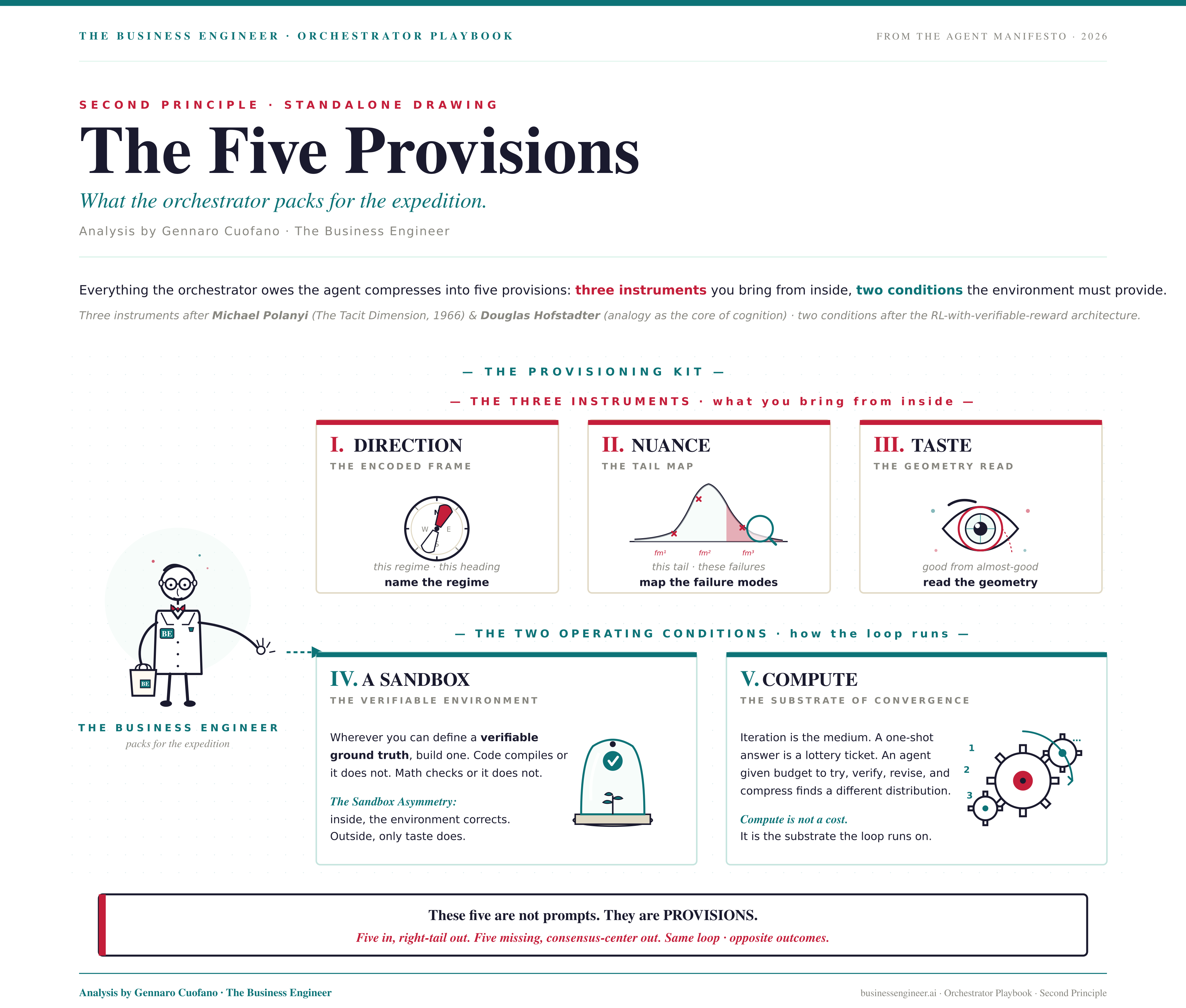
The instruments are personal. They cannot be installed. They are developed over years of structural-thinking practice, and no portal will shortcut that work.
The scaffolding can be installed.
This is where most agentic practice breaks. The first ten briefs you write for a domain are expensive. The next ten copy patterns from the first ten. By the hundredth, if you have been disciplined, you have a working system — a library behind the prompts that compounds with use. Most practitioners never get there. They cycle through individual prompts, treating each conversation as a one-off expenditure rather than a compounding investment. The scaffolding never accumulates because nothing was built to hold it.
The Portal is the working system at hour one rather than month twelve. The library behind the prompts. The moat the Manifesto pointed at.
The four-era framing.

To understand why this matters now and not five years ago, the era distinction matters.
Industrial: competitive advantage lived in physical assets and production scale. Digital: it shifted to software, distribution, and speed of replication. Platform: network effects and data became the moat; the asset was the graph. Agentic: the scarce resource is no longer information, capital, or even technology. It is judgment.
In the agentic era, every analyst at every firm has access to the same models, the same tools, the same APIs. The model is a commodity. The conditioning is not. The analyst who brings taste, nuance, and synthesis to the same model — and runs them through scaffolded methodology rather than ad-hoc prompts — will outcompete the analyst who does not, on the same problems, with the same tools, in the same domain.
This is the leverage inversion the Manifesto names. The visible hierarchy reverses. The prompt engineer who produces clever completions loses to the orchestrator who produces accurate briefs — even if the orchestrator writes less, slower, and with none of the fluency.
The practitioners who compound in this era are not the ones who prompt most fluently. They are the ones who have built — or bought — the conditioning surface.
What’s inside, by provision.

The Portal collapses seven assets I have built separately over the past decade into one substrate. The right way to walk through them is by which provision each one serves.
For taste — the instrument that reads the shape of the problem:
The Book. Twenty-seven chapters. 86,000 words. 76 original diagrams. AI-era competitive strategy as a single sustained argument. The book’s job is not to teach prompts. It is to develop the structural-thinking instinct that decides whether a problem lives in Mediocristan or Extremistan, whether you are inside the sandbox or outside it, whether what you are looking at is a narrative or a mechanism.
The 110 Mental Models Deck. Six domains. Searchable. Composable, not decorative. The instruments do not work without a model library to draw from. Most analytical errors are framing errors, and framing errors are model-selection errors before they are anything else.
For nuance — the instrument that maps the tails:
The 663 Premium Analysis Archive. BIA-structured. AI strategy, platform dynamics, business models, competitive structure. This is the worked-example layer. The cases that do not fit the dominant narrative. The edge-framing the Manifesto names as the most underweighted instrument — because most strategic errors are made in the framing phase, when genuine complexity gets compressed into something manageable but no longer accurate.
For synthesis — the instrument that encodes the brief:
The Agent OS Skill for Claude.ai. A master skill file, prompt library, and example gallery. This is where methodology becomes infrastructure. The skill encodes the BE analytical engine — the layered sequence that runs every analysis through structural mapping before narrative compression.
The BE Agent OS Harness. Pre-configured for Claude Code, Gemini CLI, and OpenAI Codex CLI. Twenty-plus slash-command skills. A guided installation wizard. The harness is what turns the skill file into agentic infrastructure your terminal actually runs.
The AI Orchestrator Playbook — interactive visual edition with hands-on workshop. The application layer in the format the Manifesto’s argument requires: not theory about agents, but the operational discipline of running them.
For the always-on layer:
The BE Assistant. Claude-powered. Trained on the full Business Engineer framework. Always on. This is the substrate the Manifesto’s scaffolding asymmetry describes — a persistent conditioning surface available without rebuilding the brief each time.
For diagnosis:
Self-Assessment, Cheat Sheet, Certification Quiz. Where you are on the conditioning curve. What you are missing. What to install first.

With massive ♥️ Gennaro Cuofano, The Business Engineer