

Eighteen months ago, somewhere in late 2024, I started feeling the ground move. Not metaphorically — measurably. My output was steady. The output of people working with the same tools, on the same problems, with the same hours in the day, was not. It was climbing past mine at a rate I could not match by trying harder, and the gap was widening month over month. Something structural had shifted, and the longer I treated it as a discipline problem or a tooling problem, the further behind I fell.
What followed was a long, deliberate migration. Not a productivity hack. Not a workflow tweak. A reorganization of where I stood inside my own work, and inside the AI economy that was rebuilding itself around all of us. It took the better part of eighteen months to complete, and the three pieces I wrote at the end of it — the Why, the Life, the Society — were the field notes of someone who had finally arrived at the destination and could look back along the path.
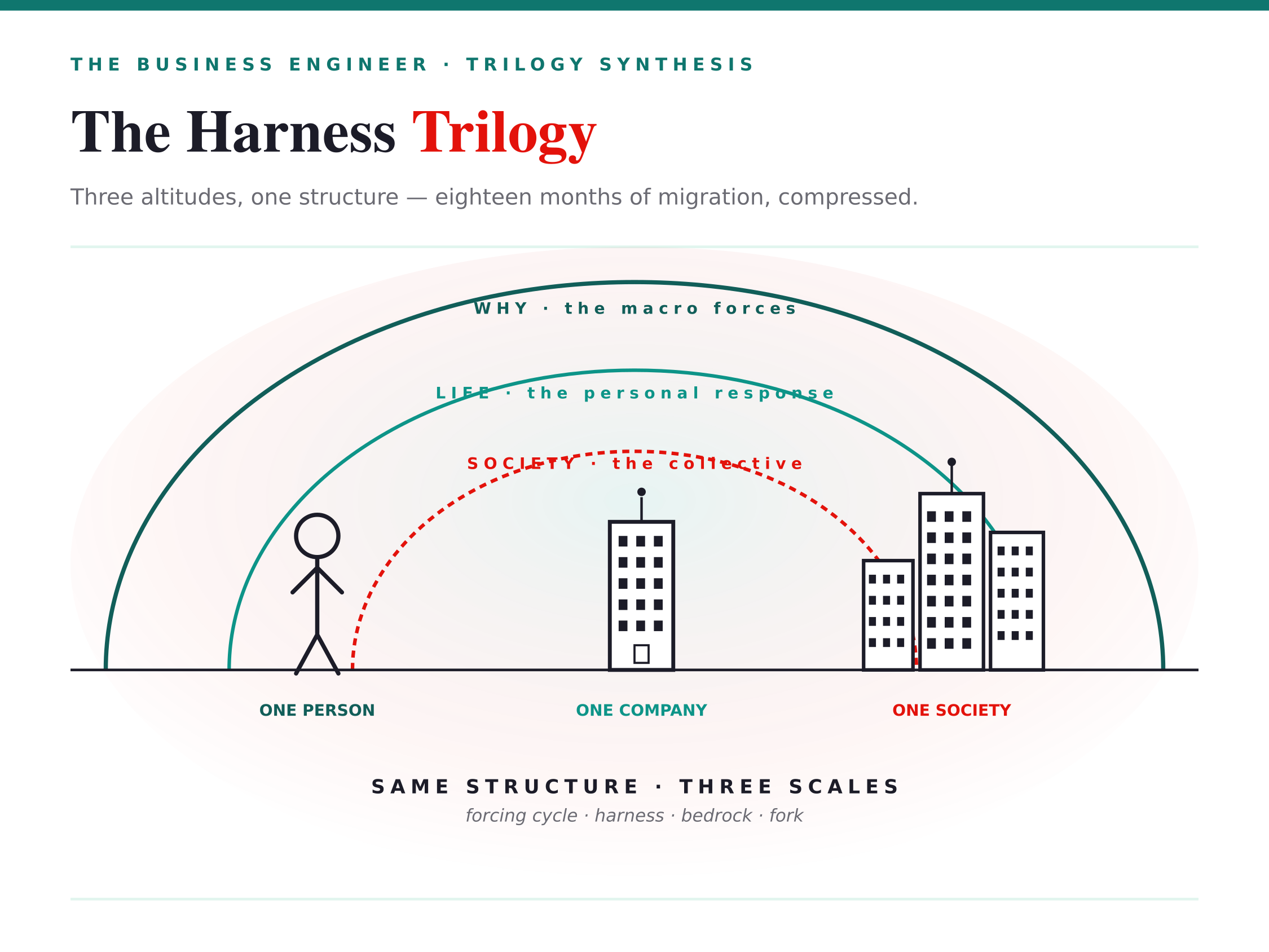
This piece is what’s visible only from the end of the journey. The three essays were never three essays. They were one phenomenon observed from three altitudes, recorded in sequence as the migration completed, and the structure that holds them together is more important than anything any of them said alone.
That structure is the thing worth synthesizing. Not the conclusions — the architecture beneath them.
Follow me also on The AI Supercycle!
Why I Ended Up in the Harness

A few days ago, I explained how, over the last eighteen months, the way I work has completely changed.
My Life in the Harness

I don’t work in a chat window anymore. I work in the Business Engineer’s harness.
The Harness Society

I’ve written two pieces about what it looks like to live inside a harness of agents as one person — how I got there, and what the daily texture of it is. This one steps back from the desk.
The migration in one sentence
Follow me also on The AI Supercycle!
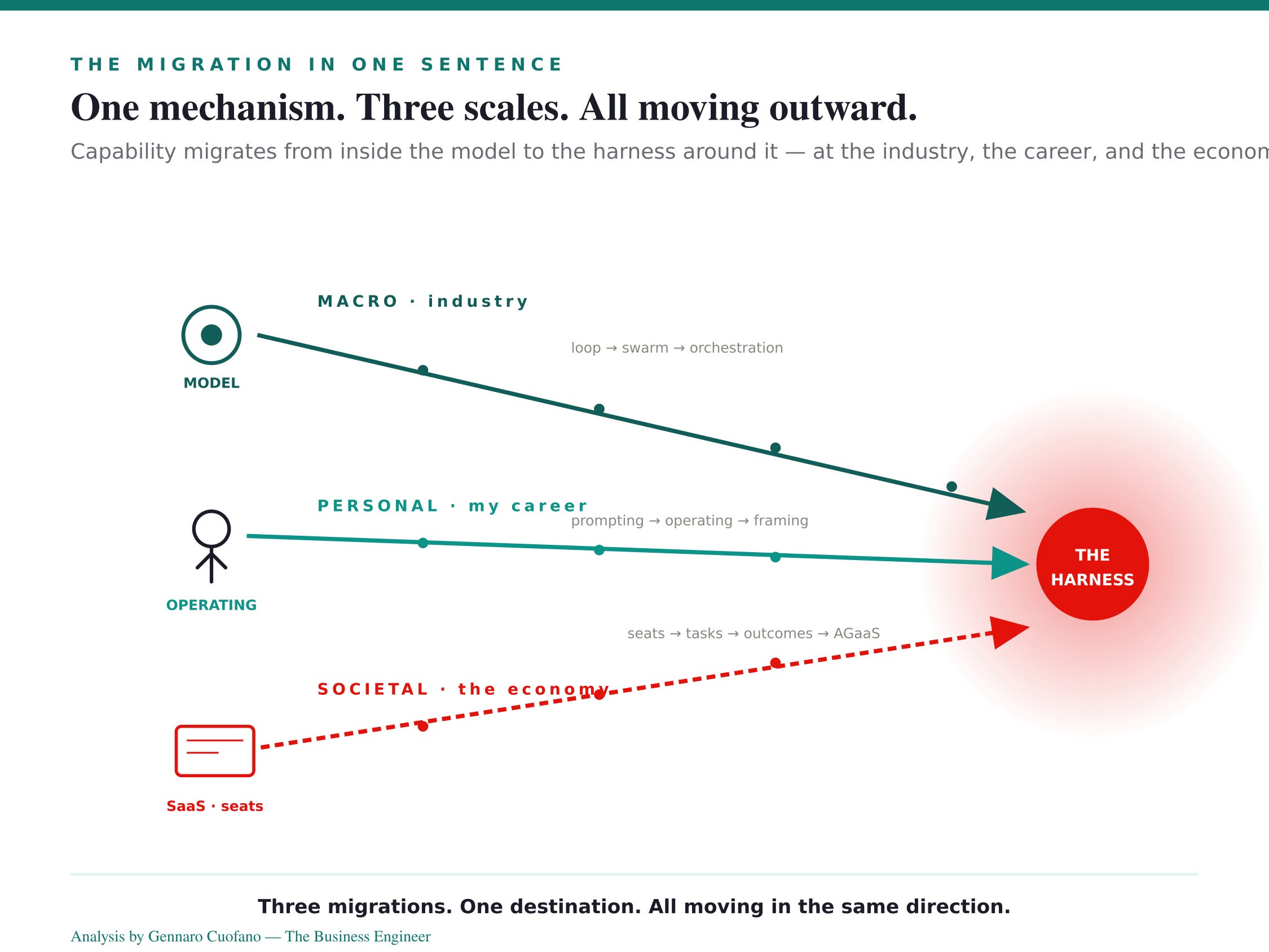
Here is what eighteen months taught me, compressed into the one sentence the trilogy was always circling:
AI’s scaling laws keep relocating capability outward — from inside the model to the harness around it. That migration produces leverage at the personal scale, restructuring at the organizational scale, and friction at the societal scale. The bedrock that doesn’t move at any scale is authorship.
Every page of every essay is downstream of that sentence. The Why piece is the migration observed at the level of the AI industry over four years. The Life piece is the same migration observed inside one person’s career. The Society piece is the same migration observed across an entire economy at once. The mechanism is identical. Only the unit of analysis changes.
But sameness across scales isn’t a coincidence. The migration is fractal, and the architecture it produces is fractal too. That is what the synthesis exists to draw.
Three altitudes, deliberately distinct
Follow me also on The AI Supercycle!
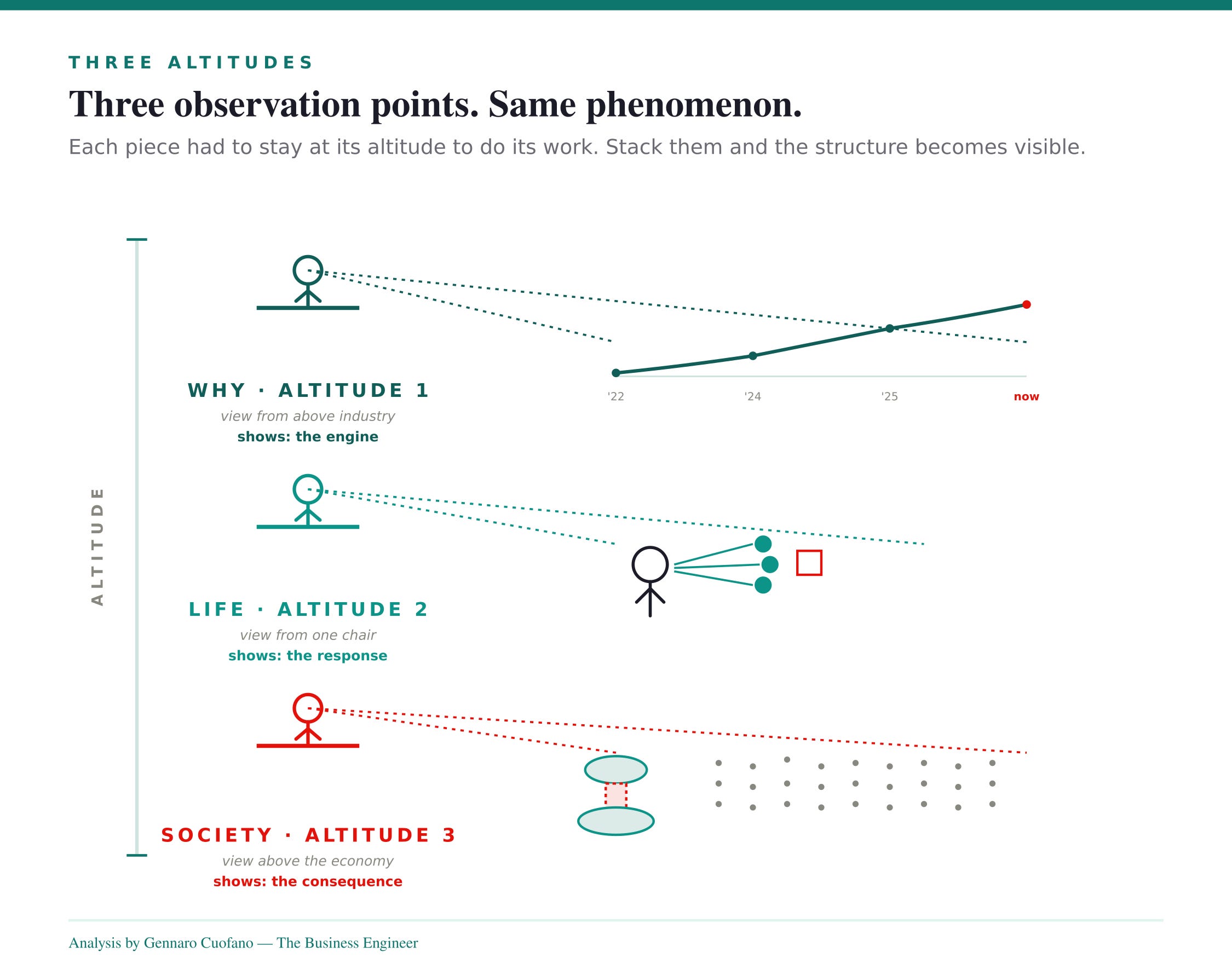
I wrote the three pieces in the order I did because each one had to stay at one altitude to do its work. Mixing them would have blurred the structure that’s only visible when you see the altitudes side by side.
Altitude 1 — the macro forces (the Why, written last). The view from above the AI industry. Pre-training scaling hit a wall in 2024. The frontier didn’t stop; it relocated, first to test-time reasoning (Sept 2024), then to agency (2025), then to swarm orchestration (2026). Four eras in four years, each shorter than the last. The unit of work climbed turn → task → goal → operation. The business model mutated from SaaS to AGaaS. The form factor migrated from screen to phone to ambient surface. This was the engine driving everything else, and it was identifiable from primary sources — Amodei’s 2024 statements, OpenAI’s o-series release cadence, MCP’s adoption curve, the Linux Foundation handoff in December 2025. None of it was prediction; all of it was retrospective accounting on what had already happened.
Altitude 2 — the personal response (the Life, written first). The view from one chair, day to day. Eighteen months of personal restructuring compressed into a description of what the destination looks like. Operating commoditized; framing became the edge. Six framing moves replaced two years of operator instincts. The harness — swarm, self-improving loop, shared memory, gates at the high-stakes edges — became the architecture I worked through instead of the chat window I worked inside. The frame I set in the morning steered a swarm through the day. The thin surface — frame in, gate out — replaced the desk. The harness ran remote; I carried the handle. This was the destination viewed from inside, with the eighteen months of migration mostly invisible behind it.
Altitude 3 — the collective consequences (the Society, written third). The view from above the economy. What the macro forces in Altitude 1 do to the millions of people who can’t or won’t make the migration in Altitude 2. The principal/operator split shows up in measurable data — Anthropic’s 70/80 planning split, the 5× expert-novice output gap, Gallup’s 3× layoff risk for non-adopters. Companies fork into shrinkers (State Farm: 19,000 contracts rewritten, −40% income) and amplifiers (Block: BuilderBot, 15% of code, 1,500 PRs/week). The middle dissolves quietly through macro shocks. AGaaS bottlenecks on the outcome-definition problem most companies can’t solve. The substrate taxes everyone — even the opt-outs paying $200 more for an iPhone because AI absorbed the HBM supply.
Each altitude is structurally complete on its own. None of them is structurally complete on its own. The phenomenon is only visible when you stack all three and notice that the same shape appears in each of them.
That repeating shape — what I’m going to call the fractal architecture — is the trilogy’s deepest insight, and the thing none of the three pieces could carry alone.
Four patterns that repeat at every scale
Follow me also on The AI Supercycle!
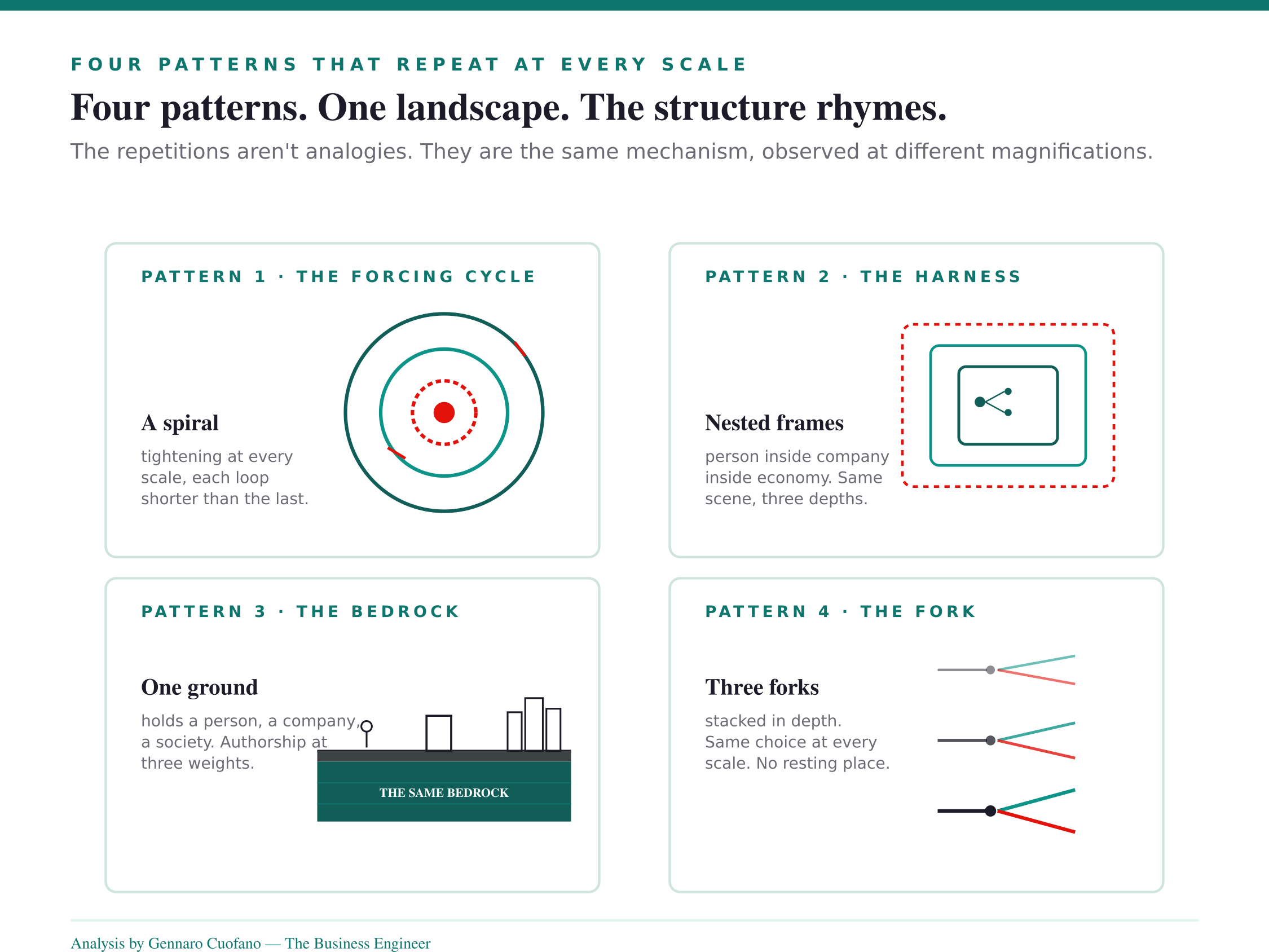
Each of these is a structural rhyme — a shape that appears identically in the Why, the Life, and the Society. The repetitions are not analogies. They are the same mechanism, observed at different magnifications.
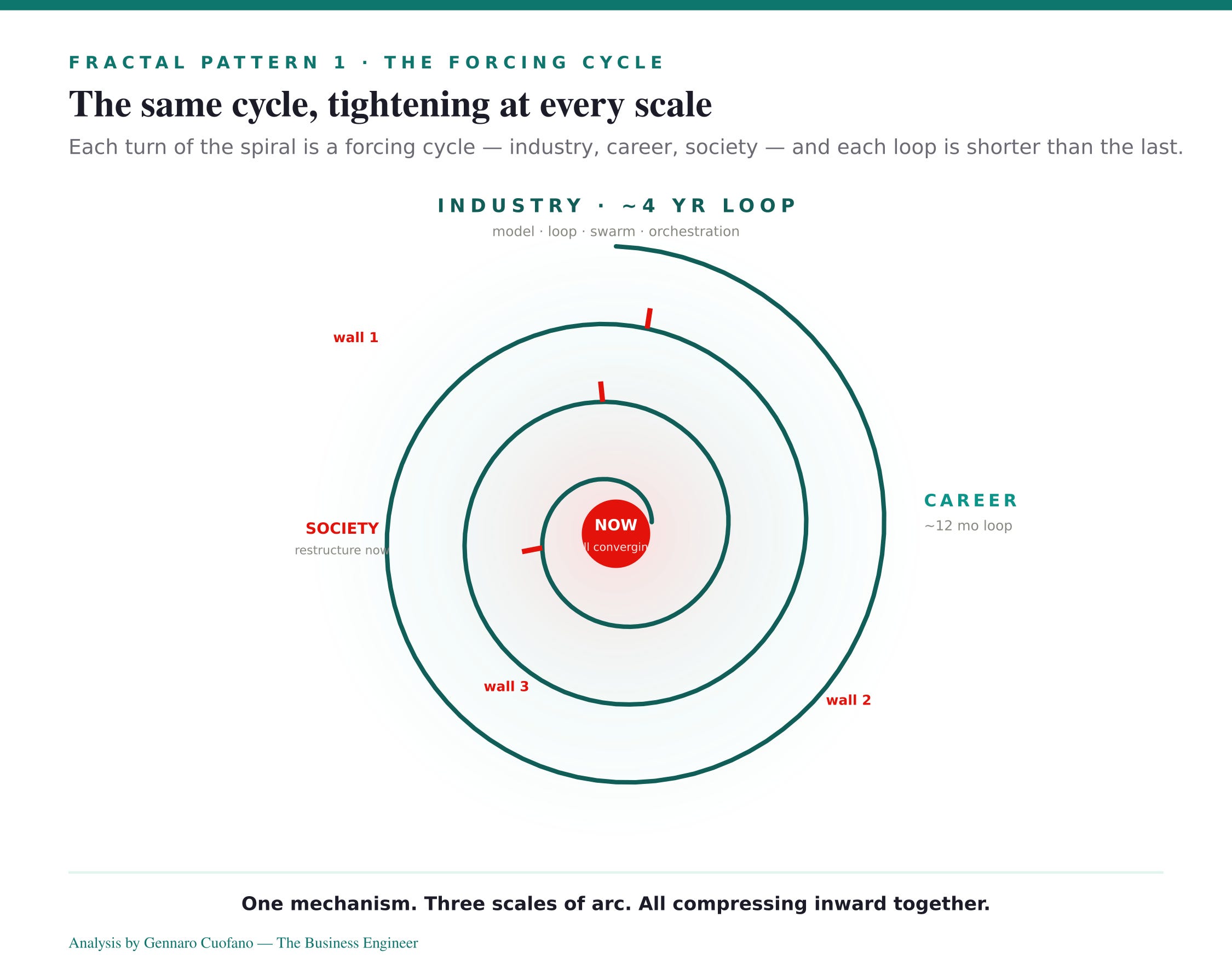
1. The forcing cycle is fractal
Follow me also on The AI Supercycle!
The macro version: when the current scaling axis hits diminishing returns, the frontier relocates outward. New axis → new unit of work → new business model → new form factor → old layer commoditizes → repeat. This ran four times in the AI industry between 2020 and 2026, with each cycle shorter than the last.
The same cycle ran inside my own career over the same period. The skill that produced value in 2023 — operating a chat model well — commoditized by 2025. The edge moved up one rung to framing. Framing-as-craft is itself starting to commoditize now, in 2026, which means it will move up one more rung to orchestration over the next year, then to something beyond that the year after. The arc of one career inside eighteen months mirrors the arc of an industry inside four years. Same shape; smaller scale; faster clock.
And the same cycle is now running inside society. The shift from SaaS to AGaaS isn’t a pricing change — it’s a forcing cycle relocating value outward at the level of the entire commercial economy. The org chart inverts because the old shape (wide operating base, narrow decision-making top) is what gets automated. The middle dissolves because operating commoditized. Governance becomes the scarce resource because authorship is the one layer that can’t commoditize, and there is no societal version of it yet. One mechanism, three resolutions, all of them compressing. This is why the trilogy keeps feeling like it’s accelerating — every altitude is running the same engine at the same time, and the engine speeds up at every level simultaneously.
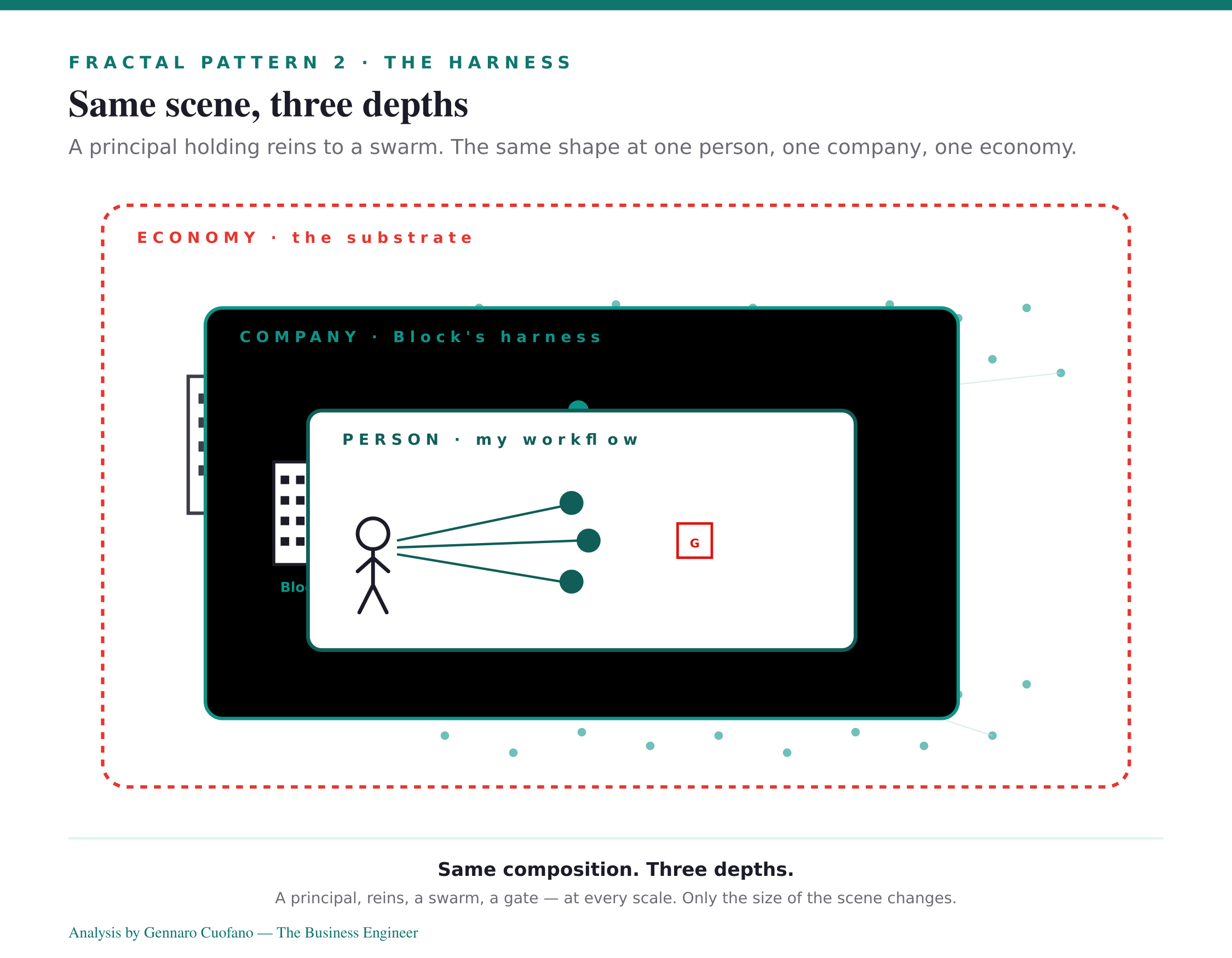
2. The harness is fractal
Follow me also on The AI Supercycle!
At the personal scale, the harness is what one person builds around their own work: a swarm of specialist agents, a self-improving loop, a shared memory layer, approval gates at the edges where stakes are high. One person plus a harness produces what used to take a department.
At the company scale, the harness is what one company becomes when it restructures around outcomes. Block’s BuilderBot is the personal harness from the Life piece, run at company scale. A frame set by a human (a Slack message). A swarm of specialist agents executing in parallel (1,500 PRs/week). One source of truth, gates at high-stakes decisions, the orchestration as the work. The pattern is identical. The only difference is the size of the swarm and the weight of the gates.
At the economic scale, the harness is what the AI economy itself is becoming. The frontier labs are running negative-margin subscriptions to acquire workload signal (a self-improving loop at lab scale). MCP standardizes how agents connect to tools (a shared memory layer at economy scale). The Agentic AI Foundation under the Linux Foundation is the gate-and-governance structure forming around the largest swarm of all. The labs are building, at economy scale, the same architecture I built at desk scale, for the same structural reasons.
The harness is not a metaphor scaled up or down. It is a single architectural pattern that emerges wherever there’s a principal with a frame, a swarm of executors, a need for coherence, and stakes worth gating. Every scale that meets those four conditions builds the same architecture. Inevitably. Because there is no other architecture that solves the problem.
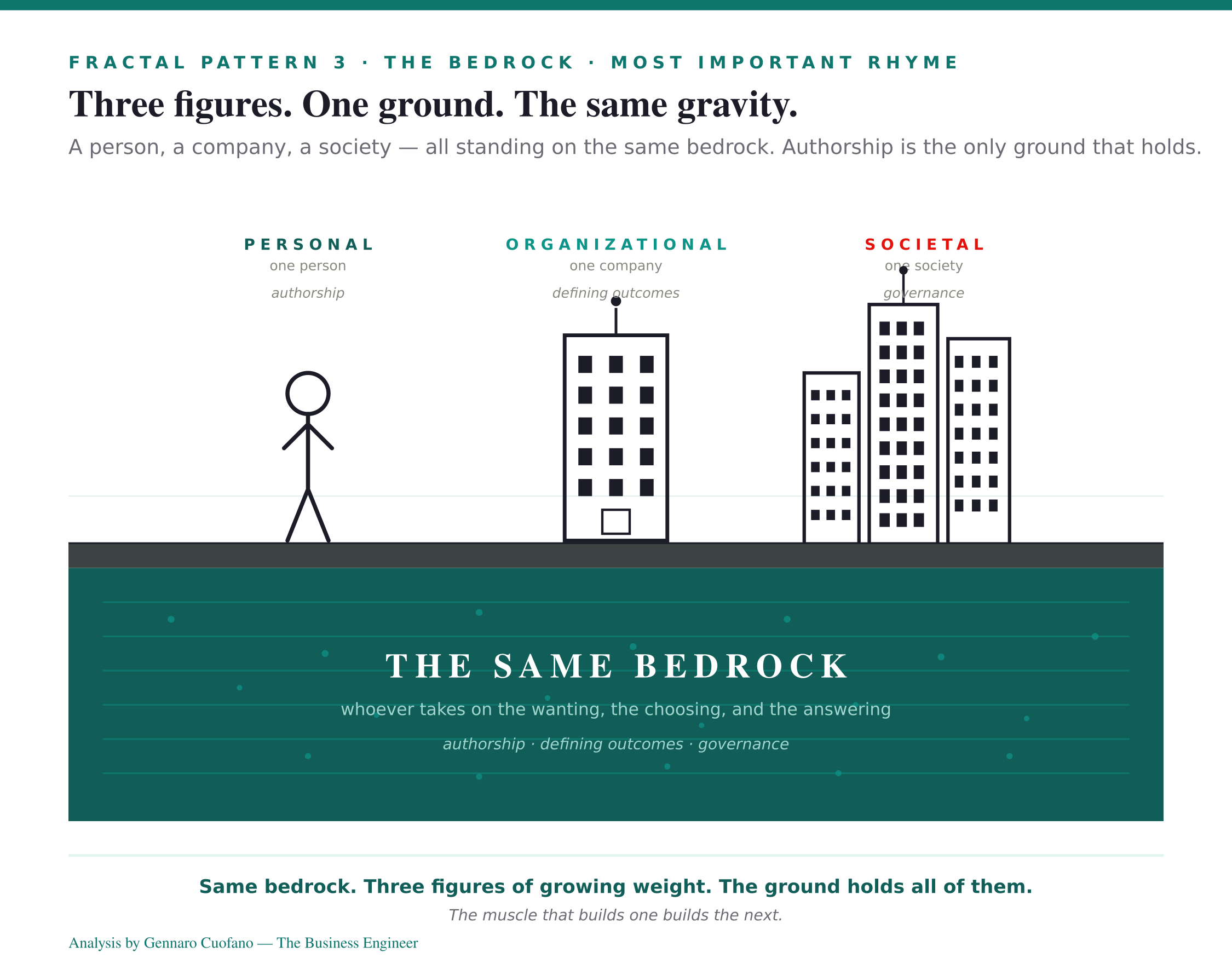
3. The bedrock is fractal — and this is the most important rhyme
Follow me also on The AI Supercycle!
At every scale, the question of what doesn’t commoditize gets the same structural answer. The form changes; the structure is identical.
At the personal scale: authorship. Wanting a particular outcome, choosing which tradeoffs are acceptable, answering for the result when it ships. Not a skill. A position. The bedrock the churn can’t reach because it isn’t a capability to be acquired faster by something faster than you.
At the company scale: defining outcomes. The AGaaS transition’s load-bearing problem isn’t pricing — it’s that most companies can’t articulate what their outcomes actually are at the granularity an agent contract requires. Solving that requires the company itself to do, at company scale, exactly what the individual did at personal scale: figure out what it wants, decide which tradeoffs are acceptable, and answer for the result. Defining outcomes is corporate authorship. The same bedrock, held by an organization instead of a person. The work it takes to define outcomes well is the work it takes to be the principal of a company-scale harness.
At the societal scale: governance. Who is allowed to be the principal of a swarm that can author at scale? Who is accountable when one goes wrong? Whose will and whose liability govern an agent that ran for fifty steps without supervision? These are not technical questions. They are the societal version of “wanting, choosing, and answering for the result.” Governance is societal authorship. Same bedrock, held by political and legal institutions instead of by a person or a company.
The trilogy keeps ending on the same note because the same answer keeps being correct at every altitude. It isn’t three different conclusions that happen to rhyme. It is one conclusion, restated at three scales, because the bedrock is the same shape no matter how far up or down you stand.
And here is the practical implication, which only becomes visible from the synthesis: the muscle you build to be the principal of your own workflow is the same muscle companies need to define their outcomes, which is the same muscle societies need to govern their swarms. Personal authorship trains the capacity for corporate authorship trains the capacity for societal authorship. The trilogy isn’t a sequence of unrelated arguments. It’s a ladder where every rung uses the same muscle and where climbing one rung makes the next one possible.
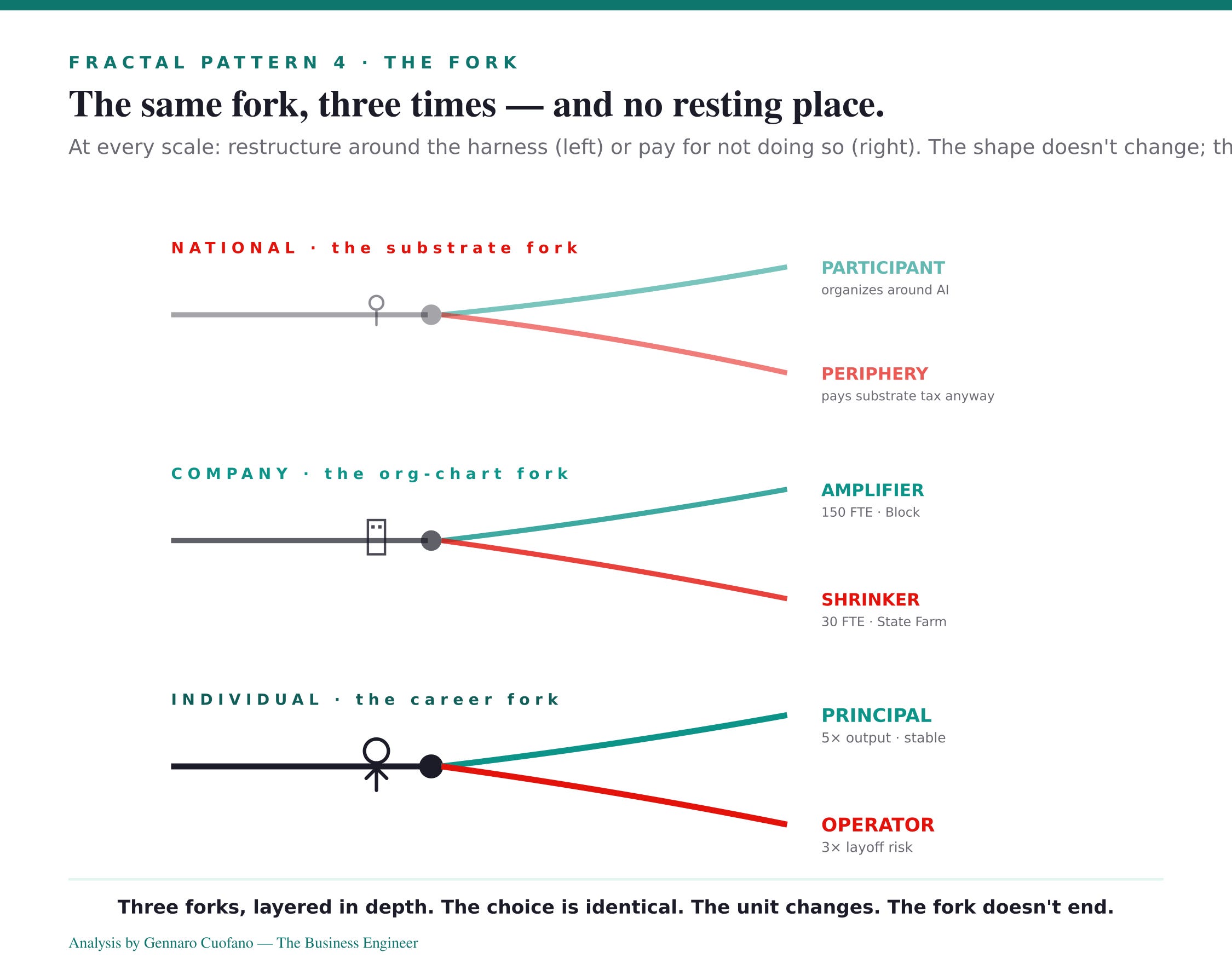
4. The fork is fractal — and it doesn’t end
Follow me also on The AI Supercycle!
At every scale, the system splits along the same line: between those who restructure around the harness and those who pay for not doing so.
At the individual scale: principal vs. operator. The 5× output gap between expert and novice using the same tool. The 3× layoff-risk gap between adopters and holdouts. The fork measured from both sides simultaneously.
At the company scale: amplifier vs. shrinker. A 100-FTE team becomes either 150 (build to multiply output) or 30 (cut to save cost). Block on one side; State Farm on the other. Two paths from the same input, with no stable middle.
At the national scale: participant vs. periphery. Countries that organize around AI as substrate vs. those that try to opt out. The opt-outs pay the tax anyway — in goods, energy, talent, attention — but get none of the leverage. The substrate doesn’t ask permission.
Three forks. Identical shape. The dividing line at every scale is whether the actor restructures around the harness or doesn’t, and the gap between the two paths compounds over time at every scale. This is the structural reason the harness society is going to be uncomfortable for a long time. The same forking choice keeps reappearing at every level of the system, with no resting place where the fork doesn’t apply, and the cost of the wrong choice compounds at every scale.
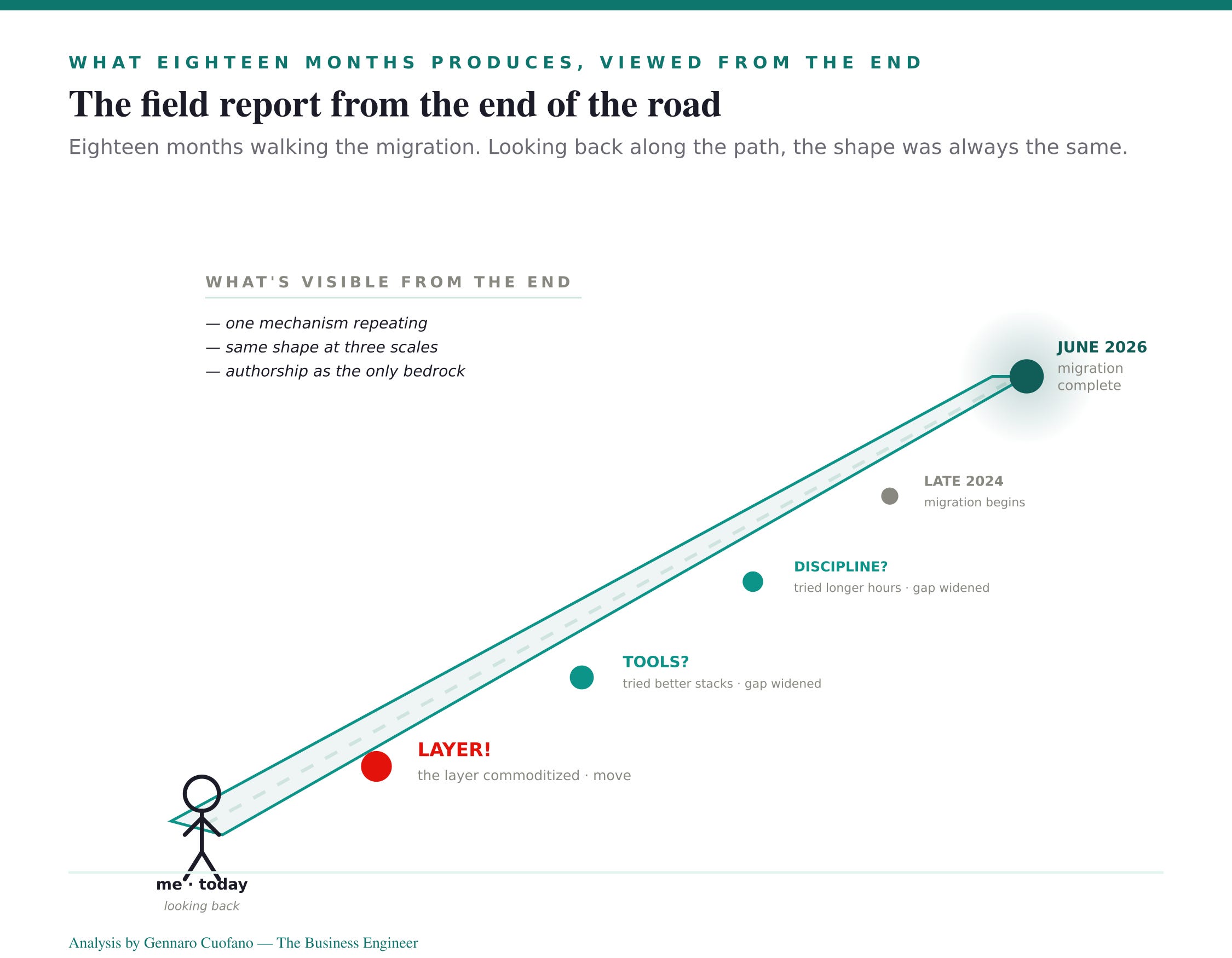
What eighteen months of migration produces, viewed from the end
Follow me also on The AI Supercycle!
Stack the four fractal patterns and the trilogy compresses into a sentence that contains the whole journey:
Scaling migrated outward; capability followed it; a fractal harness formed at every level of the system from one person’s desk to the world economy; authorship is the bedrock that holds at every scale; and at every scale, the system forks between those who restructure around the new architecture and those who pay for not doing so — and that fork doesn’t end.
That sentence is the field report from eighteen months of moving from one position to another. None of the individual pieces could carry it because each was constrained to one altitude. The synthesis is what becomes visible once you stop moving and look back along the path.
The deeper insight — the one that justifies the trilogy as a unit — is this: the migration is the same shape no matter where you stand, but it has to be made wherever you stand. Reading about my migration doesn’t make yours. Reading about Block doesn’t restructure your company. Reading about the substrate tax doesn’t change the political answer. The structure is fractal; the work to migrate through it is not transferable. Each level of the system has to do the migration at its own scale, with its own actors making its own version of the principal/operator choice.
That’s why the trilogy ends, in all three pieces and in this synthesis, on the same question: who takes on the wanting, the choosing, and the answering at your scale? That question is the only one that matters at any altitude. The migration is over for me. The migration is barely starting for most readers. The migration has not begun, in any serious form, at the societal scale. And the clock is the clock the Why piece established: each cycle shorter than the last, with less time to migrate before the next layer commoditizes.
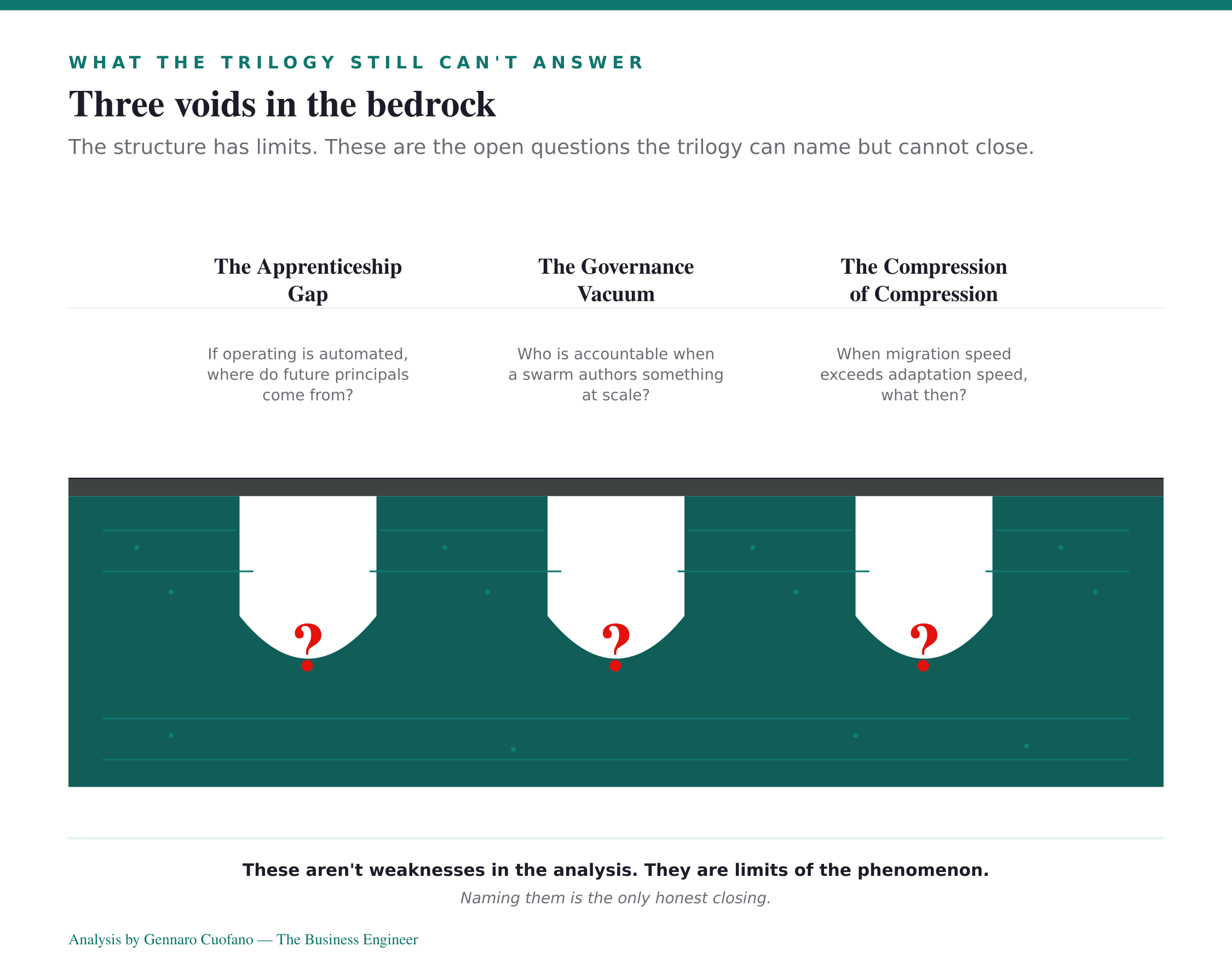
What the trilogy still can’t answer
Follow me also on The AI Supercycle!
Honest about the limits, because a synthesis that pretends to be complete is just a sales document.
The apprenticeship gap. If operating-as-training-ground is the layer being automated, where does the next generation of principals come from at any scale? At the personal scale, the answer is “from the current generation, until it retires.” At the company scale, the answer is “from Block, until competitors learn the restructure.” At the societal scale, the answer is unknown. Nobody — including me — has articulated how a society replenishes its principal class once the apprenticeship pipeline that used to make principals out of operators is gone. This is the most important unanswered question in the entire transition. The trilogy can describe it. The trilogy cannot answer it. The apprenticeship gap is the open edge of the structure at every altitude, and it is the thing that will, eventually, determine whether the harness society stabilizes or collapses.
The governance vacuum. The bedrock at the societal scale is governance, and the trilogy points at the question without filling it. The labs and the hyperscalers will not answer it — they will optimize around whatever answer the rest of the system produces. The answer needs to come from somewhere else — legislators, courts, professional associations, new institutions that do not yet exist — and right now it is not coming from anywhere. The trilogy describes the vacuum. The trilogy cannot fill it. The political question of the decade is sitting open, and no one has begun to seriously address it.
The compression of compression. Each forcing cycle has been shorter than the last: ~4 years → ~1 year → ~1 year → now. If the trend continues, the next relocation arrives faster than this one did, and the time anyone has to migrate to the new layer shrinks toward zero. At some point the migration speed exceeds human adaptation speed at the personal scale, organizational adaptation speed at the company scale, and political adaptation speed at the societal scale — possibly all three at once. The trilogy doesn’t say what happens then because nobody knows. It might not be possible to know until we get there.
These three open edges are the honest closing of the synthesis. They are not weaknesses in the analysis. They are limits of the phenomenon — and naming them is the only way the trilogy can end without pretending to know more than it does.
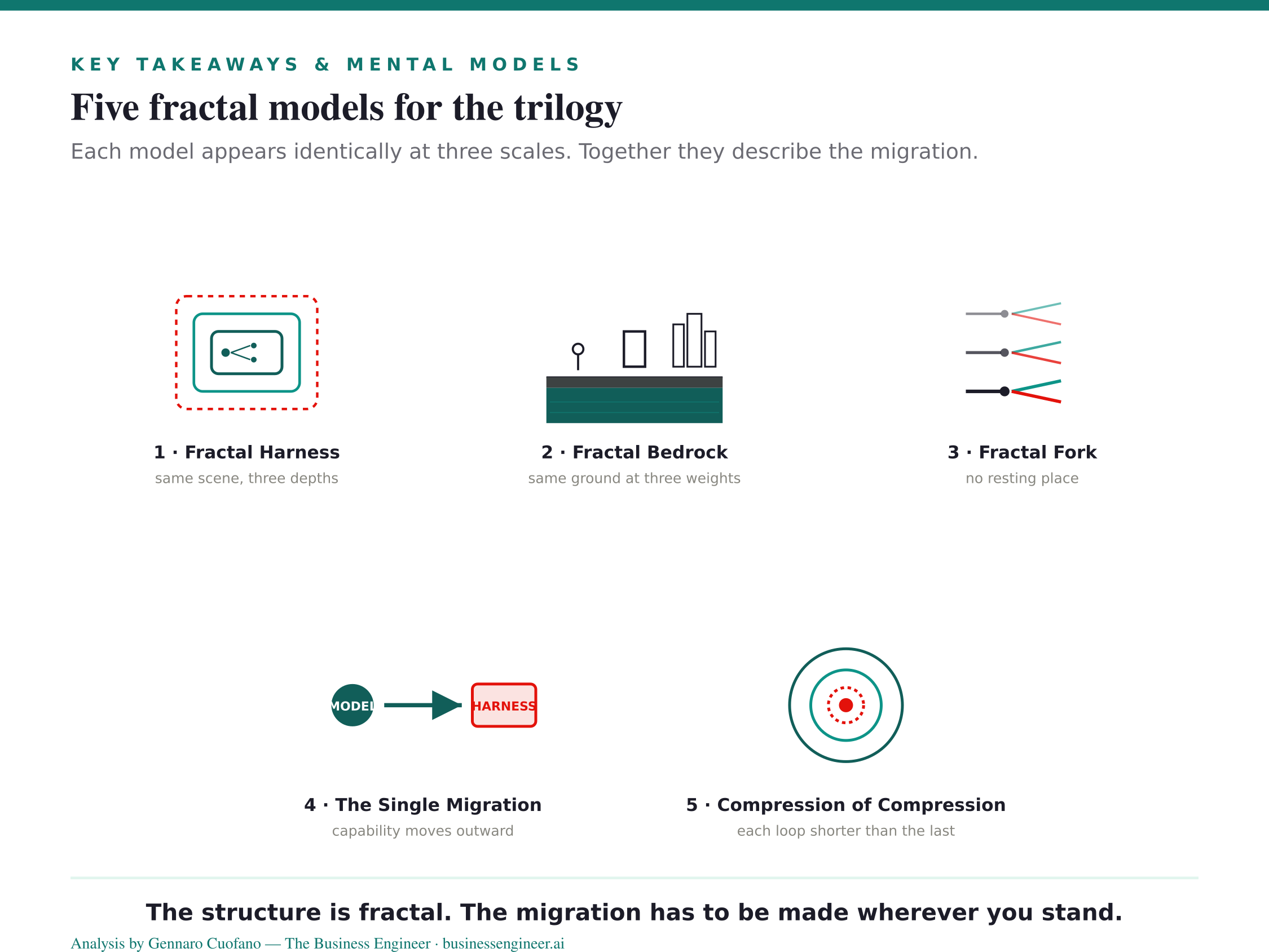
Key Takeaways & Mental Models
Follow me also on The AI Supercycle!
The Fractal Harness — The harness is not a metaphor. It is a single architectural pattern — authoring core, swarm of executors, shared memory, gates at high-stakes edges — that emerges wherever there is a principal, a frame, and stakes worth gating. It appears at every scale from one person’s workflow to the AI economy itself. Same shape; different sizes; identical mechanism.
The Fractal Bedrock — The position that doesn’t commoditize at any scale is whoever takes on the wanting, the choosing, and the answering. At the personal scale, authorship. At the company scale, defining outcomes. At the societal scale, governance. Same structure, three altitudes, and the muscle that builds one builds the next.
The Fractal Fork — At every scale, the system splits between those who restructure around the harness and those who pay for not doing so. Principal vs. operator. Amplifier vs. shrinker. Participant vs. periphery. The shape is identical; only the units change. And the fork compounds at every scale simultaneously.
The Single Migration — All three pieces describe one phenomenon: capability migrating outward from the model to the harness around it. The Why traced it at industry scale. The Life traced it inside a person. The Society traced it across everyone else. The mechanism is the same; the unit changes; the work of migrating is not transferable across units.
The Compression of Compression — Each forcing cycle is shorter than the last. The time available to migrate to the new layer shrinks at every iteration. This is the open edge of the structure at the personal, organizational, and political scales — and the limit that may eventually decide whether the harness society stabilizes or collapses under its own speed.
Recap: In This Issue!
The Trilogy Was Always About One Thing
The three essays (The Why, The Life, and The Society) are not separate arguments.
They are the same phenomenon observed from three different altitudes:
Industry
Individual
Society
The core thesis:
AI’s scaling laws continue to relocate capability outward, from the model into the harness around it. That migration creates leverage at the personal level, restructuring at the organizational level, and friction at the societal level. Authorship remains the bedrock at every scale.
The Migration Is Fractal
The most important insight in the synthesis is that the same structural patterns repeat across scales.
The same dynamics shaping frontier AI labs are shaping:
Individual careers
Company structures
Entire economies
The mechanism remains constant.
Only the unit of analysis changes.
Scaling Didn’t Stop. It Moved
The dominant narrative is that AI scaling slowed when pre-training hit diminishing returns.
The argument here is different:
Scaling never stopped.
It relocated.
The progression looks like:
Pre-training scaling
Test-time reasoning
Agentic systems
Swarm orchestration
Each transition pushes capability outward from the model into the surrounding system.
The harness becomes the new scaling surface.
The Harness Is the New Operating Layer
At the personal level, the harness consists of:
Specialist agents
Shared memory
Self-improving loops
Approval gates
Orchestration systems
The chat interface becomes secondary.
The harness becomes the primary environment for work.
The shift is from operating tools to framing systems that operate tools.
The Same Architecture Appears Everywhere
One of the strongest ideas in the piece is the concept of the Fractal Harness.
The pattern repeats at every scale:
Individual harnesses
Company-scale harnesses (e.g., Block)
Economy-scale harnesses (e.g., MCP, agent ecosystems, frontier labs)
The components are always similar:
A principal
A frame
A swarm of executors
Shared memory
Governance gates
Different scale.
Same architecture.
Authorship Is the Bedrock
The trilogy repeatedly arrives at the same conclusion.
What survives automation is not skill.
It is authorship.
At different scales authorship takes different forms:
Personal scale → authorship
Company scale → defining outcomes
Societal scale → governance
The underlying structure remains identical:
Wanting. Choosing. Answering for the result.
The Fork Repeats at Every Scale
The synthesis introduces the concept of the Fractal Fork.
The system repeatedly splits into two groups:
Individuals
Principals
Operators
Companies
Amplifiers
Shrinkers
Countries
Participants
Periphery
The dividing line is always the same:
Whether an actor restructures around the harness or resists it.
The Real Question Is Not Technology
The trilogy ultimately becomes less about AI and more about responsibility.
The recurring question at every level is:
Who takes responsibility for wanting, choosing, and answering?
That question determines:
Individual leverage
Organizational effectiveness
Societal governance
The technology changes.
The accountability structure does not.
Three Problems Remain Unsolved
The synthesis explicitly identifies three open questions.
The Apprenticeship Gap
If operators become automated, where do future principals come from?
The traditional path from execution to judgment may disappear.
The Governance Vacuum
Who governs large-scale agentic systems?
No institution currently owns this responsibility.
The Compression Problem
Each transition cycle is becoming shorter.
Eventually adaptation may become slower than the rate of change itself.
The Core Insight
The trilogy compresses into a single idea:
Capability is migrating outward from the model into the harness around it. As that migration occurs, the same patterns repeat at every scale: leverage, restructuring, friction, authorship, and ultimately a fork between those who adapt and those who pay the cost of not adapting.
The harness is not the story.
The migration is the story.
The harness is simply the structure that emerges wherever that migration arrives.
With massive ♥️ Gennaro Cuofano, The Business Engineer