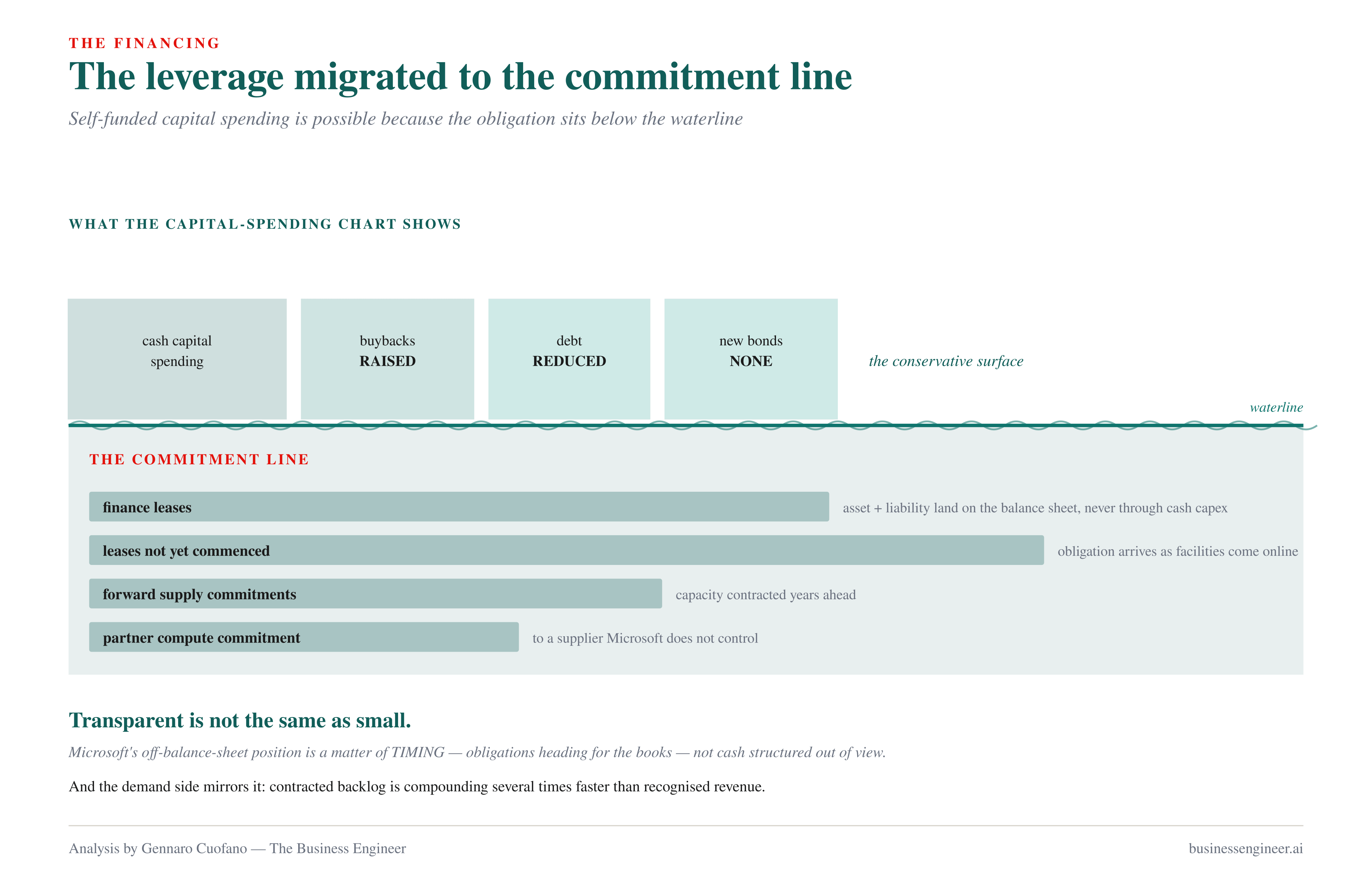

Three of the world’s largest builders of AI infrastructure reported earnings within days of one another, during the same Federal Reserve decision and in the same week that markets repriced the AI trade.
Alphabet reported first, on July 22. It doubled its capital budget, moved into negative free cash flow, and described the pressure as a deliberate use of its balance sheet.
Google's Second Act

For nearly three decades, Google has been synonymous with consumer technology, arguably the defining company of the internet era. That remains true today—but it is changing rapidly. As we speak, Google is undergoing one of the most profound transformations in its history. AI isn't simply becoming another product for the company; it's fundamentally reshaping what Google is and what it is becoming.
Meta followed on July 29, and its results were more concerning. Cash generation collapsed, the company borrowed heavily during the quarter to finance the build, and it stopped repurchasing its own shares.
Has Meta Overshot the AI Build?

Whatever the stock does at the open has almost nothing to do with what follows.
Microsoft reported on the same day. It did neither.
Microsoft funded its capital programme through operating cash flow. It increased its share repurchases, reduced debt, avoided new bond issuance, and protected its margins. The size of the AI investment left no obvious damage on either the income statement or the cash-flow statement.
That makes these three earnings releases something close to a controlled experiment. All three companies are investing in the same physical system: datacentres, accelerators, memory, networking equipment, and power. They are buying from many of the same suppliers, working against similar deployment timelines, and serving the same broad increase in demand for AI compute.
The main variable is the financial condition of the company doing the building.
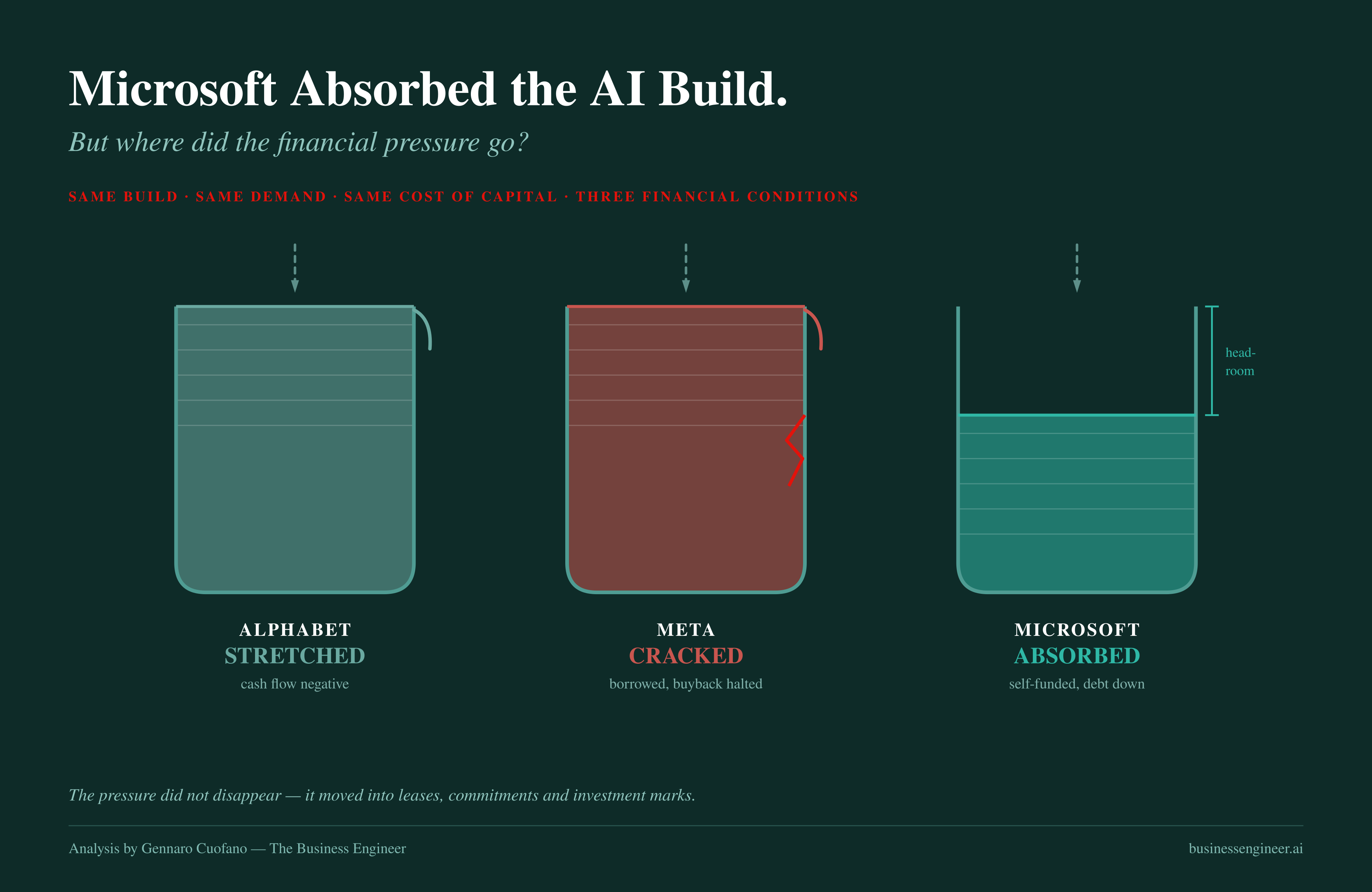
On that measure, the results diverged sharply:
Alphabet stretched.
Meta cracked.
Microsoft absorbed.
Follow me on The AI Supercycle as well!

Nobody needs to ask whether Microsoft can afford the AI build. It plainly can. The more difficult question is where the financial weight went.
If an investment cycle this large leaves almost no visible mark on Microsoft’s margins or free cash flow, where is the pressure accumulating?
A second question follows. Does the market ultimately reward the company that spent less than its rivals while still building one of the strongest positions in AI?
The answer requires looking beyond the headline capital-spending number. It sits inside Microsoft’s three-part operating engine, its transition from seat-based software to metered AI usage, the growing obligations hidden in leases and forward commitments, and the changing economics of the model layer.
At the bottom of all of this is one unresolved question that will determine whether Microsoft’s restraint was wisdom or timidity:
Is compute the decisive scarce resource in AI, or is it the layer Microsoft was right not to over-own?
The rise of open-weight models has now made that question impossible to ignore.
The core still works, and it is broader than the comparison suggests
Follow me on The AI Supercycle as well!
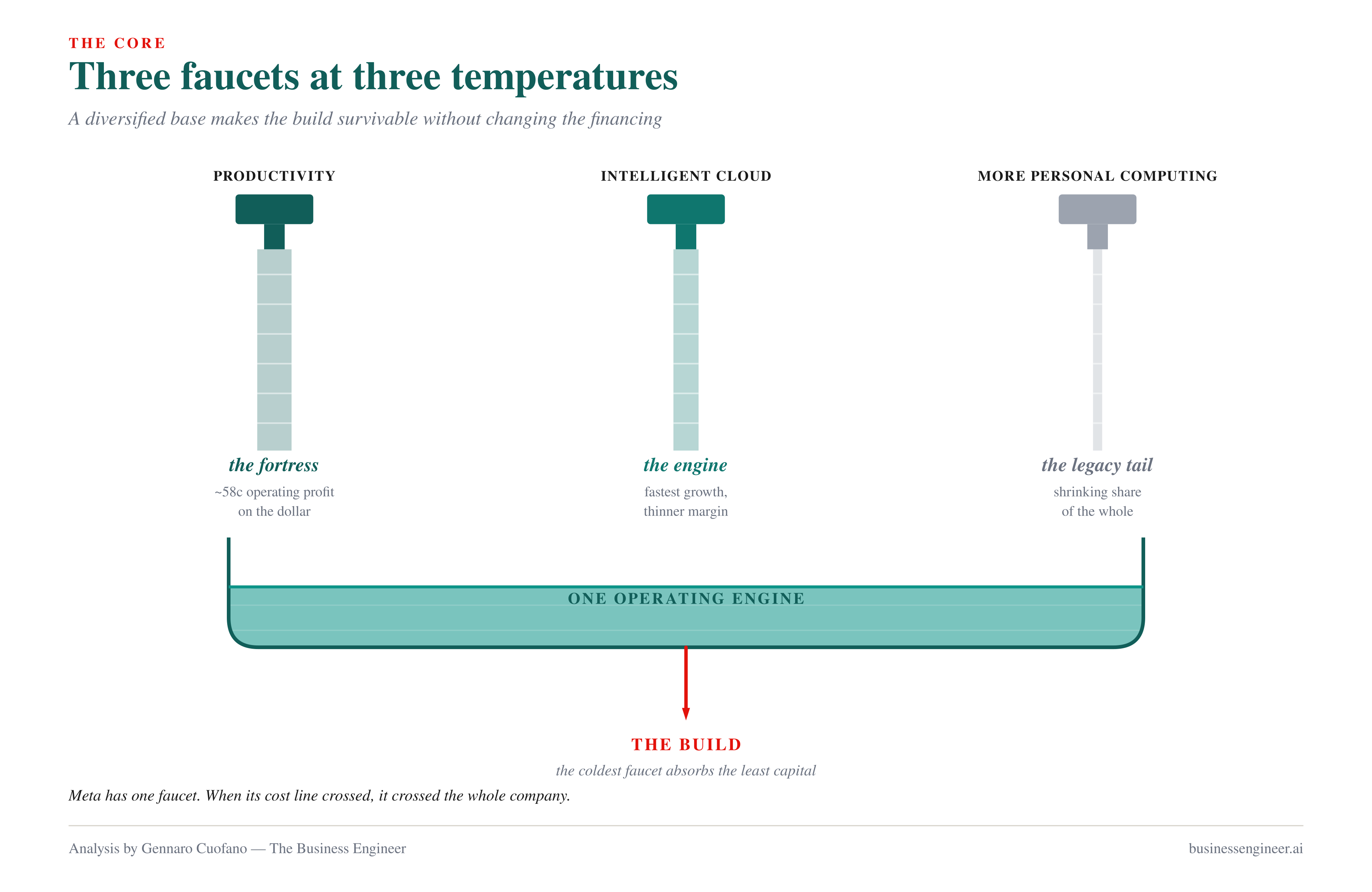
Microsoft did not report one strong business and one weak business. It reported three businesses operating at different temperatures. Their combined structure is the company’s central financial advantage.
The first is the fortress: Microsoft’s productivity software business. Office, LinkedIn, Dynamics, and related products are sold through recurring subscriptions to most large organisations in the world. Microsoft can increase prices, expand the product bundle, and add Copilot on top of an existing relationship.
This business is highly profitable because the cost of delivering another spreadsheet, email account, or collaboration session does not rise in proportion to the price of GPUs. It grew at a strong rate while producing close to sixty cents of operating profit for every dollar of revenue. It is the cash-generating foundation from which the rest of the company can invest.
The second business is the growth engine: Intelligent Cloud, led by Azure. This is where Microsoft’s strongest growth is concentrated, but it is also where the capital intensity sits. Azure requires datacentres, processors, networking, memory, and power. Its margins are therefore lower than those of the productivity business, although its growth rate is considerably higher.
Azure will determine whether the AI infrastructure thesis succeeds. It is the part of Microsoft where investment is converted into cloud capacity, and where cloud capacity must eventually become durable revenue and operating profit.
The third business is the legacy tail: Windows, devices, gaming, and search advertising. Some parts of this segment declined modestly, with softer Windows OEM and Xbox content results, while search advertising remained comparatively resilient.
The important point is that this segment is becoming a smaller share of the overall company. Microsoft’s revenue growth, investment, and strategic attention are increasingly concentrated in productivity software and cloud infrastructure, the two businesses with the strongest compounding potential.
This structure matters because it separates Microsoft from Meta.
Meta depends overwhelmingly on one financial engine: advertising. When the cost of AI infrastructure rises faster than the profitability of advertising, the pressure reaches the entire company.
Microsoft has several engines. Its high-margin software business can finance its capital-intensive cloud business without forcing an immediate change in the way the company funds itself.
Diversification does not make the infrastructure cheaper. It makes the infrastructure survivable without changing the character of the financing.
That is the difference between a company that must reach for the debt market and one that does not.
The cost line did not cross
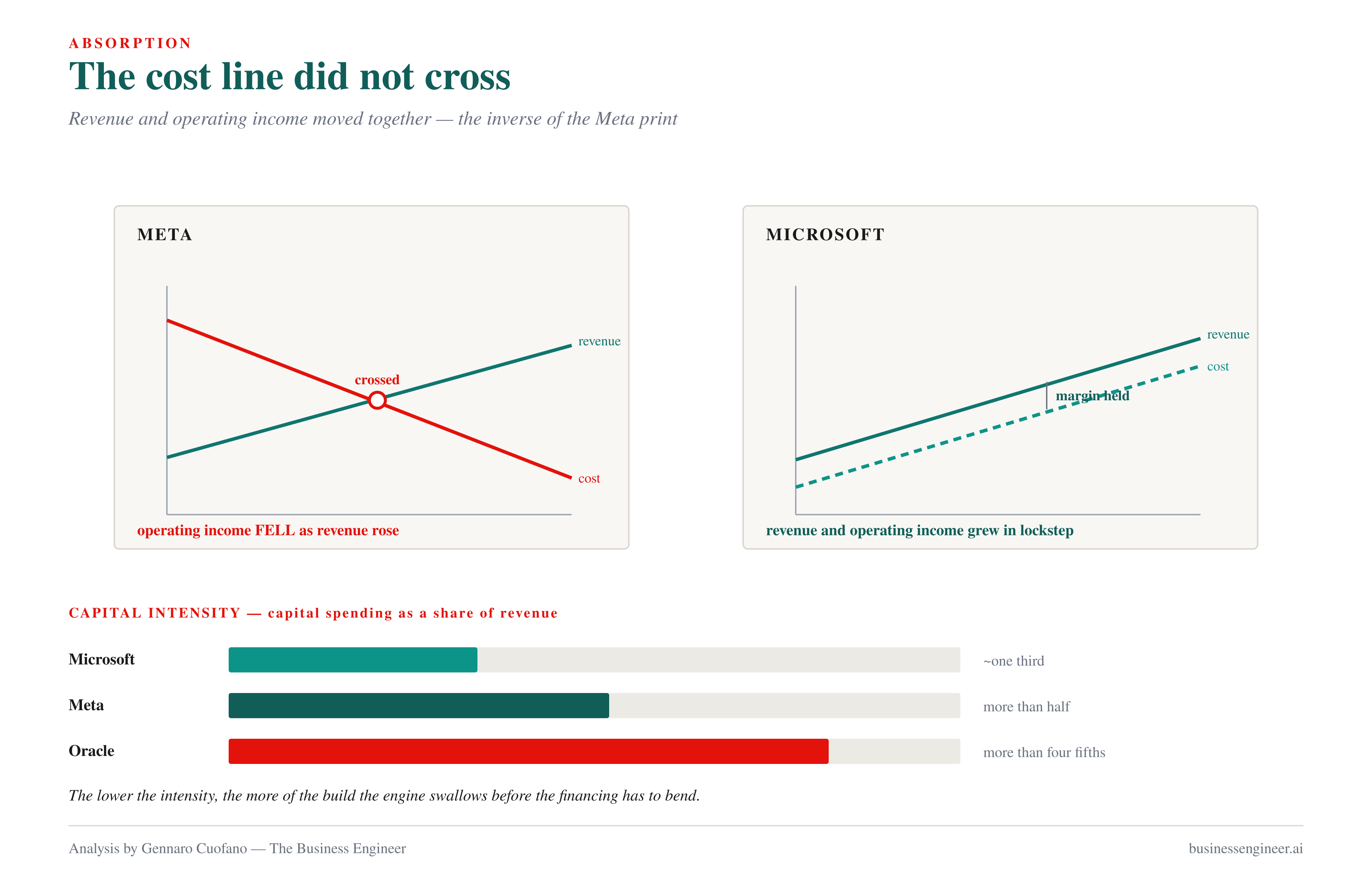
Meta’s results showed the build beginning to consume the growth it was intended to support. Revenue rose sharply, but operating income fell and margins contracted. Infrastructure spending had crossed the point where it was beginning to alter the economics of the company’s core business.
Has Meta Overshot the AI Build?
Whatever the stock does at the open has almost nothing to do with what follows.
Microsoft showed the opposite pattern.
Revenue and operating income grew broadly in line with one another. The operating margin held during the quarter and improved over the full year. The AI build did not visibly consume the company’s operating growth.
The cash-flow statement tells the same story. Microsoft’s operating cash flow grew faster than revenue. Capital investment increased significantly, but roughly one-third of every operating cash-flow dollar still remained as free cash flow.
Meta, by comparison, generated almost no free cash flow in its comparable quarter. Capital spending consumed virtually all the operating cash the company produced.
The number that explains the difference is capital intensity: capital spending as a percentage of revenue.
Microsoft’s capital spending is roughly one-third of revenue.
Meta’s is more than half.
Oracle’s is more than four-fifths.
The higher the capital intensity, the faster an infrastructure build can overwhelm the financial engine underneath it. Microsoft begins with a much larger and more profitable revenue base, allowing it to absorb an enormous capital programme before it needs to reduce buybacks, issue debt, or accept meaningful margin compression.
This is Microsoft’s absorption capacity.
The same infrastructure programme can look like financial stress at one company and a normal investment cycle at another. The difference is not simply the size of the build. It is the size and capital intensity of the business beneath it.
Microsoft’s operating engine is large enough, and its capital intensity remains low enough, for the current build to sit inside cash flow without forcing a structural financing decision.
The business-model transition: where the compounding happens
Follow me on The AI Supercycle as well!
The absorption story explains how Microsoft can finance the infrastructure. It does not fully explain how that infrastructure might generate an acceptable return.
The deeper mechanism is a change in Microsoft’s business model.
Amy Hood described it clearly in April, and Satya Nadella has repeated the idea since: Microsoft’s traditional per-user businesses, including productivity, coding, and security, are moving towards a combination of per-user and usage-based pricing.
That transition changes the way Microsoft’s revenue can compound.
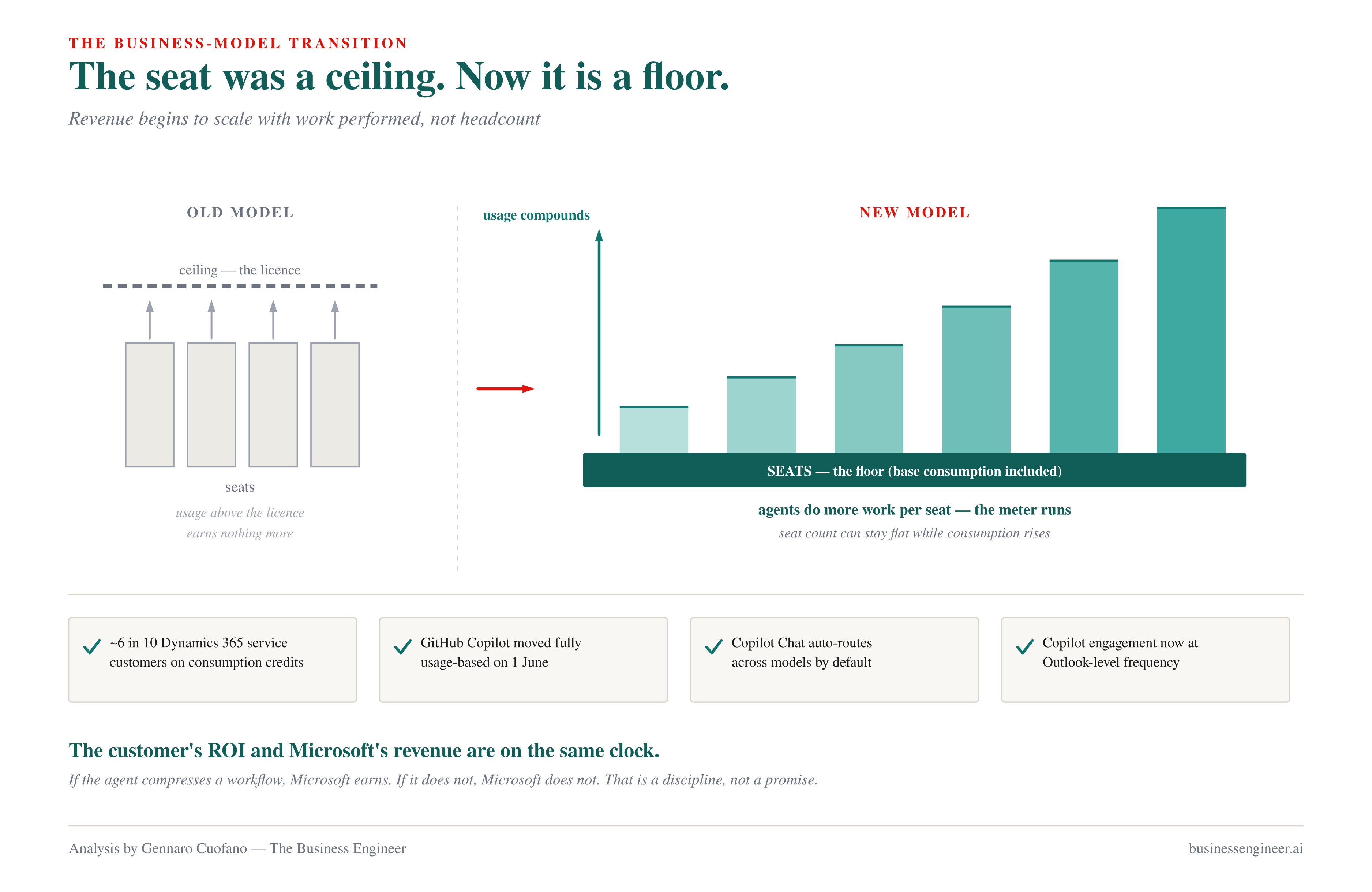
In the traditional software model, an enterprise pays for a fixed number of seats. Revenue grows when the number of employees increases, when Microsoft raises the price per seat, or when the customer purchases another product at renewal.
The seat therefore acts as a ceiling. Once the licence has been sold, additional use of the product does not necessarily create additional revenue.
In the emerging model, the seat becomes the floor.
A user licence includes a base amount of AI consumption, such as tokens, agent executions, evaluations, or automated workflows. When usage exceeds the included allowance, the customer pays according to consumption. Large customers can commit to future consumption in exchange for discounts, while additional usage is billed at metered rates.
As AI agents perform more work, consumption can increase even when employee numbers remain flat.
Microsoft’s revenue begins to scale with the amount of work performed through the platform, not only with the number of people employed by the customer.
This is already visible across the portfolio.
Roughly six in ten Dynamics 365 service customers are using consumption-based credits rather than traditional seats.
GitHub Copilot moved to a fully usage-based pricing model on June 1.
Microsoft 365 Copilot Chat now automatically routes requests between different models according to complexity, cost, and performance.
The seat remains the access point, while the model usage becomes the meter.
This creates two important consequences.
First, bookings may become a less reliable indicator of future revenue. Traditional seat commitments appear clearly in bookings, but usage revenue arrives as customers consume the service. Analysts relying on a simple bookings-to-revenue relationship may therefore underestimate the growth generated by the meter.
Second, the model only works if customers receive measurable value. Usage-based pricing puts Microsoft’s revenue on the same clock as the customer’s return on investment.
As Nadella has explained, the economics work when agents either lower a customer’s cost per task or increase the revenue produced by that task. If Copilot compresses a workflow, improves productivity, or enables more output, Microsoft earns more. If it fails to deliver value, usage does not expand.
That introduces discipline into the model. It also ties Microsoft’s revenue directly to whether AI adoption creates real business outcomes.
The evidence so far is not limited to seat growth. Usage per seat is also increasing. Copilot queries per user rose by close to one-fifth quarter over quarter. Weekly Copilot engagement has reached levels comparable to Outlook, which is an important threshold for habitual workplace use. Monthly active usage of Microsoft’s first-party agents has multiplied during the year.
When a product reaches the engagement frequency of Outlook, it is no longer merely an optional feature.
It is becoming part of the infrastructure through which work gets done.
The model can therefore be compressed into one line:
Microsoft is turning the world’s largest software subscription base into a metered agent economy. Seats provide the foundation. Usage provides the compounding layer.
Microsoft kept the character of its financing, but the discipline is partly restraint