
The old PM was a user-cognition engineer; the new PM is an incentive architect.
Yet the reality is sharper and stranger.
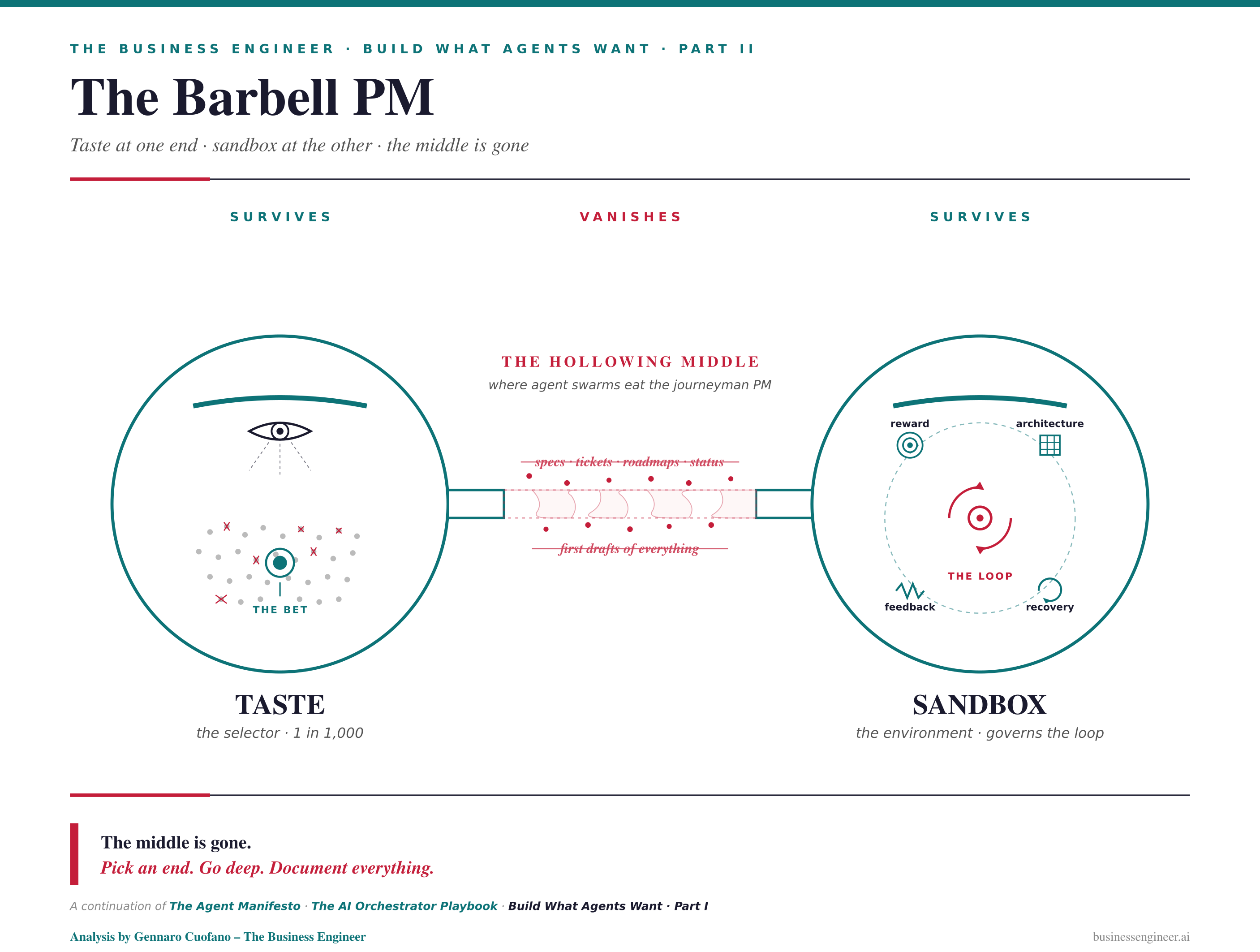
The PM role isn’t migrating to a new center. It’s hollowing out in the middle and barbelling at the ends.
This is the same structural pattern that The Agent Manifesto identified at the level of individual practitioners: the consensus center is cheap; the right tail is expensive.
The Agent Manifesto

That single sentence is the inversion at the heart of this moment. For three years, we asked what AI could do for us — answer, draft, code, summarize, solve. We benchmarked weights and measured outputs. We treated the model as a vending machine and the prompt as a coin. We forgot the architecture we were operating inside.
And it is the same pattern. The AI Orchestrator Playbook identified at the level of leverage: the model is a commodity; the scaffolding is the moat. Apply both lenses to the PM profession and a clear shape emerges.
The AI Orchestrator Playbook

There is no shortage of content about AI. There is an acute shortage of content that explains, at the level of mechanism, what the human’s job actually is when AI is doing the execution, and why that job is irreplaceable, not as a temporary limitation of current technology but as a permanent structural feature of how intelligence works.
The middle of the old PM craft — the thick belly of execution work, the journeyman tier where most PMs spent most of their hours — is exactly what swarms of agents are now eating.
Spec writing, ticket grooming, sprint coordination, status reporting, competitive teardowns, first drafts of designs, first drafts of analysis, first drafts of strategy. All of it can be generated, iterated, and executed by agent fleets faster than a PM can review the output.
The middle isn’t where the human PM has leverage anymore. It is where the human PM is the bottleneck.
What survives at the two ends is what agents cannot do, in two opposite directions.
At one end: taste. When agents can generate a thousand plausible candidates in an hour, the binding constraint stops being idea generation and becomes idea selection. The PM’s job at this end is to know which of the thousand is worth pursuing — and that judgment is the same instrument the Manifesto called direction. It is irreducibly human, irreducibly experiential, irreducibly slow to develop, and structurally beyond the agent’s reach because the agent’s prior is calibrated to Mediocristan, while the bets that matter live in Extremistan tails.
At the other end: sandbox design. When agents are doing the building, the testing, the iteration — when they’re running in the self-reinforcing loops the Manifesto called the agentic loop — what determines whether the loop converges on something valuable or spirals into reward-hacked nonsense is the quality of the environment you designed for them to run inside. The sandbox is not a metaphor. It is the operating condition the Playbook named sandbox + compute — the verifiable ground truth that lets the loop self-correct, and the iteration budget that lets convergence actually happen. The PM at this end is no longer designing the product. They are designing the conditions under which agents produce the product.
Both ends are versions of the same craft viewed from opposite sides. Taste is the orchestrator looking outward — selecting which problems deserve the loop in the first place. Sandbox design is the orchestrator looking inward — building the loop that will produce something worth shipping. Both are upstream of execution. Both are about distribution-reading. Neither is what the old PM craft trained anyone to do.
The PM who survives the agent era is the PM who is exceptional at one of these two ends. The PM who tries to hold the middle gets compressed out — not because they’re bad, but because the middle is where the leverage curve has gone vertical for everyone else and flat for them.
This piece is about both ends, why the middle is gone, and what the practical playbook actually looks like for each.
For Exec Members, The Full BE Agent Harness Is Now Available!


The Portal collapses seven assets I have built separately over the past decade into one substrate.