

OpenAI-OpenClaw Deal & the War for Personal Agents

On February 15, 2026, OpenAI confirmed the acqui-hire of Peter Steinberger, the Austrian developer behind OpenClaw, the viral open-source personal agent that hit 198,000 GitHub stars in record time.
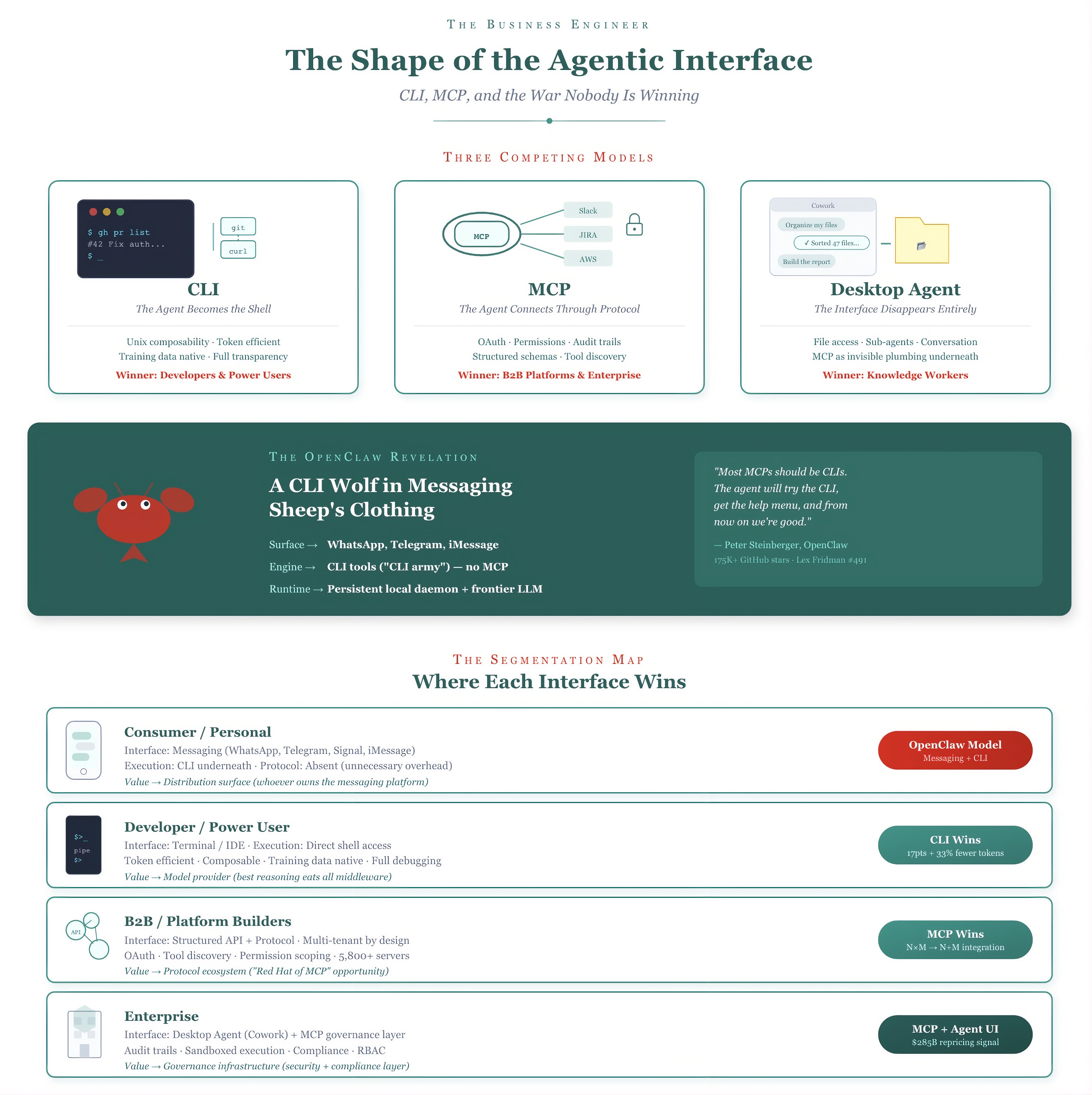
It runs as a daemon on your machine, talks to you on WhatsApp, and executes through the command line, the same interface that has been powering software for over fifty years.
Hundreds of thousands of GitHub stars later, Peter Steinberger’s OpenClaw is the most important data point in the debate over how AI agents should talk to the world.
Meanwhile, Anthropic’s Model Context Protocol, the “USB-C for AI” has crossed 97 million monthly SDK downloads, been adopted by OpenAI, Google, and Microsoft, and is now governed by the Linux Foundation.
Enterprise teams are wrapping everything from JIRA to AWS behind MCP servers. Gartner projects 75% of API gateway vendors will integrate MCP features by 2026.
And then there’s Cowork, Anthropic’s desktop agent that replaced $285 billion in SaaS market cap in a single week by doing what neither CLI nor MCP does: making the interface disappear entirely.
Three models. Three architectures. Three completely different theories about who the agent serves and how it should interact with the world.
The debate between CLI and MCP isn’t a technical argument. It’s a structural question about where value accumulates in the agentic economy, and the answer fractures sharply depending on whether you’re building for developers, platforms, or enterprises.
I sit down with you to understand what business goals you want to achieve in the coming months, then map out the use cases, and from there embed the BE Thinking OS into the memory layer of ChatGPT or Claude, for you to become what I call a Super Individual Contributor, Manager, Executive, or Solopreneur.

If you need more help in assessing whether this is for you, feel free to reply to this email and ask any questions!

You can also get it by joining our BE Thinking OS Coaching Program.