

We are entering the fourth year of the AI supercycle — measured from the ChatGPT moment in late 2022. The map has redrawn itself three times already. Each redrawing produced a different set of winners and a different set of losers.
And we are now at the point where the next redrawing is becoming visible — not because the technology is slowing down, but because the structural logic of where value concentrates is shifting underneath the models themselves.
My job as a Business Engineer is to sit at the intersection of three things: the shape of the technology, the dynamics of the business model, and the mental models that help us understand what comes next.
Not just the tech layer. Not just the financial layer.
All three simultaneously, with the geopolitical layer sitting above them as the primary context that most tech analysis continues to underweight.
So let’s build the full map.

The Updated Map of AI

As we reach mid-March 2026, the AI landscape has become more structurally legible than at any prior point. The model race is secondary. Five races are running simultaneously: infrastructure, distribution, agentic stack, enterprise capture, and governance
The 7-Layer Stack
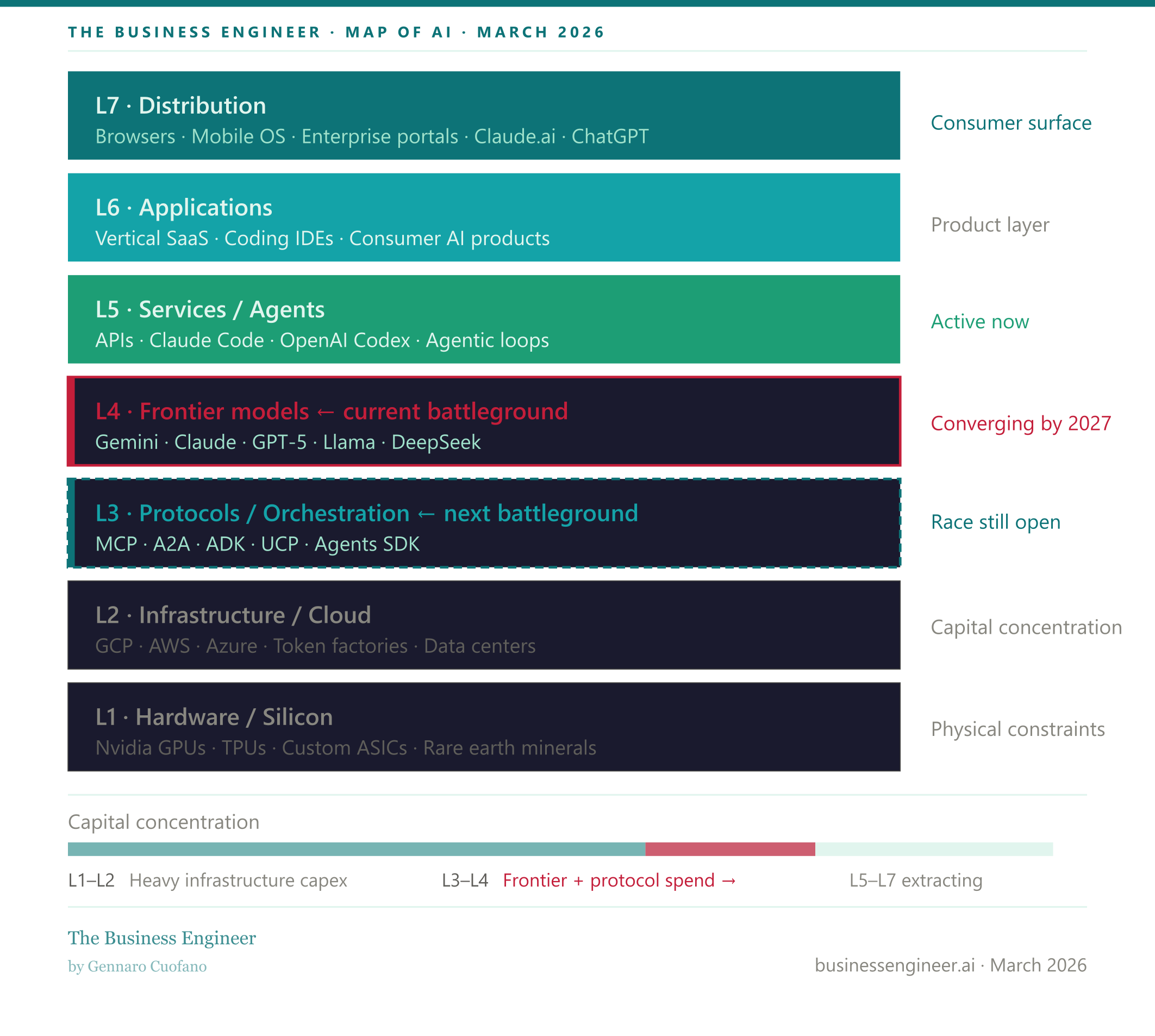
The Map of AI spans seven dimensions. Not because seven is a magic number, but because the AI landscape has seven structurally distinct layers where different competitive dynamics operate, different capital concentrates, and different moats are being built.
From the bottom up: hardware and silicon, infrastructure and cloud, platforms and protocols, frontier models, services and agents, applications, and distribution.
The hardware layer is where the physical constraints live — Nvidia GPUs, custom TPUs, ASICs, and the rare earth minerals that go into all of it. China’s leverage at this layer is real and underappreciated. The infrastructure layer is the cloud — GCP, AWS, Azure — now being reframed as what Jensen Huang called “token factories” at GTC 2026. Not compute-as-cost-center. Compute-as-production-facility, measured in tokens per watt and throughput per dollar.
The platform and protocol layer is currently unsettled. This is the layer that determines how agents communicate with each other, which tools they can invoke, and how orchestration works across systems. It is the new battleground, and I will come back to it at length.
The frontier model layer is where most of the public narrative lives — Gemini, Claude, GPT-5, Llama, DeepSeek. This is still a battleground, but it is one with a known timeline: by 2027, the top three players will be close enough in capability that model quality alone will not be a decisive competitive advantage.
The services and agents layer is where the current wave of value creation is happening — APIs, Claude Code, OpenAI Codex, agentic loops running across tools and systems. The applications layer is the product surface — Claude.ai, ChatGPT, Gemini, vertical SaaS built on top of the model providers. And the distribution layer is where the incumbents hold their structural advantage: Google Search and Android, Apple iOS, Microsoft’s enterprise productivity suite, the browsers and operating systems through which AI reaches humans and, increasingly, other agents.
In 2026, capital is concentrated in the bottom four layers. Billions flowing into silicon, data centers, and frontier model companies — OpenAI at over $800 billion post-money valuation, Anthropic at $380 billion, neither of them profitable. The capital structure is barbellled: a massive concentration in infrastructure and a small number of frontier players, with the middle squeezed.

The weekly newsletter is in the spirit of what it means to be a Business Engineer:

We always want to ask three core questions:
What’s the shape of the underlying technology that connects the value prop to its product?
What’s the shape of the underlying business that connects the value prop to its distribution?
How does the business survive in the short term while adhering to its long-term vision through transitional business modeling and market dynamics?
These non-linear analyses aim to isolate the short-term buzz and noise, identify the signal, and ensure that the short-term and the long-term can be reconciled.