
This research hub, the Business Engineer, has been focusing for over a decade on dissecting the intricacies of tech business world. Yet by the early 2020s, it was clear to me that the global system's contradictions were becoming impossible to ignore.
The preceding decades of hyperglobalisation had allowed companies to organise production, capital and knowledge across borders at extraordinary scale. Much of that integration developed within a US-led international order, supported by institutions and political commitments that businesses increasingly treated as permanent features of the landscape. A particular arrangement of power had come to look like the natural order of things.
The pandemic exposed how conditional those arrangements were. Supply disruptions revealed the vulnerabilities of concentrated production networks. The scramble for vaccines showed how quickly domestic priorities and export restrictions could constrain international supply. Companies began reconsidering resilience and security alongside efficiency. Globalisation continued, but its geography, dependencies and political conditions were changing.
What struck me at the time was how much of the technology industry remained attached to the idea of a flat world: one in which economic incentives would eventually pull everyone in the same direction, commercial integration would soften strategic rivalry, and political power could be left in the background.
That assumption has become increasingly difficult to sustain.
For me, this is central to understanding the AI supercycle. Technology is being pulled deeper into geopolitical competition, while its development changes the capabilities, dependencies and economic interests that governments are competing over. The influence runs in both directions.
Huang and the idea of America as a platform
The events surrounding Jensen Huang bring that tension into focus.
Huang represented a particular vision of American power: the United States as the technological platform on which much of the world would build, including China.
He made that argument explicitly in Nvidia’s May 2025 earnings call:
“The question is whether one of the world’s largest AI markets will run on American platforms.”
His concern was that excluding American technology from China would accelerate the development of competing Chinese ecosystems. Keeping developers and businesses attached to American infrastructure, in his account, was itself a source of strategic advantage.
That deserves to be understood as a geopolitical argument in its own right. Huang’s commercial interests and his view of American influence pointed in the same direction: make the platform sufficiently useful, widespread and difficult to replace that the rest of the world continues to build on it.
The competing view places greater weight on restricting a rival’s capabilities. From that perspective, selling the infrastructure can strengthen an adversary even when American companies capture the revenue.
The tension is between two ways of preserving American power: extending the reach of its platforms and restricting access to its most consequential technologies.
This Week In The AI Supercycle: The Great Convergence of Capital, Power, and Geopolitics

We’re entering another inning of one of the most extraordinary technological races ever seen.
That convergence is already visible. On 9 November, Democratic Senator Elizabeth Warren and Republican Senator Jim Banks jointly called for stronger chip controls and legislation to close routes through which China obtains advanced computing capabilities.
What may emerge is a more durable strategic baseline on China, even within a deeply divided American political system. The uncertainty is how far that convergence will go, which restrictions it will produce, and how consistently they will be applied.
For anyone working in technology, ignoring these dynamics is an increasingly reliable way to misunderstand the market. A company can have the best product, enormous demand and willing investors, while still finding that the conditions under which it can operate have changed.
That is why I created The AI Supercycle as a spin-off of The Business Engineer: to understand the interaction between technology, capital and political power, and how each changes the conditions under which the others develop.

The balance sheet behind the build
This Week In The AI Supercycle: The Great Convergence of Capital, Power, and Geopolitics
We’re entering another inning of one of the most extraordinary technological races ever seen.
This week brought another dependency into sharper focus: the financial support that allows the build to happen in the first place.
Nvidia has become a central financier of its own ecosystem. It has invested in customers, committed to purchasing cloud capacity and provided guarantees covering defined infrastructure obligations. Its disclosures include signed guarantees for parts of the lease and power payments associated with an OpenAI deployment at SB Energy’s Ohio campus. These arrangements help customers build the infrastructure that, in turn, creates demand for Nvidia’s products.
That is the sense in which Nvidia has come to resemble a private central bank for parts of the AI economy. Its balance sheet has supported expansion, absorbed certain risks and helped other companies obtain financing.
The limits of the analogy matter. These are corporate commitments, backed by finite resources and a commercial appetite for risk. Nvidia cannot create dollars or provide an unlimited guarantee to the system.
On Thursday, 12 November, Nvidia announced Huang’s departure as president, chief executive and director. Its SEC filing records the board’s acceptance of his resignation on the previous day. Colette Kress became interim CEO while retaining her position as CFO.
The board said it expected operations, customer commitments and the product roadmap to continue without interruption. Existing commitments do not disappear because the chief executive changes.
The more consequential uncertainty concerns what comes next: how readily Nvidia makes new investments, how much additional risk it accepts, and whether its next leader will have the same willingness and ability to coordinate customers, suppliers, financiers and governments.
Huang’s departure therefore raises a question that goes well beyond succession: how much of Nvidia’s role in financing the ecosystem has become institutional, and how much depended on the judgement and relationships of its founder?
Capital is still moving, with more parties carrying the risk
Alongside that leadership change, the financing base of the AI build-out was already expanding.
Anthropic’s preliminary prospectus set out its IPO price range and a concurrent $26 billion placement with suppliers, conditional on completing the offering. Nvidia itself is committed to buying $10 billion of that stock. The supplier remains part of the customer’s financing.
OpenAI was also raising additional capital: Reuters reported an initial $11 billion funding close on 6 November, before Huang’s resignation. Meanwhile, the hyperscalers’ growing use of debt markets forms part of a broader expansion in borrowing for computing infrastructure documented in the Federal Reserve’s November Financial Stability Report.
The chronology matters. These transactions were already under way when Nvidia’s leadership changed. They show that major AI companies continued to attract capital; they do not establish that the labs replaced Nvidia’s financing role within a few days.
My reading is that the build is drawing on a wider pool of capital while remaining dependent on a concentrated network of companies. The labs are selling ownership to finance future capacity. The hyperscalers are borrowing against their businesses. Suppliers are investing in customers whose spending supports their own growth.
That can give the system more ways to finance expansion. It can also spread exposure to the same underlying expectations across more balance sheets. A larger pool of investors does not automatically mean a more diversified set of risks.
This is where the geopolitical and financial stories meet. Export controls can change the markets a supplier can serve. Financing decisions can determine which customers expand and which projects reach construction. The companies coordinating the build must navigate both at once.
That is why this issue begins with what Huang built across Nvidia’s 33 years, then examines the roles the company now performs across hardware, software, customer financing and open models. It asks which commitments are already embedded in contracts, which depend on future decisions, and how different leadership approaches could change them.
From there, it follows the expanding role of the labs and capital markets in financing the next phase, and examines what that could mean for competition and the funding of open models.
The question running through the issue is who has the authority, capital and willingness to sustain the next stage of the AI build—and what they will require in return.
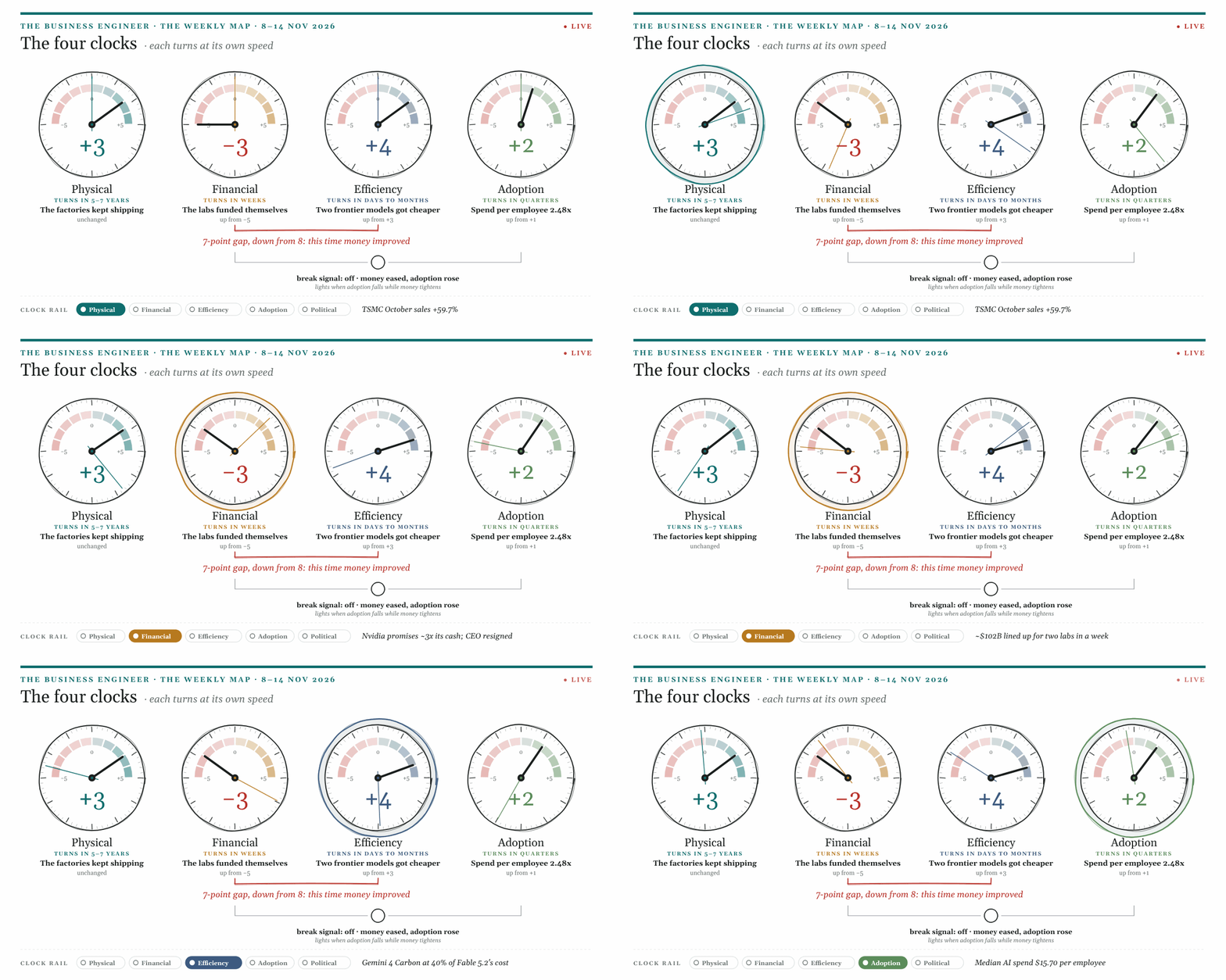
That’s why, this week in The AI Supercycle, we saw the financial clock come under further strain while, paradoxically, the physical, efficiency, and adoption clocks continued to strengthen.
Get The New Enterprise AI Embedding Series