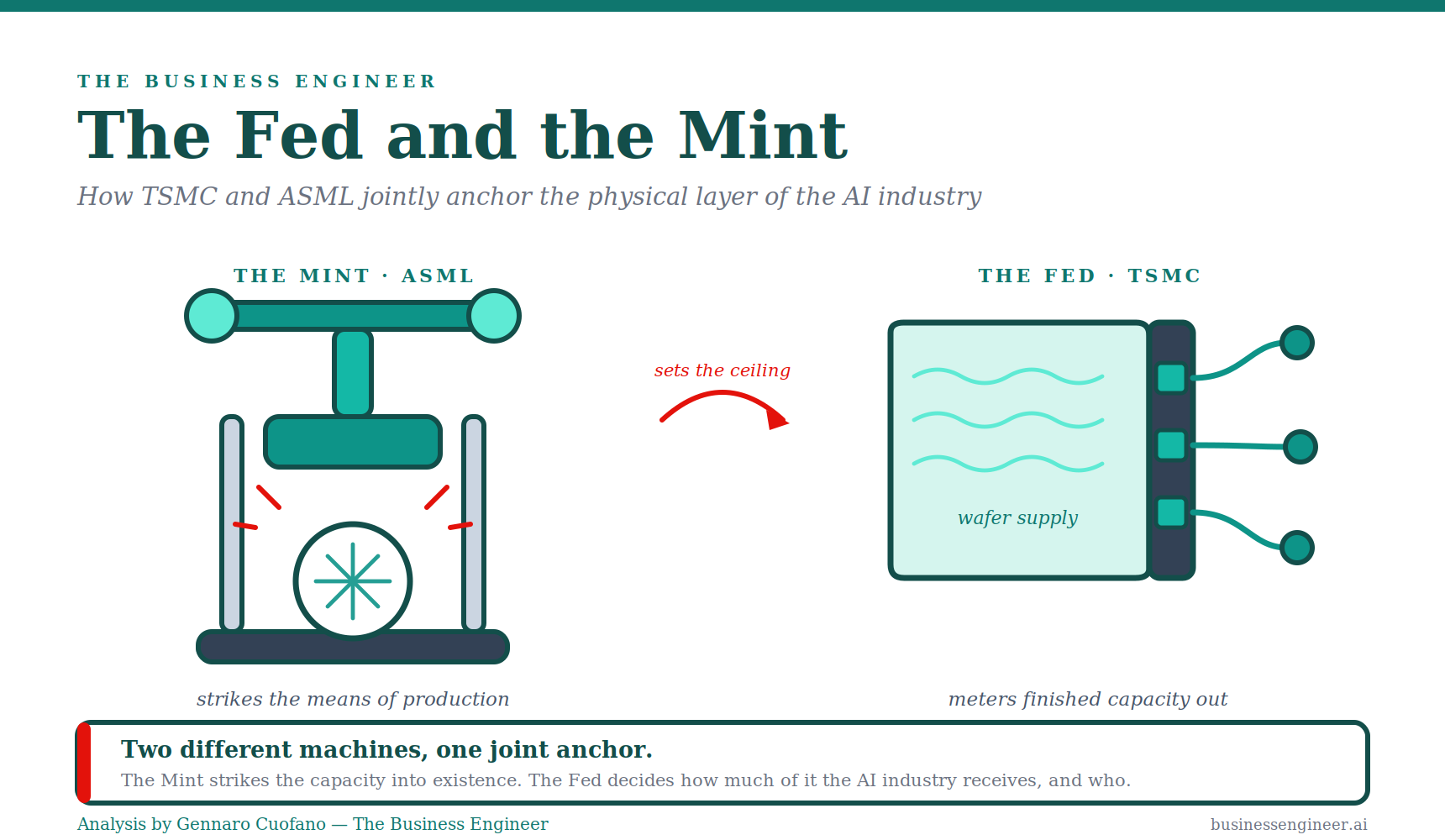

Two earnings reports. Two days apart. Two companies that, between them, decide how much AI computing the world can actually produce.
On July 15, ASML raised its full-year guidance and told the market it will expand production capacity by roughly 30% in each of the next two years. Two days later, TSMC raised its capital spending, committed another $100 billion to Arizona, and announced 13 new fabs at home.
Both companies see multi-year visibility they’ve never had before. Both are raising output mid-year. Both are committing to physical expansions that only pay off at the end of the decade.
The two companies with the most reliable read on AI demand — because they carry the highest cost of being wrong — are betting on it more aggressively than at any point in their histories.
The Foundry Is the New Federal Reserve of AI

Once every ninety days, a chairman walks up to a podium in Taipei and delivers the closest thing the AI industry has to a Federal Reserve meeting. He announces how much capital the industry will get, at what price, on what timeline, and — crucially — how it will be allocated across competing uses. He does this without ever using monetary policy vocabulary, because the vocabulary of his industry is nanometers, wafers, and yields rather than basis points and reserve requirements.
That should settle a question that’s been running loudly for six months. It doesn’t, because the AI-skepticism camp has split cleanly in two, and reading the market response to this print cycle requires knowing which camp you’re listening to.
One camp — the disingenuous one — is arguing that AI demand is fake, artificially inflated, a hyperscaler capex bubble justified by circular contracts and marketing.
This is the loudest camp on social media, and it is not what the numbers show. TSMC audits data-center construction before it commits at the foundry. ASML cross-references the whole contract chain before it commits at the equipment layer.
Both discount their customers’ forecasts and both still raised. The idea that TSMC and ASML — the two most physically exposed companies in the whole stack — are collectively hallucinating a fake demand curve is not a serious position.
The other camp — the serious one — is arguing something more interesting: that AI demand is real but the AI industry is now running on three different clocks that don’t match, and the interesting risk lives in the gaps between them. That is a much harder argument to dismiss, and the rest of this piece is really about that argument.
Something else changed in this print cycle, too, and it matters more than the numbers. The market has started to distinguish between companies that control scarce production capacity and companies that merely benefit from the AI narrative. TSMC held. NVIDIA, Micron, ARM, Marvell — all fell, some sharply. The toll booths held up better than the tourists.
That divergence is the frame for everything that follows.