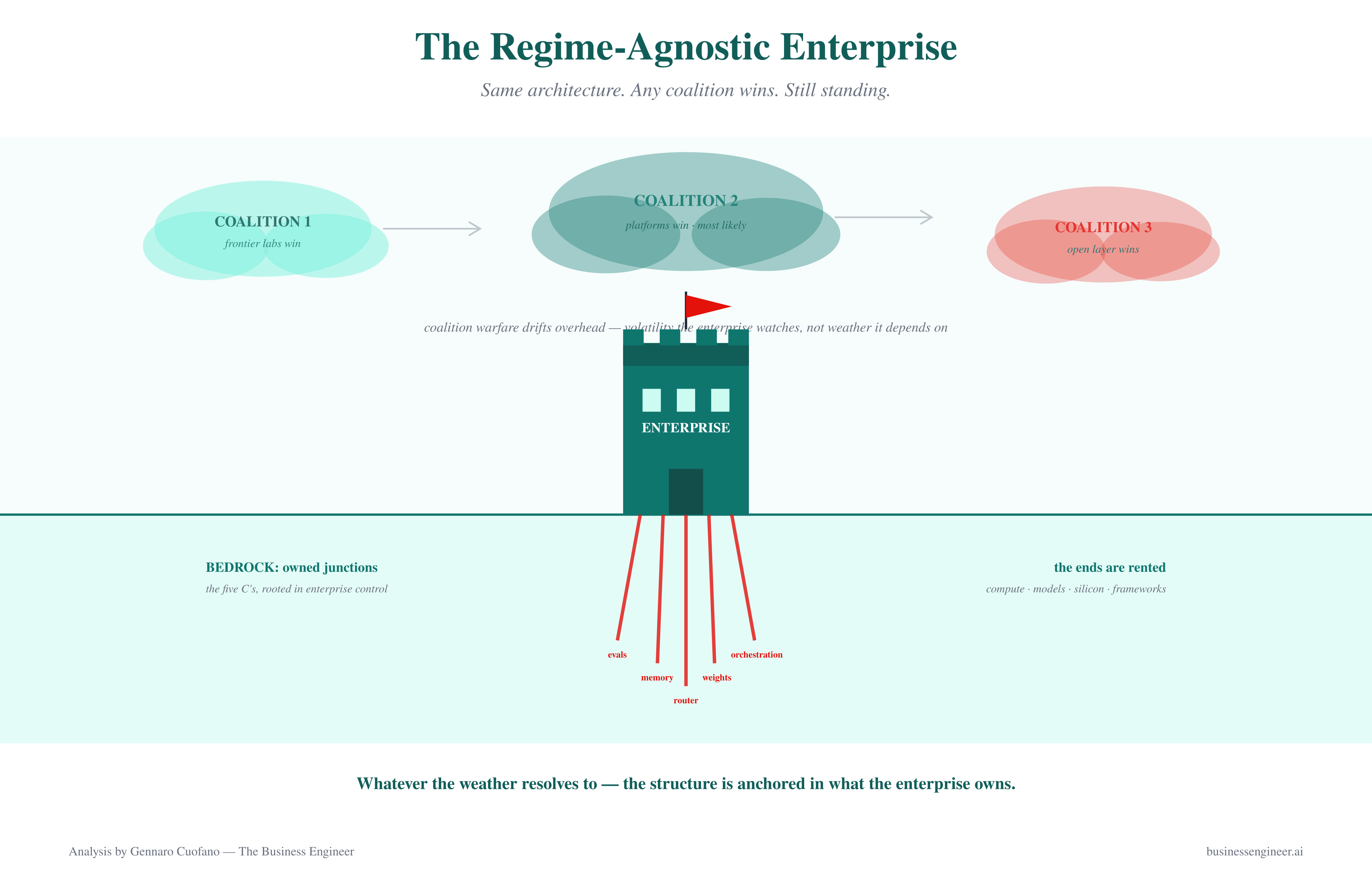

The three-coalition analysis established the strategic landscape: enterprise AI is consolidating into three structurally opposed camps, only one of which will capture the median-buyer market.
The Enterprise AI Coalitions

Yesterday, I explained and dissected to you why a coalition is forming in Enterprise AI, based on the manifesto that Microsoft’s CEO, Satya Nadella, had published.
The Five C’s Reread established the architectural principles for building an AI stack that resists lock-in to any specific vendor.
The Enterprise AI Tenant Boundary Doctrine

When the CEO of the world’s most valuable enterprise software company writes a manifesto and quotes the CEO of the industry’s most controversial data platform inside it, that is not decoration. That is a coalition forming in public.
This piece answers the operational follow-up: given that no enterprise can reliably predict which coalition wins, how does an enterprise actually build so that its leverage and its compounding surface survive whichever one does?
The core insight is that the winning-coalition question is the wrong question for a buyer to try to answer. A buyer who bets correctly on Coalition 2 winning still ends up locked into whichever Coalition 2 vendor they picked, and that lock-in eats their leverage over the 5-10 year enterprise horizon. A buyer who bets wrong — betting on Coalition 1 while Coalition 3 emerges as the dominant substrate, for example — ends up rebuilding their AI stack in year 4. Both bets have the same structural problem: the enterprise’s fate becomes coupled to a single coalition’s success, and the enterprise pays the switching cost when the coalition landscape evolves.
The right posture is different. Architect so the same underlying stack works whether Coalition 1, Coalition 2, or Coalition 3 dominates. This is what “regime-agnostic” means. Not neutral — the enterprise still buys products, still signs contracts, still adopts vendors — but structurally arranged so that the coalition warfare above the enterprise’s architectural layer does not translate into forced migrations, hostage renegotiations, or catastrophic re-platformings. Coalition warfare becomes market volatility the enterprise participates in but does not depend on.
This piece walks through what regime-agnostic architecture looks like concretely: the survival playbook for each coalition winning scenario, the portfolio approach to distributing coalition exposure, the specific components worth owning versus outsourcing, the enterprise-size gradient of pragmatic implementations, and a concrete action timeline for the next 18 months.