

The Business Engineer

The Business Engineer

This Week In AI Business: The Shape of The AI Economy [Week #47-2025]

Gennaro Cuofano's avatar
Gennaro Cuofano
Nov 23, 2025
∙ Paid

What’s the shape of the AI market? Is it a monopoly, oligopoly, or a completely fragmented market? Well, the answer will surprise you, as the shape of it will really be determined by the vertical market dynamics, and there is no single answer to it.

The Similarweb traffic data ending November 2025 reveals a fundamentally bifurcated AI ecosystem experiencing simultaneous consolidation, commoditization, and fragmentation across different value chain layers. This analysis identifies three distinct market dynamics:
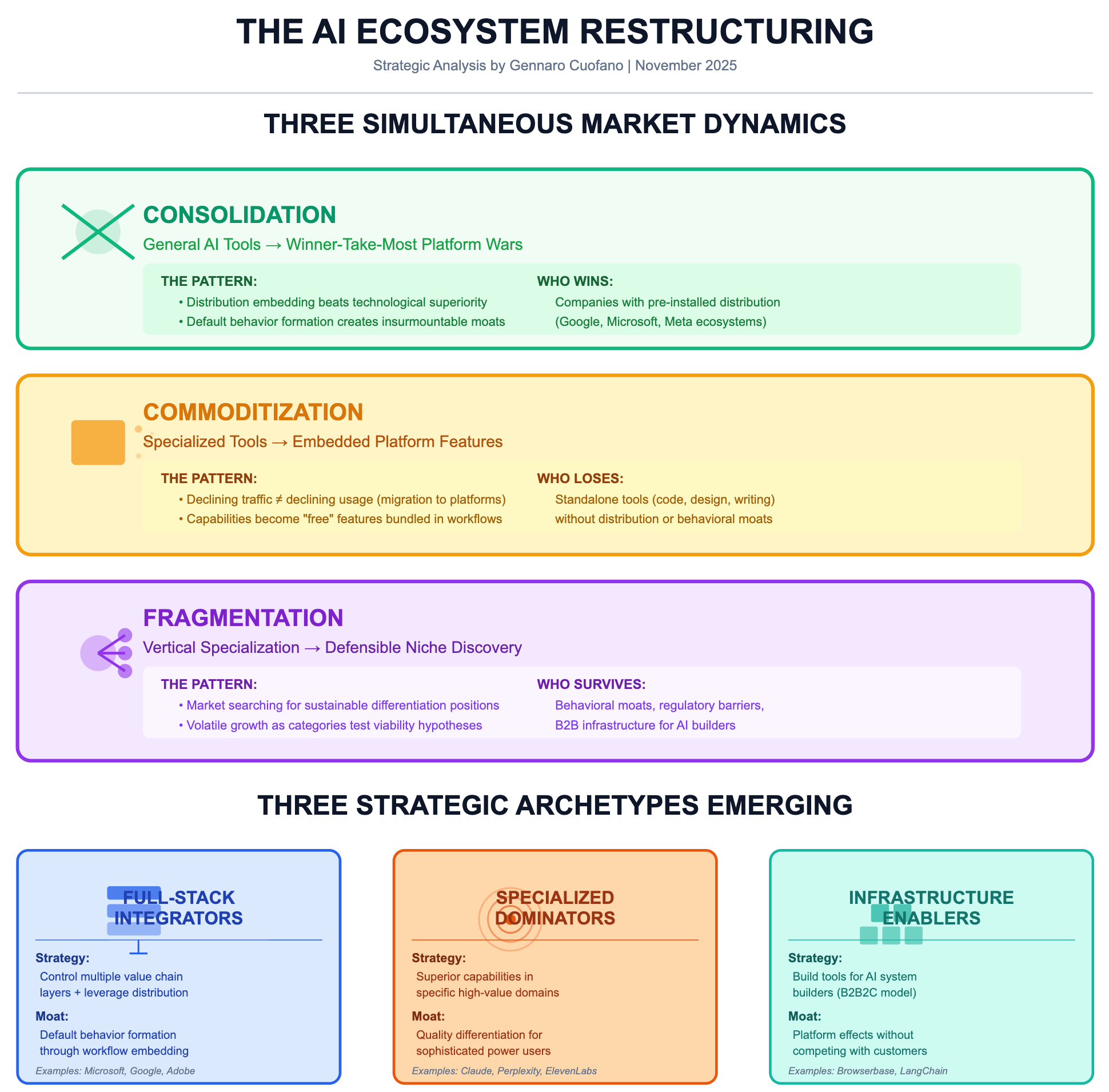
THE CONSOLIDATION LAYER (General AI Tools): Winner-take-most dynamics with 7% YoY growth dominated by infrastructure players leveraging distribution advantages.

THE COMMODITIZATION LAYER (Code/Design/Content Tools): Collapsing traffic (-16% to -8% YoY) as capabilities become embedded features rather than standalone products.

THE FRAGMENTATION LAYER (Vertical Applications): Emerging specializations showing volatile growth as the market searches for sustainable differentiation.

The critical insight: We’re witnessing the end of the “AI tool” category and the beginning of “AI-augmented everything.” Traffic patterns reveal which players are winning the platform wars, which categories are being absorbed, and where value will concentrate in the next phase.


Get The Business Engineering Thinking OS


Get The AI Bundle Now!


Read Also:

The FRED Test: Your AI Transformation Reality Check

The FRED Test: Your AI Transformation Reality Check

Gennaro Cuofano
·
September 23, 2025
Read full story
Archetypes for Successful AI Implementation In The Enterprise

Archetypes for Successful AI Implementation In The Enterprise

Gennaro Cuofano
·
September 22, 2025
Read full story
The Digital Distribution Layers

The Digital Distribution Layers

Gennaro Cuofano
·
September 16, 2025
Read full story
The Great Inversion

The Great Inversion

Gennaro Cuofano
·
September 15, 2025
Read full story
Uncovering the Real Forces Behind Decisions

Uncovering the Real Forces Behind Decisions

Gennaro Cuofano
·
September 1, 2025
Read full story
Enterprise AI Unlocked

Enterprise AI Unlocked

Gennaro Cuofano
·
August 23, 2025
Read full story

The weekly newsletter is in the spirit of what it means to be a Business Engineer:

We always want to ask three core questions:

  1. What’s the shape of the underlying technology that connects the value prop to its product?

  2. What’s the shape of the underlying business that connects the value prop to its distribution?

  3. How does the business survive in the short term while adhering to its long-term vision through transitional business modeling and market dynamics?

These non-linear analyses aim to isolate the short-term buzz and noise, identify the signal, and ensure that the short-term and the long-term can be reconciled.


What’s the shape of the AI market? Is it a monopoly, oligopoly, or a completely fragmented market? Well, the answer will surprise you, as the shape of it will really be determined by the vertical market dynamics, and there is no single answer to it.

The Similarweb traffic data ending November 2025 reveals a fundamentally bifurcated AI ecosystem experiencing simultaneous consolidation, commoditization, and fragmentation across different value chain layers. This analysis identifies three distinct market dynamics:

THE CONSOLIDATION LAYER (General AI Tools): Winner-take-most dynamics with 7% YoY growth dominated by infrastructure players leveraging distribution advantages.

THE COMMODITIZATION LAYER (Code/Design/Content Tools): Collapsing traffic (-16% to -8% YoY) as capabilities become embedded features rather than standalone products.

THE FRAGMENTATION LAYER (Vertical Applications): Emerging specializations showing volatile growth as the market searches for sustainable differentiation.

The critical insight: We’re witnessing the end of the “AI tool” category and the beginning of “AI-augmented everything.” Traffic patterns reveal which players are winning the platform wars, which categories are being absorbed, and where value will concentrate in the next phase.


Get The Business Engineering Thinking OS


Get The AI Bundle Now!


Read Also:

The FRED Test: Your AI Transformation Reality Check

The FRED Test: Your AI Transformation Reality Check

Gennaro Cuofano
·
September 23, 2025
Read full story
Archetypes for Successful AI Implementation In The Enterprise

Archetypes for Successful AI Implementation In The Enterprise

Gennaro Cuofano
·
September 22, 2025
Read full story
The Digital Distribution Layers

The Digital Distribution Layers

Gennaro Cuofano
·
September 16, 2025
Read full story
The Great Inversion

The Great Inversion

Gennaro Cuofano
·
September 15, 2025
Read full story
Uncovering the Real Forces Behind Decisions

Uncovering the Real Forces Behind Decisions

Gennaro Cuofano
·
September 1, 2025
Read full story
Enterprise AI Unlocked

Enterprise AI Unlocked

Gennaro Cuofano
·
August 23, 2025
Read full story

The weekly newsletter is in the spirit of what it means to be a Business Engineer:

We always want to ask three core questions:

  1. What’s the shape of the underlying technology that connects the value prop to its product?

  2. What’s the shape of the underlying business that connects the value prop to its distribution?

  3. How does the business survive in the short term while adhering to its long-term vision through transitional business modeling and market dynamics?

These non-linear analyses aim to isolate the short-term buzz and noise, identify the signal, and ensure that the short-term and the long-term can be reconciled.


The Consolidation Layer: General AI Tools

The Platform Wars: Traffic as Strategic Proxy

The General AI tools category (+7% 12-week YoY growth) masks a brutal winner-take-most dynamic where distribution trumps technology:

Critical Pattern: Distribution Beats Innovation

Gemini’s 71% growth represents the power of pre-installed distribution. Google’s strategy mirrors Microsoft’s Copilot playbook: embed the tool where users already work, making discovery frictionless.

OpenAI’s plateau (-2% growth) despite superior technology reveals the commoditization of capability. When GPT-4 class models become table stakes, distribution becomes the only sustainable moat.

Claude’s 49% trajectory demonstrates that quality differentiation still works — but only for sophisticated users who actively seek alternatives. This represents a premium niche, not a mass market challenge.

The Strategic Insight: Platform Integration Endgame

Traffic patterns reveal that standalone AI tools face an embedded platform future:

  1. Microsoft’s Strategy: Copilot integration across Office, Windows, Edge creates default usage patterns. Standalone tools become specialty alternatives.

  2. Google’s Countermove: Gemini embedded in Search, Gmail, Workspace. The battle is for default behavior formation, not conscious tool choice.

  3. The OpenAI Dilemma: Despite ChatGPT’s brand strength, traffic growth stalls without comparable distribution infrastructure. Microsoft partnership only partially solves this.

Traffic Translation: Gemini’s growth comes predominantly from embedded discovery (Workspace integrations), while Claude’s comes from active seeking (developer/power user adoption). These represent fundamentally different market positions.

The Commoditization Layer: Tool Categories Collapsing

Code Completion & DevOps: The Great Embedding

-16% total category decline (11/7) tells a brutal story about feature absorption:

The Strategic Reality: Features, Not Products

Why traffic is collapsing:

  1. IDE Integration Trumps Standalone: GitHub Copilot, VSCode extensions, JetBrains AI make separate coding tools redundant. Developers choose workflow continuity over superior AI.

  2. Cloud IDE Consolidation: Replit’s traffic collapse coincides with GitHub Codespaces maturity. The pattern: first-mover advantage evaporates when incumbents integrate.

  3. UI Generation Commoditized: Bolt and V0’s catastrophic declines (-36%/-95%) show that capability without distribution dies quickly in fast-moving markets.

The Exception: Base44’s anomalous +76% growth represents geographic arbitrage or temporary workflow gaps, not sustainable differentiation. Watch for similar collapse.

Design & Image Generation: From Products to Features

-8% category decline masks different commoditization patterns:

The Embedding Dynamic:

  • Adobe Firefly: Integrated into Creative Cloud, removing need for standalone tools

  • DALL-E in ChatGPT: Multi-modal consolidation makes separate image generation redundant

  • Canva’s AI: Embedded generation maintains traffic while standalone tools decline

Strategic Pattern: Traffic follows workflow integration, not capability leadership. Midjourney’s premium positioning can’t overcome Adobe’s Creative Cloud distribution.

Writing & Content: The Fastest Commoditization

-3% category decline (recovery from -14%) shows absorption into platforms:

The Consolidation Winners:

  • Originality (+44%): Detection tools remain valuable as generation commoditizes

  • SurferSEO (+11%): SEO intelligence maintains moat

  • Writer/Sudowrite (+11%/-17%): Enterprise specialization survives

The Commodity Losers:

  • Jasper (-25%): Generic content generation absorbed by ChatGPT/Claude

  • Writesonic (-18%): Mid-market squeeze between free and specialized

  • Tome (-19%): Presentation generation embedded into Canva/PowerPoint

The Strategic Lesson: General-purpose content generation has zero sustainable value. Only specialized applications (SEO, detection, compliance) maintain pricing power.

Traffic Translation: The Embedding Endgame

These collapsing categories reveal the AI value chain restructuring:

  1. Standalone Tool → Platform Feature: Capabilities become embedded, traffic migrates to integrated experiences

  2. Premium → Commodity: Technology advantages evaporate within 6-12 months

  3. B2C → B2B2C: Direct user tools lose to embedded enterprise deployments

The Critical Insight: Traffic decline doesn’t mean demand decline — it means migration of capability to platforms. Users still generate images, write content, and complete code — they just do it within existing workflows.

The Fragmentation Layer: Vertical Specialization

Character & Chat: The Niche Survivors

+7% category growth driven entirely by Character AI’s dominance reveals that behavioral niches persist:

Why Character.AI Survives (+8% growth):

  1. Emotional Use Case: Companionship/roleplay has no workflow alternative

  2. Network Effects: Character persistence creates switching costs

  3. Behavioral Moat: Users return for relationships, not capabilities

The Contrast: Replika (-26%), Chai (-46%) show that first-mover advantage evaporates without continuous differentiation. Character.AI’s growth while competitors decline demonstrates winner-take-most even in niches.

Video/Voice Generation: Infrastructure Plays

Voice Generation (-5% overall) and Video Generation (-8%) show platform infrastructure patterns:

Winners:

  • ElevenLabs (-7% but dominant): B2B infrastructure play, not consumer tool

  • Heygen (+37%): Enterprise video generation maintains growth

  • Typecast (+27%): Niche persistence through anime/character focus

Losers:

  • Play.ht (-34%): Mid-market squeeze

  • Lumalabs (-25%): Consumer video hits embedding competition

  • Captions (-40%): Social media tools absorbed by platforms

The Pattern: B2B infrastructure survives, B2C tools get absorbed. ElevenLabs succeeds as API layer; consumer voice tools die as TikTok/Instagram integrate generation.

Music Generation: The Recovery Surprise

+21% category growth (11/7) after months of decline represents creative tool persistence:

Why Music Survives:

  1. Expertise Barrier: Music creation requires specialized knowledge even with AI

  2. Copyright Clarity: Licensing concerns create moat for compliant platforms

  3. Platform Independence: Output works anywhere, no embedding pressure

The Winners:

  • Suno (+28%): Consumer-friendly interface captures growth

  • Musixmatch (+9%): Lyrics database creates persistent value

The Losers:

  • Udio (-16%): Second-mover disadvantage in quality-first market

  • Boomy (-38%): Generic generation loses to specialized tools

Strategic Insight: Categories with high expertise barriers and copyright complexity resist platformization longer than commoditized capabilities.

Automation & Browser: Infrastructure Layer Emerges

Automation Tools (-12% overall decline) and Browser Tools (+3% growth) reveal an emerging infrastructure layer:

The Automation Consolidation:

  • n8n (-15%): Open-source can’t overcome Zapier distribution

  • Zapier (-4%): Incumbent holds but doesn’t grow

  • Make (-13%): Mid-market squeeze continues

The Browser Opportunity:

  • Browserbase (+29%): Infrastructure for AI agents gains traction

  • Browser-use (-18%): Direct consumer tools struggle

The Critical Pattern: Developer infrastructure shows resilience; end-user tools face embedding. Companies building picks and shovels for AI agents maintain value while agent products themselves commoditize.

The Disrupted Sectors: Traffic as Disruption Proxy

Traditional Search: Stable Disruption (-3% YoY)

The search category’s stable 3% decline masks defensive positioning:

The Non-Event: Traditional search isn’t collapsing because Google embedded AI before disruption arrived. Perplexity’s 39% growth is impressive in isolation but represents <1% of Google’s scale.

Strategic Lesson: Incumbents with distribution can defend by embedding — they don’t need to win the AI race, just prevent AI tools from stealing queries.

EdTech: The Collapsing Middle (-6% YoY)

The EdTech bifurcation:

Catastrophic Declines:

  • Chegg (-66%): Homework help completely replaced by ChatGPT

  • CourseHero (-59%): Study resources commoditized

  • Mathway (-61%): Problem-solving absorbed by AI

Survivors:

  • Grammarly (-5%): Writing assistant remains valuable

  • Duolingo (-12%): Gamification moat persists

  • Coursera (-6%): Credential value holds

The Pattern: Transactional knowledge lookup dies; behavioral change applications (language learning, writing improvement) maintain value through habit formation moats.

Web & Shop Builders: Consolidation Inflection (0% → Rising)

The remarkable story: Category stabilizes at 0% YoY after sustained decline, but composition shifts dramatically:

The Winners:

  • Square (+19%): Payment infrastructure captures value

  • Squarespace (+16%): Premium positioning survives

  • Shopify (-19% but recovering): Platform power reasserts

The Losers:

  • Wix (-16% declining): Mid-market squeeze continues

  • Woocommerce (-20%): Open-source loses to integrated platforms

Traffic Translation: Consolidation toward payment-integrated platforms. Users choose Square/Shopify not for website building but for commerce infrastructure. Pure website builders lose to AI-augmented commerce platforms.

Stock Media & Freelance: The Slow Decline

Stock Media (-6% YoY) and Freelance Platforms (-4% YoY) show gradual displacement:

Stock Media Reality:

  • Freepik (-14%): Free stock images hit by Midjourney/DALL-E

  • Getty Images (-1%): Premium/licensed content holds

  • Shutterstock (+3%): Enterprise relationships sustain

Freelance Platform Resilience:

  • Fiverr (-2%): Marketplace effects maintain value

  • Upwork (-6%): Professional services resist automation

  • Toptal (+3%): Premium talent marketplace grows

The Insight: Marketplace network effects create resilience. AI displaces individual freelancers but platforms maintain value by aggregating human specialists for complex work AI can’t yet handle.

Strategic Implications: The Value Migration

Where Value Concentrates: The Three Layers

Traffic patterns reveal value chain restructuring into three distinct layers:

Layer 1: Platform Infrastructure (Expanding Value)

Winners capturing traffic AND pricing power:

  1. Cloud Infrastructure: AWS, Azure, GCP grow as AI compute demand explodes

  2. Model APIs: OpenAI, Anthropic, Google capture model-layer value

  3. Developer Tools: Cursor, Replit declining because GitHub/Microsoft absorb

  4. Agent Infrastructure: Browserbase, LangChain capture orchestration value

The Pattern: Infrastructure for building AI systems holds value; infrastructure for using AI gets embedded.

Layer 2: Workflow Integration (Consolidating Value)

Winners maintaining traffic through distribution:

  1. Microsoft/Google Workspaces: Copilot/Gemini integration captures default usage

  2. Adobe Creative Suite: Firefly integration maintains dominance

  3. Design Platforms: Canva/Figma survive through workflow lock-in

  4. Communication Tools: Slack, Notion add AI without losing users

The Pattern: Workflow continuity trumps capability superiority. Users choose “good enough AI in my existing tools” over “better AI elsewhere.”

Layer 3: Specialized Applications (Fragmenting Value)

Winners through behavioral moats:

  1. Habit Formation: Duolingo, Grammarly maintain value through persistent behavior

  2. Emotional Connection: Character.AI survives through relationship building

  3. Compliance/Safety: Originality, Copyleaks gain value as detection matters more

  4. Creative Expertise: Suno, Runway maintain value in high-expertise creation

The Pattern: Behavioral switching costs create defensibility where technical capabilities cannot.

The Commoditization Timeline

Traffic decline rates reveal commoditization velocity by category:

Strategic Insight: First-mover advantage duration shrinking. Code tools commoditized in 6 months; image generation took 12. Each successive category commoditizes faster as embedding patterns accelerate.

The Traffic-to-Value Disconnect

Critical observation: Declining traffic ≠ declining usage. Traffic migrates from standalone tools to embedded features, but aggregate usage grows.

Example:

  • Writing tool traffic: -14% (6 months ago) → -3% (now)

  • Total AI-generated content: +200% (estimate)

  • Meaning: Content generation explodes, but happens in ChatGPT/Notion/Google Docs, not Jasper/Copy.ai

The Investor Implication: Traffic metrics increasingly misleading for measuring AI impact. Must track API usage, embedded feature adoption, workflow integration metrics.

The Consolidation Endgame: Strategic Archetypes

Archetype 1: Full-Stack Integrators (Distribution Winners)

Definition: Companies controlling multiple value chain layers who leverage distribution to embed capabilities

Traffic Evidence:

  • Gemini: +71% growth from Workspace/Search integration

  • Microsoft Copilot: +12% growth from Windows/Office embedding

  • Meta AI: +73% spike from WhatsApp/Instagram integration

Strategic Advantages:

  1. Default Discovery: Users encounter AI in existing workflows, zero activation friction

  2. Data Synergies: Integration across services creates personalization moats

  3. Bundling Power: AI becomes free feature, destroying standalone pricing

Vulnerability: Antitrust exposure and organizational complexity limit agility. Full-stack players excel at distribution but struggle with cutting-edge innovation.

Archetype 2: Specialized Dominators (Quality Differentiation)

Definition: Companies winning through superior capabilities in specific domains

Traffic Evidence:

  • Claude: +49% growth from developer/enterprise quality preference

  • Perplexity: +39% growth from search-native architecture

  • ElevenLabs: -7% but dominant in voice infrastructure

Strategic Advantages:

  1. Quality Premium: Sophisticated users pay for superior capabilities

  2. Niche Depth: Specialization creates expertise moats

  3. B2B Pricing Power: Enterprise customers value reliability over cost

Vulnerability: Commoditization pressure as larger players match capabilities. Must constantly innovate to maintain quality gap.

Archetype 3: Infrastructure Enablers (B2B2C Winners)

Definition: Companies providing tools/APIs for others to build AI products

Traffic Evidence:

  • Browserbase: +29% growth as agent infrastructure

  • Huggingface: -18% but maintains model hub dominance

  • LangChain: Traffic not measured but powers most AI applications

Strategic Advantages:

  1. Platform Effects: More developers → more tools → more developers

  2. Technology Agnostic: Enable all models, avoid competitive threats

  3. Enterprise Relationships: Infrastructure contracts more stable than consumer

Vulnerability: Consolidation risk if OpenAI/Google/Microsoft vertically integrate. Must maintain technology independence to avoid conflict.

Future State Predictions: The 2026 Landscape

Prediction 1: The Three-Player Consumer AI Oligopoly

Traffic trends project:

2026 General AI Market Share (by traffic):

  • Google Gemini: 35-40% (Workspace/Search embedding)

  • Microsoft Copilot: 30-35% (Windows/Office embedding)

  • OpenAI ChatGPT: 20-25% (Premium standalone)

  • All Others: <10% (Claude, Perplexity, regional alternatives)

Reasoning: Distribution advantages compound as habit formation creates switching costs. ChatGPT maintains premium position but can’t overcome Microsoft/Google integration.

Wild Card: Apple Intelligence. If Apple executes well, Siri could capture 15-20% through iOS integration, fragmenting the oligopoly.

Prediction 2: Complete Standalone Tool Collapse

Categories reaching <5% of peak traffic by end 2026:

  1. Code Completion: Cursor, Replit, Tabnine absorbed into IDEs

  2. Generic Content Writing: Jasper, Copy.ai, Writesonic eliminated

  3. Consumer Image Generation: Midjourney, Leonardo become niche tools

  4. Consumer Video Generation: Runway, Lumalabs lose to TikTok/Instagram integration

Survivors: Only B2B infrastructure, regulated applications, and behavioral moats maintain standalone existence.

Prediction 3: The B2B Infrastructure Layer Expands

Winners in 2026:

  1. Agent Orchestration: Companies building “operating systems for AI agents”

  2. Model Routing: Intelligent switching between models for cost/quality optimization

  3. Governance/Compliance: Tools managing AI usage in regulated enterprises

  4. Fine-tuning Platforms: Enabling companies to customize foundation models

Evidence: Browserbase’s +29% growth represents infrastructure for the next layer — tools that enable AI systems to take actions, not just generate content.

Prediction 4: The Search Disruption Finally Arrives

Current State: Google losing only 2% traffic despite Perplexity/ChatGPT search

2026 Inflection: Traffic shifts accelerate as:

  1. AI-native behavior becomes default for younger users

  2. Agent-mediated search removes need for browsing multiple results

  3. Google’s embedding strategy cannibalizes its own ad revenue

Predicted Impact: Google search traffic down 10-15% YoY in 2026, first sustained decline. Not from competitor disruption but from Google’s own AI features reducing ad exposure.

Prediction 5: The Rise of “AI-Augmented Incumbents”

The Surprise Winners: Traditional software companies successfully integrating AI

Traffic Evidence:

  • Adobe: Creative Cloud maintains traffic while embedding Firefly

  • Canva: +29% growth (11/7) by adding AI to design platform

  • Notion: Maintains productivity platform while adding AI

  • Figma: Steady traffic despite coding tool chaos

The Pattern: Incumbents with workflow lock-in outperform AI-first startups. Users prefer “my tool with AI” over “better AI without my workflow.”

2026 Landscape: Most valuable AI companies will be transformed incumbents, not AI-native startups. Adobe, Microsoft, Google, Salesforce capture majority of AI-derived value.

Strategic Recommendations by Company Type

For AI-Native Startups: Narrow or Die

The Harsh Reality: Standalone AI tools face embedded platform competition. Success requires extreme specialization.

Viable Strategies:

  1. Infrastructure Play: Build tools for AI developers, not AI tools for users

    • Example: Browserbase (agent infrastructure)

    • Moat: Technical depth, platform effects

    • Exit: Acquisition by cloud provider or IPO at scale

  2. Regulated Application: Target industries with compliance requirements

    • Example: Healthcare diagnostic AI, financial risk assessment

    • Moat: Regulatory approval, specialized data

    • Exit: Enterprise acquisition or domain consolidation

  3. Behavioral Moat: Create habit-forming applications with emotional connection

    • Example: Character.AI (companion relationships)

    • Moat: Switching costs from relationship formation

    • Exit: Gaming/entertainment company acquisition

Avoid: Generic productivity, content creation, image generation. These categories are definitively lost to platform embedding.

For Incumbents: Embed or Be Embedded

The Distribution Advantage: Existing user bases create default AI adoption paths.

Winning Strategies:

  1. Workflow Integration: Embed AI where users already work

    • Adobe’s approach: Firefly in Creative Cloud

    • Don’t build standalone AI tool; augment existing products

    • Metric: Feature adoption rate, not traffic growth

  2. Bundle Aggressively: Make AI “free” feature to destroy standalone competition

    • Microsoft’s approach: Copilot included in Microsoft 365

    • Accelerates competitor revenue collapse

    • Risk: Cannibalization of own premium products

  3. Vertical Integration: Control model → application stack

    • Google’s approach: Gemini → Workspace → Ads

    • Prevents platform fee extraction

    • Requires massive capital investment

Risk: Organizational sclerosis. Large companies struggle with AI innovation velocity. Mitigation: Acquire specialists rather than build internally.

For Investors: Infrastructure Over Applications

Traffic data reveals investment thesis:

High Conviction (Growing despite commoditization):

  1. Cloud Infrastructure: AWS, Azure, GCP capture AI compute demand

  2. Chip Design: NVIDIA, AMD, custom silicon benefit from training costs

  3. Model API Layer: OpenAI, Anthropic, open-source infrastructure

  4. Developer Tools: Infrastructure for building AI systems

Medium Conviction (Consolidating winners):

  1. Workflow Platforms: Notion, Figma, Adobe with successful AI integration

  2. Vertical SaaS: Industry-specific AI applications with moats

  3. Agent Orchestration: LangChain, Browserbase, emerging coordination layer

Low Conviction (Facing embedding pressure):

  1. Generic AI Tools: Writing, image, video generation without distribution

  2. AI Wrappers: Thin layers over foundation models

  3. Consumer AI: Unless behavioral moat (Character.AI) or distribution (Gemini)

Tactical Observation: Short standalone AI tools with growing competitors in their categories. Traffic decline precedes revenue collapse by 2-3 quarters.

The Measurement Challenge: Beyond Traffic

Why Traffic Data Increasingly Misleading

The Core Problem: As AI embeds into platforms, usage grows while traffic declines.

Example Distortions:

  1. Microsoft Copilot: Most usage happens in Excel/Word, not copilot.microsoft.com

    • Traffic metric: +12% growth

    • Actual usage: Likely +200%+ through Office integration

    • Gap: 90%+ of usage invisible in web traffic data

  2. Google Gemini: Search integration usage uncounted in gemini.google.com traffic

    • Traffic metric: +71% growth

    • Actual usage: Every Google search with AI Overview = Gemini usage

    • Gap: Billions of uses per day invisible

  3. OpenAI ChatGPT: API usage dominates revenue but not traffic

    • Traffic metric: -2% growth (website)

    • API usage: Likely +100%+ growth (unreported)

    • Gap: Revenue increasingly disconnected from traffic

Alternative Metrics for AI Market Analysis

What to track instead of (or alongside) traffic:

  1. API Call Volume:

    • More reliable for actual usage

    • Correlates with revenue for model providers

    • Limited public availability (quarterly earnings only)

  2. Embedding Adoption Rates:

    • Percentage of Office 365 users with Copilot enabled

    • Workspace adoption of Gemini features

    • Creative Cloud Firefly usage rates

    • Requires company disclosure or surveys

  3. Developer Integration Metrics:

    • npm package downloads for AI libraries

    • GitHub Copilot active users

    • LangChain/LlamaIndex integration counts

    • Proxy for B2B infrastructure health

  4. Compute Utilization:

    • Cloud provider AI/ML service revenue growth

    • NVIDIA datacenter revenue (indirect proxy)

    • GPU cluster capacity expansion

    • Indicates aggregate AI demand

  5. Job Market Signals:

    • AI Engineer job postings

    • Skills requirements in software engineering roles

    • Freelancer displacement in content/design categories

    • Leading indicator of market maturity

Strategic Implication: Traffic data is still valuable for early-stage tools but increasingly inadequate for the mature AI market. Investors and strategists must triangulate multiple data sources.

Conclusion: The AI Ecosystem Restructuring

The Three Simultaneous Transformations

The November 2025 traffic data reveals an AI ecosystem undergoing three simultaneous restructurings:

1. Consolidation at the Platform Layer

  • General AI tools converge toward distribution-driven oligopoly

  • Gemini, Copilot, ChatGPT capture 85%+ of consumer AI usage

  • Standalone tools relegated to professional/specialized niches

  • Winner-take-most dynamics driven by embedding and habit formation

2. Commoditization of Capability Layers

  • Code completion, image generation, content writing collapse as standalone categories

  • Traffic migrates from specialized tools to embedded platform features

  • Technology differentiation loses to workflow integration

  • Standalone tool revenue models systematically destroyed

3. Fragmentation of Application Layer

  • Vertical specializations emerge in regulated, behavioral, and expertise-intensive domains

  • B2B infrastructure layer develops to enable AI system builders

  • Niche defensibility through compliance, habit formation, or technical depth

  • Long tail of specialized applications resists platformization

The Strategic Meta-Pattern: Distribution Destiny

The Overarching Lesson: In AI, capability parity arrived faster than expected. When all models can generate images, write content, and complete code, distribution becomes the only sustainable moat.

The Three Distribution Strategies:

  1. Own the Workflow (Adobe, Microsoft, Google):

    • Embed AI where users already work

    • Make switching cost prohibitive

    • Destroy standalone tool pricing power

  2. Own the Relationship (Character.AI, Grammarly):

    • Create behavioral switching costs through habit/emotion

    • Persist despite superior alternatives

    • Monetize loyalty, not capabilities

  3. Own the Infrastructure (Browserbase, LangChain):

    • Enable others to build AI systems

    • Avoid competing with customers

    • Capture orchestration value

Losing Strategy: Pure capability differentiation. Every category leader relying solely on superior AI quality faces traffic decline as incumbents match functionality.

The Value Migration Pattern

Where value concentrates in 2026+:

Layer 1: Foundation Infrastructure ($100B+ TAM)

  • Cloud providers (AWS, Azure, GCP)

  • Chip manufacturers (NVIDIA, AMD)

  • Foundation model APIs (OpenAI, Anthropic, open-source)

Layer 2: Embedded Platforms ($500B+ TAM)

  • Productivity suites (Microsoft 365, Google Workspace)

  • Creative tools (Adobe, Canva, Figma)

  • Development environments (GitHub, VSCode, JetBrains)

  • Enterprise SaaS (Salesforce, ServiceNow, SAP)

Layer 3: Specialized Applications ($200B+ TAM)

  • Regulated industries (healthcare, finance, legal)

  • Agent infrastructure (orchestration, safety, governance)

  • Behavioral moats (education, habits, relationships)

Value destruction: Standalone AI tool category ($50B peak → $5B by 2027). Generic productivity, content, and creative tools absorbed into platforms.

The Geographic Dimension: Global Market Fragmentation

Traffic data reveals regional differences that impact global AI strategy:

U.S. Market: Platform consolidation most advanced

  • Microsoft/Google dominance in enterprise

  • OpenAI maintains consumer brand

  • Regulatory risk: Antitrust scrutiny emerging

China Market: Separate ecosystem developing

  • Baidu, Alibaba, Tencent compete in walled gardens

  • ByteDance (Doubao) emerging as dark horse

  • Western tools (ChatGPT, Claude) blocked; creates persistent parallel market

Europe Market: Regulatory arbitrage opportunities

  • GDPR compliance creates moat for European AI

  • Mistral, Aleph Alpha position as “sovereign AI”

  • Privacy-first positioning differentiates from U.S. platforms

Emerging Markets: Leapfrog potential

  • Mobile-first usage patterns favor lightweight models

  • Language diversity creates local specialization opportunities

  • Infrastructure gaps enable alternative platform emergence

Strategic Implication: No global AI winner. Market fragments along regulatory, infrastructure, and language boundaries. Successful companies need regional strategies, not global dominance plays.

The Timeline Acceleration

Critical observation: Commoditization cycles accelerating with each generation:

  • GPT-3 era (2020-2022): 18-24 month advantage period for capability leaders

  • GPT-4 era (2023-2024): 9-12 month advantage before parity

  • GPT-4+ era (2025+): 3-6 month advantage before embedding/commoditization

Implication for Startups: First-mover advantage duration collapsing. By the time a specialized AI tool reaches product-market fit, incumbents have embedded equivalent capabilities.

Implication for Investors: Due diligence timelines compressed. Companies that looked defensible 6 months ago face existential platform competition today. Must evaluate distribution moats over capability moats.

The Final Insight: AI as Feature, Not Product

The fundamental restructuring: AI transforms from product category to feature set embedded across all software.

Historical Parallel: Cloud computing trajectory

  • 2006-2010: Standalone cloud companies (Salesforce, Workday)

  • 2010-2015: Cloud infrastructure layer (AWS, Azure)

  • 2015-2020: Every software company becomes “cloud”

  • 2020+: “Cloud” stops being differentiator, becomes baseline

AI following same path:

  • 2023-2024: Standalone AI companies (ChatGPT, Midjourney)

  • 2024-2025: AI infrastructure layer (OpenAI API, Anthropic)

  • 2025-2026: Every software company adds AI

  • 2026+: “AI” stops being differentiator, becomes baseline expectation

Traffic data evidence: Declining standalone tool traffic while aggregate AI usage explodes. Users don’t want “AI tools” — they want their existing tools augmented with AI.

Appendix: Methodology and Data Considerations

Data Source and Limitations

Source: Similarweb traffic data ending November 7, 2025

Measurement Methodology:

  • 2-week period aggregations comparing 12-week YoY changes

  • Domain-level traffic (does not capture API usage or integrations)

  • Primarily web traffic (limited mobile app visibility)

Key Limitations:

  1. Embedded Usage Invisible: Microsoft Copilot in Excel, Google Gemini in Search not captured

  2. API Usage Missing: OpenAI’s majority usage through API not reflected

  3. Geographic Bias: Traffic patterns reflect primarily North American/European usage

  4. Mobile Undercount: iOS/Android app usage partially invisible

  5. Enterprise Invisible: Behind-firewall enterprise deployments not measured

Implications: Traffic data best for early-stage consumer tools and relative trend analysis. Absolute numbers increasingly misleading for mature platforms with multi-surface distribution.

Analytical Framework: The Business Engineering Approach

This analysis applies Gennaro Cuofano’s Business Engineering methodology:

  1. Value Chain Thinking: Map traffic patterns to value chain layers

  2. Strategic Positioning: Identify sustainable competitive positions

  3. Market Structure Analysis: Recognize consolidation, commoditization, fragmentation

  4. Distribution Mechanics: Understand how products reach users

  5. Behavioral Economics: Account for switching costs, habits, defaults

Synthesis with Previous Frameworks:

  • Strategic Archetypes (Full-Stack, Specialists, Enablers)

  • Cognitive Value Chain (Human-AI collaboration patterns)

  • Platform Ecosystem Dynamics (Network effects, embedding strategies)

  • Disruption Patterns (Adjacent market attacks, incumbent response)

Traffic-to-Strategy Translation

How to read traffic patterns strategically:

Traffic PatternStrategic Meaning
Explosive growth (+50%+)Distribution unlock or viral moment (temporary)
Steady growth (+10-30%)Product-market fit with sustainable moat
Flat (±5%)Mature category or consolidation phase
Declining (-10-30%)Commoditization or embedding pressure
Collapsing (-50%+)Category elimination or rapid disruption

Contrarian Indicators:

  • High traffic growth in declining category → Short-term arbitrage, not sustainable

  • Traffic decline in growing category → Possible measurement gap or embedding success

  • Volatile traffic patterns → Market uncertainty or seasonal effects

Future Research Directions

Questions for continued monitoring:

  1. When does Google Search traffic decline accelerate? Current -2% likely bottoms at -15-20% as AI Overviews cannibalize traditional results

  2. How fast do enterprises adopt Copilot/Gemini? B2B embedding slower than consumer but higher revenue per user

  3. Do specialized AI tools find sustainable niches? Healthcare, legal, finance AI may resist platformization longer

  4. What new infrastructure layers emerge? Agent orchestration, safety/governance tools likely next growth category

  5. Does geopolitical fragmentation create separate ecosystems? China, EU, US AI markets may decouple further

Data sources to integrate:

  • App Annie/Sensor Tower (mobile usage)

  • Cloud provider earnings (infrastructure demand)

  • Job market data (skills transition)

  • Patent filings (innovation trends)

  • Venture funding (forward-looking capital allocation)

Final Thoughts: The AI Ecosystem Maturation

The November 2025 traffic snapshot captures a pivotal market transition from capability explosion to distribution consolidation. The “AI tool” category that defined 2023-2024 is systematically collapsing into embedded platform features and specialized infrastructure.

The winners: Companies with distribution advantages (Microsoft, Google, Adobe) or behavioral moats (Character.AI, Grammarly). Not necessarily the best AI, but the best AI-augmented experiences integrated into existing workflows.

The losers: Standalone tools relying on capability differentiation without distribution or behavioral lock-in. Traffic patterns reveal their collapse 6-12 months before revenue impact.

The opportunity: B2B infrastructure layer for enabling AI systems. Agent orchestration, governance tools, model routing, fine-tuning platforms capture value as AI becomes ubiquitous.

The AI ecosystem isn’t dying — it’s restructuring from product category to infrastructure layer. Just as “cloud” became embedded expectation rather than differentiator, “AI” will disappear as separate category while transforming all software.

Traffic patterns don’t lie. The embedding has begun.

Recap: In This Issue!

Three Core Insights

  • The AI market is not one market. It splits into three distinct structural layers — each with different competitive dynamics and value concentration patterns.

  • The data shows simultaneous consolidation (platform layer), collapse (capability layer), and fragmentation (vertical layer) across the value chain.

  • The category “AI tools” is ending. We’re entering the era of AI-augmented workflows, platforms, and vertical systems.

Market Structure: The Three-Layer Split

Insight 1: Platform Consolidation (General AI Tools)

Shape: Winner-take-most oligopoly
Growth: +7% YoY
Drivers: Distribution > capability

Patterns revealed by traffic:

  • Gemini +71% — distribution dominance via Workspace, Search, Gmail.

  • Copilot +12% — AI becomes default inside Windows + Office.

  • Claude +49% — quality premium but niche, requires active seeking.

  • ChatGPT -2% — superior capability, but lacking embedded distribution.

Strategic Conclusion:
Platform-level AI is consolidating around Microsoft + Google, with standalone LLM interfaces increasingly disadvantaged. The long-term market structure resembles 3–4 global gateways (Google, Microsoft, OpenAI, Apple as wildcard).

Insight 2: Capability Commoditization (Code, Design, Content)

Shape: Collapsing category; AI becomes feature, not product
Growth: -16% to -8% YoY declines
Drivers: Embedding into IDEs, creative suites, writing tools

Patterns:

  • Code generation: separate tools shrinking as VSCode, JetBrains, GitHub absorb value.

  • Image generation: standalone apps eroded by Adobe, Canva, ChatGPT multimodal.

  • Writing/content: generic tools (Jasper, Writesonic) collapse as ChatGPT/Claude/Workspace absorb use cases.

Strategic Conclusion:
Traffic decline ≠ usage decline. Capability migrates from standalone tools into existing workflows. The category “AI tool” collapses as AI becomes a horizontal feature layer.

Insight 3: Vertical Fragmentation (Narrow AI Apps)

Shape: Explosive but unstable specialization
Growth: Volatile, category-dependent

Surviving verticals:

  • Character AI +8% — emotional/behavioral moat

  • Suno +28% — creative expertise moat

  • Heygen +37% — enterprise video workflow

  • ElevenLabs — B2B infrastructure, not consumer

Failing verticals:

  • Replika, Chai (relationship churn)

  • Udio, Play.ht, Mid-tier video generators (distribution squeeze)

Strategic Conclusion:
Vertical applications splinter into hundreds of micro-markets where defensibility comes from behavior, regulation, expertise, or infrastructure, not tech capability.

Strategic Patterns: What Traffic Really Proves

Pattern 1: Distribution Destiny

  • Gemini’s surge shows: control the workflow = control the category.

  • Superior models get commoditized; superior distribution compounds.

  • Microsoft/Google’s embedding strategies are forming default AI behaviors at global scale.

Pattern 2: Feature Absorption

  • Code, design, writing tools are not “products” anymore.

  • The winning category is: the existing tool you already use + AI.

  • Standalone interfaces fail unless they lock in users via habit or emotion.

Pattern 3: Infrastructure Ascendant

  • Browserbase, LangChain, ElevenLabs represent the next value layer:
    infrastructure for agents, orchestration, safety, routing, fine-tuning.

  • These B2B layers survive embedding pressure longer than B2C tools.

Pattern 4: Behavioral Moats > Technical Moats

  • Character AI, Grammarly, Duolingo survive because of habit loops, not model power.

  • Switching costs become behavioral rather than technical.

Competitive Archetypes Emerging

Archetype 1: Full-Stack Distribution Winners

Gemini, Copilot, Meta AI

  • Strength: distribution, embedding, defaults

  • Weakness: innovation velocity, regulatory risk

Archetype 2: Quality-First Specialists

Claude, Perplexity, ElevenLabs

  • Strength: superior experience for power users

  • Weakness: niche scale unless paired with distribution

Archetype 3: Infrastructure Enablers

Browserbase, LangChain, HuggingFace

  • Strength: enable entire ecosystem; model-agnostic

  • Weakness: risk of platform vertical integration above/below

Market Outlook: 2026 State of Play

Prediction 1: Consumer AI becomes a three/four-player global oligopoly

Likely market share:

  • Google Gemini: 35–40%

  • Microsoft Copilot: 30–35%

  • OpenAI ChatGPT: 20–25%

  • Apple Intelligence: 15–20% potential if executed well

Prediction 2: Standalone AI tools collapse

Categories likely <5% of peak by end 2026:

  • code gen tools

  • generic writing tools

  • consumer image/video tools

Prediction 3: Infrastructure layer becomes the new frontier

Growth shifts to:

  • agent orchestration

  • safety/governance

  • model routing

  • enterprise deployment infrastructure

Prediction 4: Search disruption accelerates

Google’s defensive embedding delays collapse, but AI Overview cannibalizes Google’s own traffic.
Forecast: -10% to -15% search traffic YoY decline in 2026.

Prediction 5: Incumbents win by augmentation

Adobe, Canva, Notion, Figma become some of the biggest AI winners.

Strategic Implications for Builders, Incumbents, and Investors

For AI Startups

Narrow or die.
Survival strategies:

  • Infrastructure, not apps

  • Regulated verticals

  • Deep behavioral moats
    Avoid: generic productivity tools, generic content, generic creative tools.

For Incumbents

Embed aggressively.
Advantages come from:

  • Workflow control

  • Bundling

  • Universal distribution
    Risk: cannibalization is preferable to displacement.

For Investors

Shift from “AI tools” → AI infrastructure, workflow platforms, vertical moats.
Traffic is backward-looking; use API volume, embedding metrics, compute utilization instead.

The Meta-Pattern: AI as Feature, Not Product

The market is transitioning from “AI tools” to AI everywhere, embedded in every workflow, platform, and application.

Historical parallel:
Cloud → no longer a category, but the substrate of all software.
AI following same trajectory:
Standalone → Infrastructure → Embedded → Invisible baseline.

Traffic signals indicate the embedding phase has begun.

Final Distillation

  • Consolidation: General AI becomes a platform oligopoly.

  • Commoditization: Capabilities collapse into features inside incumbents.

  • Fragmentation: Vertical specializations emerge with behavioral/regulatory moats.

The question isn’t “who has the best model” but “who controls the workflow, habit, or infrastructure.”

With massive ♥️ Gennaro Cuofano, The Business Engineer

© 2026 Gennaro Cuofano · Privacy ∙ Terms ∙ Collection notice
Start your SubstackGet the app
Substack is the home for great culture