
Every piece of software that has ever existed depends on a database. Not most software. All of it. When you buy something online, a database records the transaction and decrements the inventory count. When you log into an app, a database checks your credentials.
When a hospital records your diagnosis, when a bank processes your transfer, when a logistics company routes a package, a database is what makes the state of the world persistent and consistent. Software without a database is a calculator. It computes but remembers nothing.
In the last few days, I’ve given you a view of where this is going next, and it’s not just a passing change; it’s structural.


This is why databases are the most lucrative, most defensible, and most difficult-to-displace category in enterprise software. The reason database vendors have historically commanded extraordinary multiples is not that their software is beautiful — it is that their software is load-bearing. Migrating a production database is one of the most feared projects in any engineering organization. The data is the business. The database that holds it becomes, over time, nearly impossible to remove.
The economics of this are extreme. Oracle built a $300 billion company almost entirely on database lock-in. Once an enterprise’s data was inside Oracle’s proprietary formats, Oracle could raise prices indefinitely because the cost of leaving exceeded the cost of staying. IBM’s DB2 followed the same model. SQL Server made Microsoft indispensable to an entire generation of enterprise applications. These are not niche products — they are the hidden infrastructure beneath global commerce, healthcare, finance, and government.
Now AI has made databases even more important — and simultaneously broken the assumption on which they were built.
The assumption was this: databases exist to serve human queries. A human analyst asks a question; the database returns an answer. A human developer writes a record; the database stores it. The entire architecture of the traditional database — optimized for concurrent human-scale reads and writes, measured in thousands of operations per second — was designed around human interaction patterns.
AI agents do not interact like humans. An agent processing a workflow might execute tens of thousands of reads and writes per minute. An agent training a model needs to make millions of passes over terabytes of data. An agent coordinating with other agents needs transactional guarantees that span systems. The database architectures built for human-scale interaction are structurally misaligned with machine-scale workloads. And the companies that recognized this earliest — building infrastructure for machines rather than for humans — are the ones winning the current era.
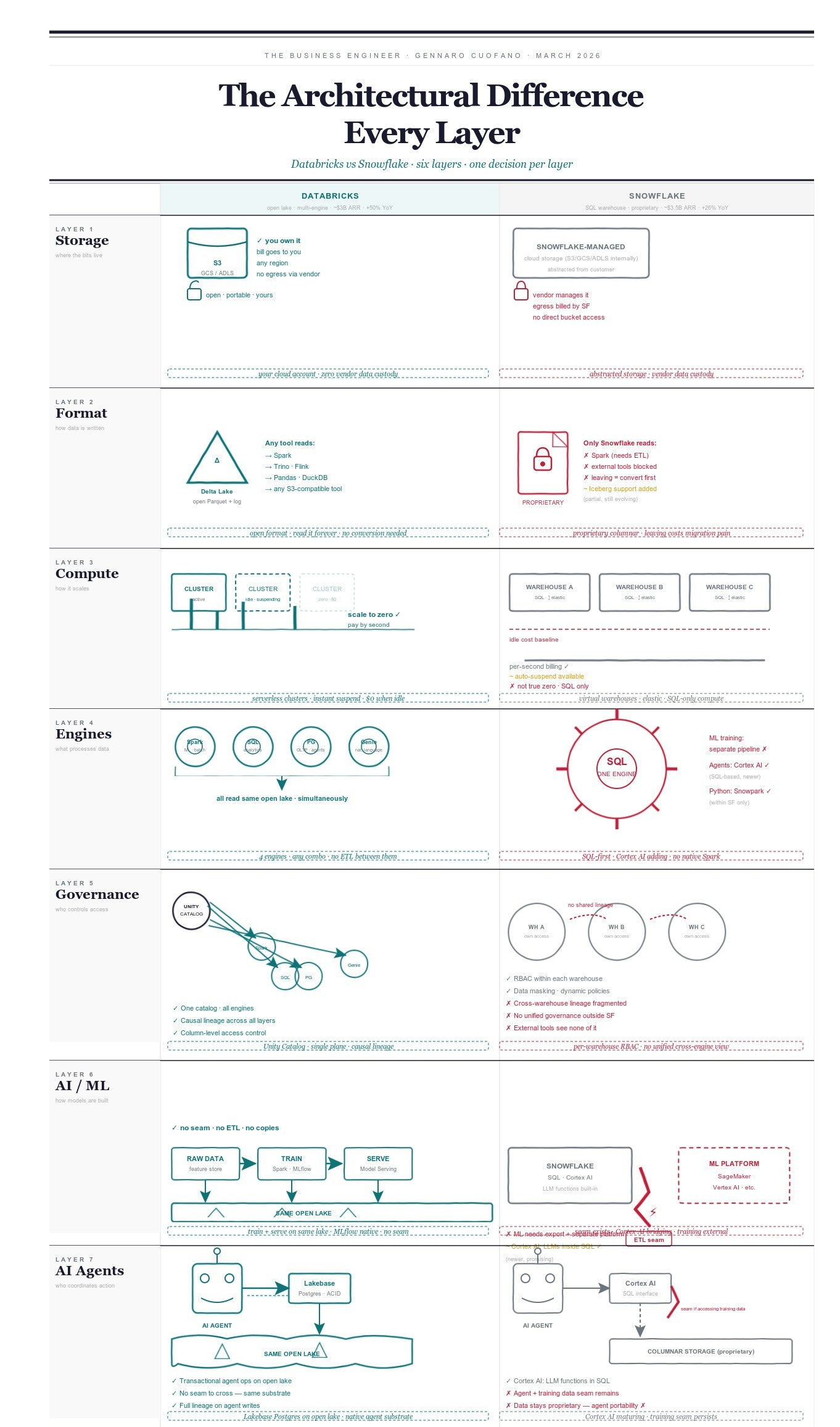
That is the deeper story of Databricks.