

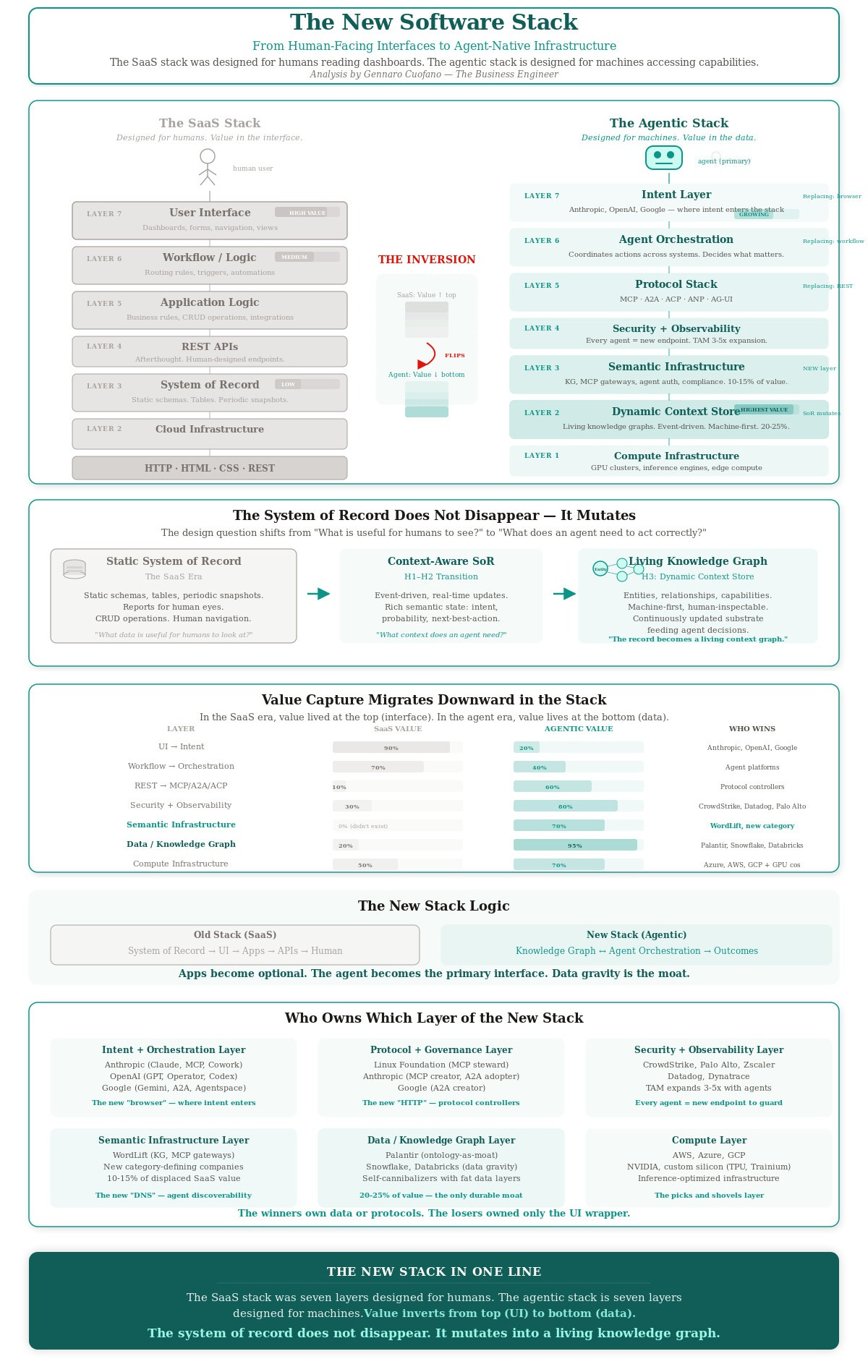
The SaaS stack was a seven-layer stack designed for humans navigating software. The agentic stack is a fundamentally different architecture designed for machines executing outcomes. This is not an incremental upgrade — it is a structural inversion of where value lives, how it flows, and who captures it.
In the last few days, I’ve given you a view of where this is going next, and it’s not just a passing change; it's structural.


The critical insight the market keeps missing: the new stack is not primarily about knowledge graphs, data layers, or any single technology. It is about the emergence of a System of Action—an orchestration architecture in which agents understand intent, coordinate across systems, and directly execute outcomes. The entire enterprise technology stack is reorganizing around this new center of gravity.
The SaaS era’s defining architecture was the System of Record — Salesforce, Workday, ServiceNow, SAP. Static schemas are designed for humans to input, navigate, and extract data. The agentic era’s defining architecture is the System of Action — an intelligent coordination layer where agents consume context, reason about intent, and produce outcomes without requiring humans to operate the software in between.
This structural shift creates a barbelled distribution of value — what I call the SaaS Hourglass — where maximum value concentrates at two extremes (orchestration at the top, proprietary data at the bottom) while the middle (UI-dependent workflow applications) gets hollowed out.

Read Also:


The weekly newsletter is in the spirit of what it means to be a Business Engineer:

We always want to ask three core questions:
What’s the shape of the underlying technology that connects the value prop to its product?
What’s the shape of the underlying business that connects the value prop to its distribution?
How does the business survive in the short term while adhering to its long-term vision through transitional business modeling and market dynamics?
These non-linear analyses aim to isolate the short-term buzz and noise, identify the signal, and ensure that the short-term and the long-term can be reconciled.