

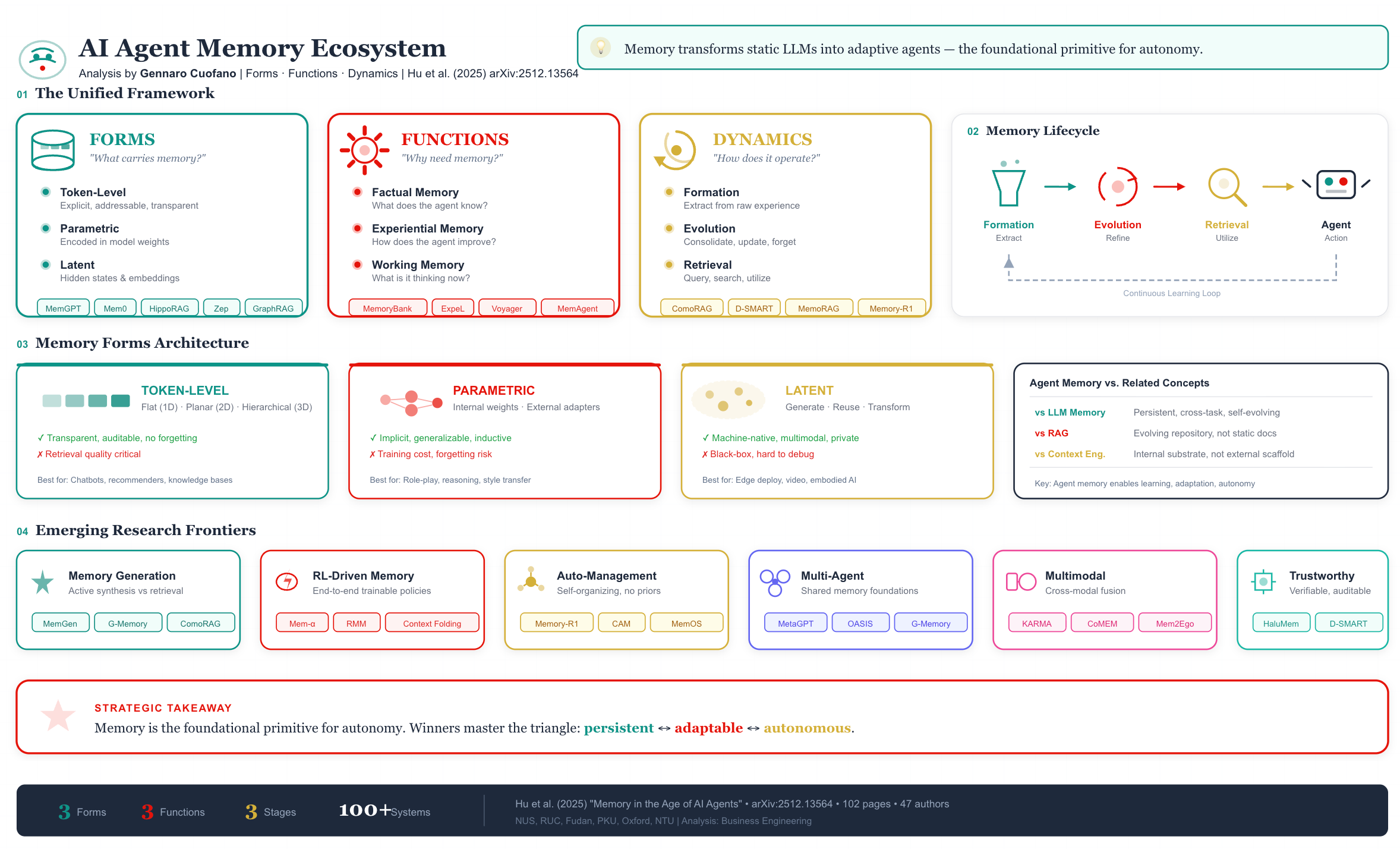
Memory has emerged as the cornerstone capability enabling the transformation of large language models from static text processors into adaptive, goal-directed AI agents.
This comprehensive analysis synthesizes the findings from a landmark 102-page survey by researchers across the National University of Singapore, Renmin University of China, Fudan University, Peking University, Oxford University, and other leading institutions.
The central thesis is clear: memory is not a peripheral feature but a foundational primitive in the design of future agentic intelligence.
Without robust memory systems, AI agents cannot maintain behavioral consistency, learn from experience, or adapt to evolving environments—capabilities that define the transition from narrow AI tools to genuinely autonomous systems.
I sit down with you to understand what business goals you want to achieve in the coming months, then map out the use cases, and from there embed the BE Thinking OS into the memory layer of ChatGPT or Claude, for you to become what I call a Super Individual Contributor, Manager, Executive, or Solopreneur.

If you need more help in assessing whether this is for you, feel free to reply to this email and ask any questions!

You can also get it by joining our BE Thinking OS Coaching Program.

Read Also:


The weekly newsletter is in the spirit of what it means to be a Business Engineer:

We always want to ask three core questions:
What’s the shape of the underlying technology that connects the value prop to its product?
What’s the shape of the underlying business that connects the value prop to its distribution?
How does the business survive in the short term while adhering to its long-term vision through transitional business modeling and market dynamics?
These non-linear analyses aim to isolate the short-term buzz and noise, identify the signal, and ensure that the short-term and the long-term can be reconciled.