

If I ask you what the most essential part of a human is? Chances are (if you’re like me) you’ll answer the brain.
Yet, counterintuitively, this AI wave has taught us that knowledge work has actually been the first part of the automation pyramid to be challenged. In contrast, physical AI has so far proved way more challenging.
In other words, the secret to real-world intelligence might lie way more in our bodies than we might like to believe.
Also, because, indeed, our bodies are the sensory mechanisms that connect our brains to the real world, and while the incredible feat of the brain is its ability to speculate about the real world, possibly producing mental models that make us capable of thriving better in the real world.
Truth is, these mental models are valuable and effective precisely because they may represent the accumulated physical learning experiences we have gained over the years.
These experiences become mental modeling, which in turn becomes intuition, or knowledge that can be accessed in the snap of a finger.
And indeed, that knowledge is valuable just because it is highly tied to the real, physical world.
In that respect, a key part of our body serves as a bridge between the enclosed skull that houses our brain and the real world: our hands.
As I’ll explain in this in-depth analysis of the humanoid robot, figuring out the hand is indeed among the critical elements to make this industry viable in the first place.
I’ll start the analysis from the Tesla Optimus Gen 2 bill of materials (BOM) breakdown, which reveals a ~$55,000 hardware cost structure, illuminating the fundamental economics of humanoid robotics. This analysis deconstructs the cost architecture, identifies the strategic bottlenecks, and maps the path to commercial viability.
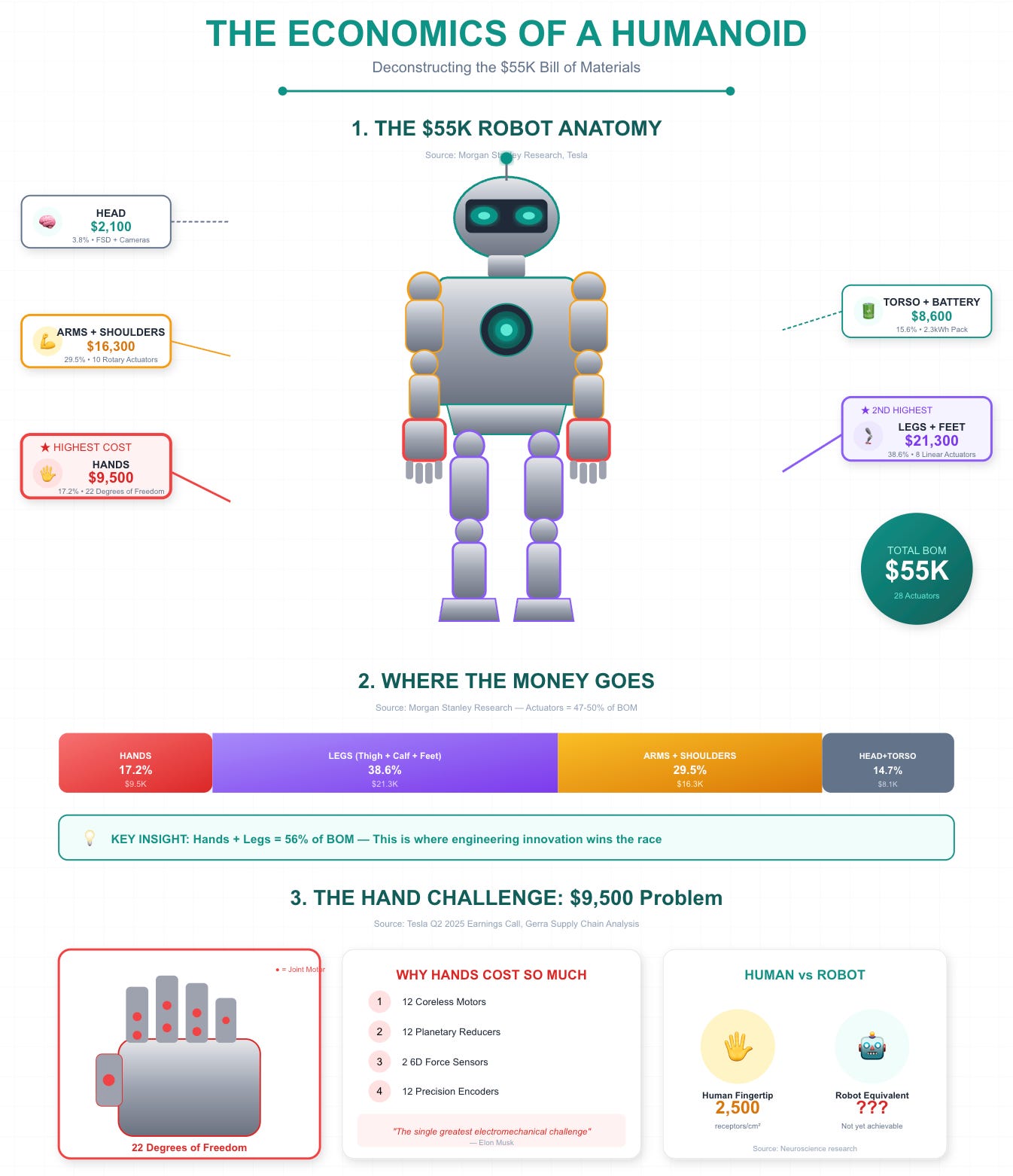
The core insight: Hands (17.2%) and legs (38.6%) account for over half of the BOM—these are the frontier challenges where scale economies and engineering innovation will determine which players dominate the $38-182 billion market by 2035.
I sit down with you to understand what business goals you want to achieve in the coming months, then map out the use cases, and from there embed the BE Thinking OS into the memory layer of ChatGPT or Claude, for you to become what I call a Super Individual Contributor, Manager, Executive, or Solopreneur.

If you need more help in assessing whether this is for you, feel free to reply to this email and ask any questions!

You can also get it by joining our BE Thinking OS Coaching Program.

Read Also: