

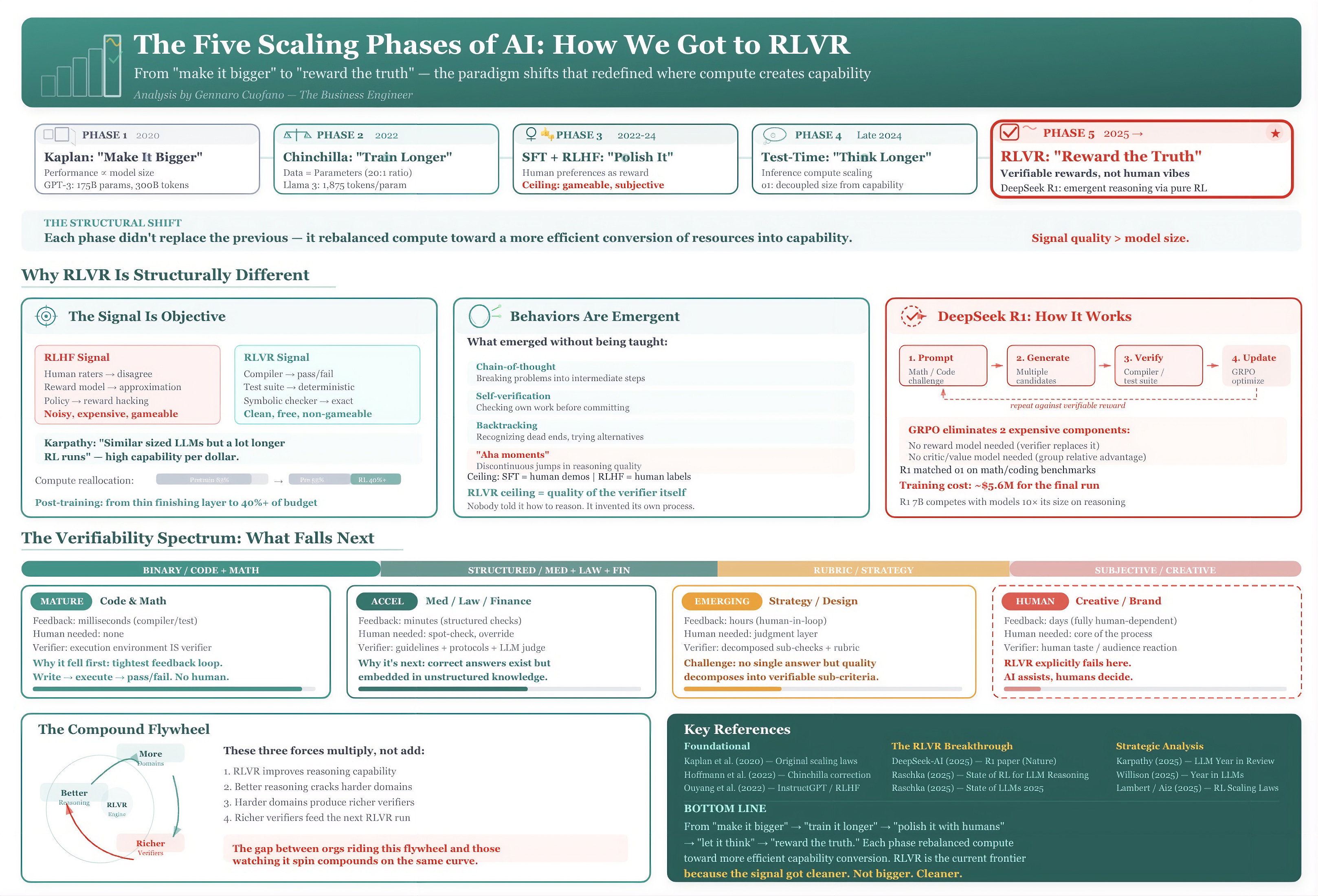
The story of modern AI isn’t a straight line of “bigger models = better results.” It’s a sequence of paradigm shifts, each one redefining where compute creates capability.
Understanding these phases isn’t academic — it’s the structural map that explains why 2025’s models weren’t dramatically larger than 2023’s, yet reasoned dramatically better.
And why RLVR — the fifth phase — represents the most consequential training breakthrough since pretraining itself.
I sit down with you to understand what business goals you want to achieve in the coming months, then map out the use cases, and from there embed the BE Thinking OS into the memory layer of ChatGPT or Claude, for you to become what I call a Super Individual Contributor, Manager, Executive, or Solopreneur.

If you need more help in assessing whether this is for you, feel free to reply to this email and ask any questions!

You can also get it by joining our BE Thinking OS Coaching Program.

Read Also:


The weekly newsletter is in the spirit of what it means to be a Business Engineer:

We always want to ask three core questions:
What’s the shape of the underlying technology that connects the value prop to its product?
What’s the shape of the underlying business that connects the value prop to its distribution?
How does the business survive in the short term while adhering to its long-term vision through transitional business modeling and market dynamics?
These non-linear analyses aim to isolate the short-term buzz and noise, identify the signal, and ensure that the short-term and the long-term can be reconciled.