

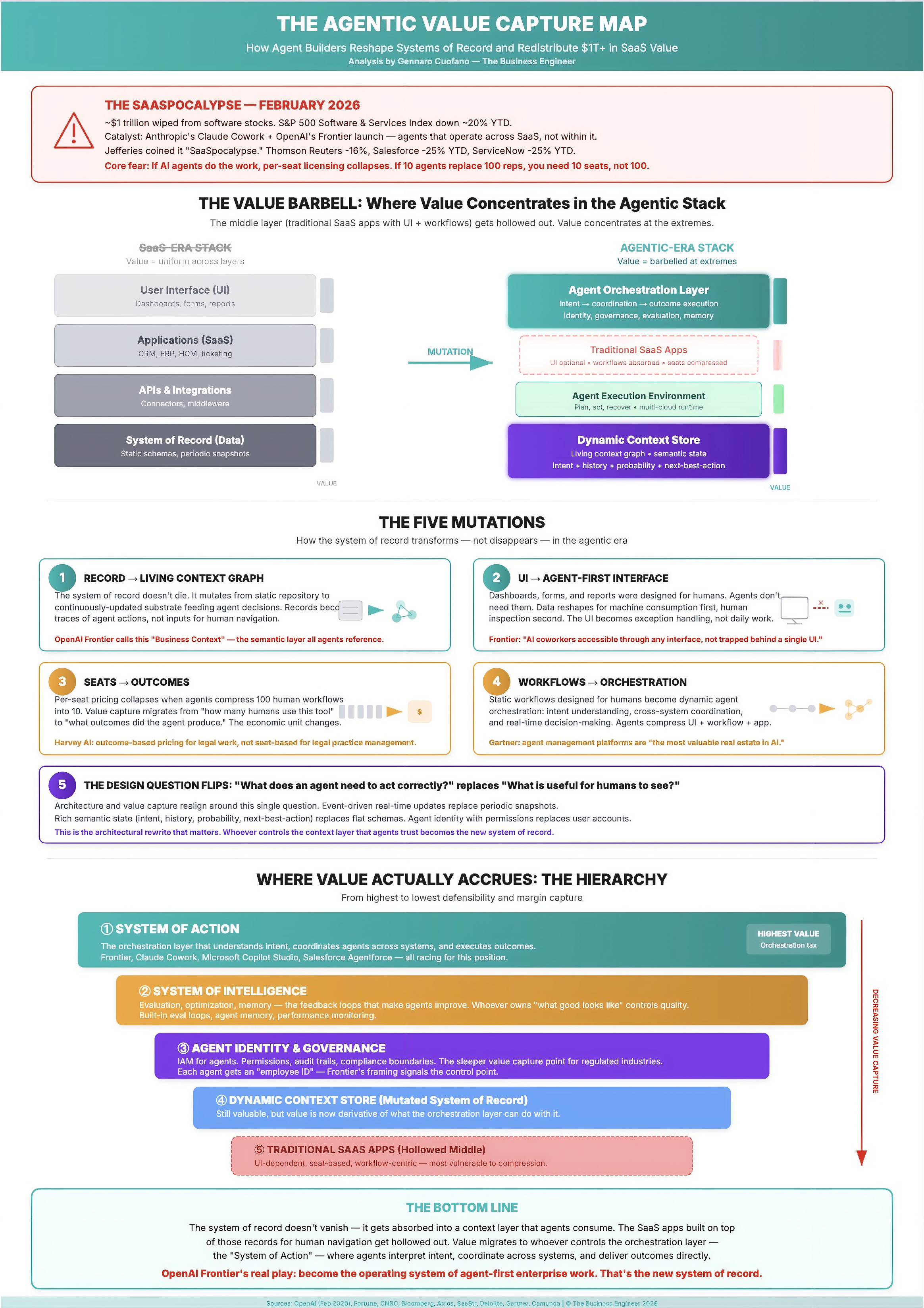
For two decades, enterprise software followed a linear, human-centric value chain. Each layer fed the next, each layer captured margin, and the entire architecture assumed a person sitting at a keyboard navigating screens. The chain ran like this:
Raw Data → System of Record → APIs & Middleware → SaaS Applications → UI → Human User
Raw data lived in warehouses and lakes — Snowflake, Databricks, Redshift. Largely undifferentiated infrastructure.
The system of record — Salesforce, SAP, Workday, Oracle — sat on top, organizing that data into static schemas optimized for compliance, reporting, and human queries.
APIs and middleware (MuleSoft, Zapier, REST integrations) connected these records to the application layer. SaaS applications — CRM, ERP, HCM, ticketing, project management — wrapped the data in workflows, dashboards, forms, and business logic designed for human operators.
The UI was the final delivery layer: the screen where a sales rep updated a pipeline, an HR manager approved a request, and a support agent resolved a ticket.
Value is distributed relatively evenly across this chain. The system of record captured a significant margin because it was sticky and compliance-critical. SaaS applications captured margin because they owned the workflows and user experience.
The UI layer justified per-seat pricing — each human who needed to see dashboards, click buttons, and navigate workflows represented a billable unit. Middleware captured integration fees. Even the raw data infrastructure took its cut.
The pricing model matched the architecture perfectly: per-seat, per-user, per-employee, per-month. More humans interacting with software meant more revenue.
The entire economics of enterprise technology assumed a roughly linear relationship between organizational headcount and software spend. Salesforce charges per seat. Workday charges per employee. Adobe charges per creative professional.
This model generated trillions in cumulative enterprise software value. It worked because humans were both the operators and the bottleneck. Every workflow required a person to initiate, monitor, approve, or execute.
The UI existed because the human needed an interface. The seat existed because humans needed access to it. The workflow existed because the human needed structure.
The value chain was stable, predictable, and extraordinarily profitable. It was also entirely dependent on one assumption: that humans would remain the primary operators of business processes.
I sit down with you to understand what business goals you want to achieve in the coming months, then map out the use cases, and from there embed the BE Thinking OS into the memory layer of ChatGPT or Claude, for you to become what I call a Super Individual Contributor, Manager, Executive, or Solopreneur.

If you need more help in assessing whether this is for you, feel free to reply to this email and ask any questions!

You can also get it by joining our BE Thinking OS Coaching Program.

Read Also: