

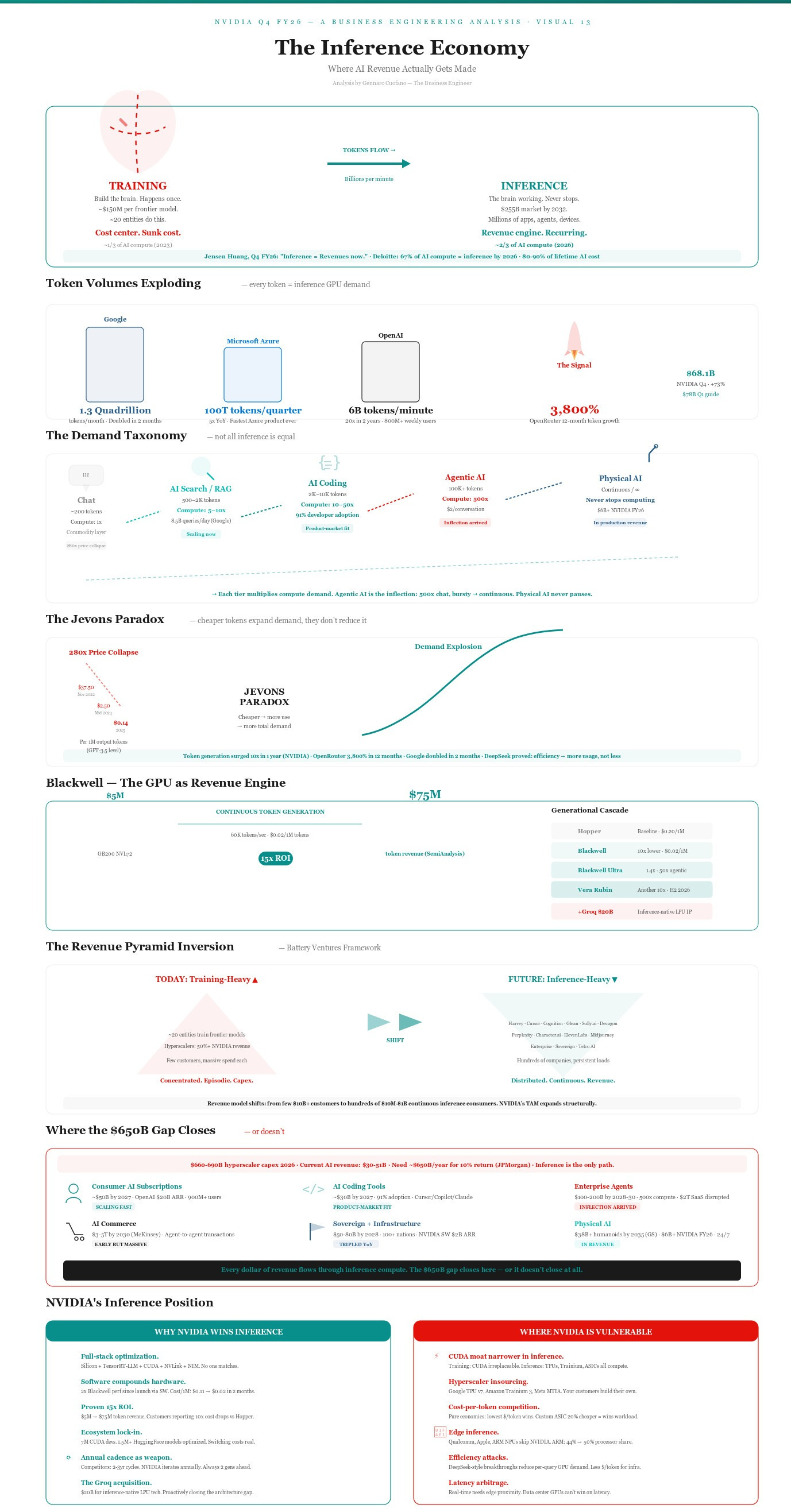
AI has crossed from the training era to the inference era. This is not a technical nuance. It is a fundamental economic restructuring that changes who makes money, how they make it, and where value concentrates in the AI economy.
Training was a cost center: episodic, concentrated among roughly twenty frontier model labs, amortizable across trillions of tokens. Inference is a revenue engine: continuous, distributed across millions of applications and agents, incurring marginal cost with every query. Training builds the brain. Inference is the brain working. And the AI brain never sleeps.
The numbers confirm the shift. Inference now accounts for approximately two-thirds of all AI compute in 2026, up from one-third in 2023 and half in 2025 (Deloitte). The AI inference market was valued at $91.4 billion in 2024 and is projected to reach $255 billion by 2032 (Fortune Business Insights). The market for inference-optimized chips alone will exceed $50 billion in 2026 (Deloitte). Inference accounts for 80 to 90 percent of the lifetime cost of a production AI system.
On NVIDIA’s Q4 FY26 earnings call on February 25, 2026, CEO Jensen Huang made the shift explicit: “Inference equals revenues now. Compute equals revenues.” Grace Blackwell with NVLink delivered record quarterly revenue of $68.1 billion, up 73% year-over-year, with Q1 FY27 guidance of $78 billion. The inference economy is no longer a prediction. It is NVIDIA’s business model.

You can also get it by joining our BE Thinking OS Coaching Program.

Read Also:


The weekly newsletter is in the spirit of what it means to be a Business Engineer:

We always want to ask three core questions:
What’s the shape of the underlying technology that connects the value prop to its product?
What’s the shape of the underlying business that connects the value prop to its distribution?
How does the business survive in the short term while adhering to its long-term vision through transitional business modeling and market dynamics?
These non-linear analyses aim to isolate the short-term buzz and noise, identify the signal, and ensure that the short-term and the long-term can be reconciled.