

For roughly twenty years, software was built on a coherent and stable design philosophy. It had four components that fitted together so naturally that most product teams never articulated them explicitly:
Fixed UX: Design a predictable interface. Users navigate from screen to screen. Features are discoverable through menus, buttons, and flows. The designer controls the path.
Narrow features: Build a defined set of capabilities. The product does specific things. Users learn what it does and use it for those things.
Thin data layer: Store the data needed to run the interface. The data layer is a backend for the UI — it holds state, persists records, and serves queries. Intelligence lives in the interface, not in the data.
Static API endpoint: Expose functionality through a documented set of fixed API calls. Other systems integrate against known endpoints. Integrations are designed and maintained deliberately.
This logic produced twenty years of SaaS success. It worked because the consumer of every software surface was a human navigating a screen. Fix the human, fix the interface. The model held.
The Assumption That Broke
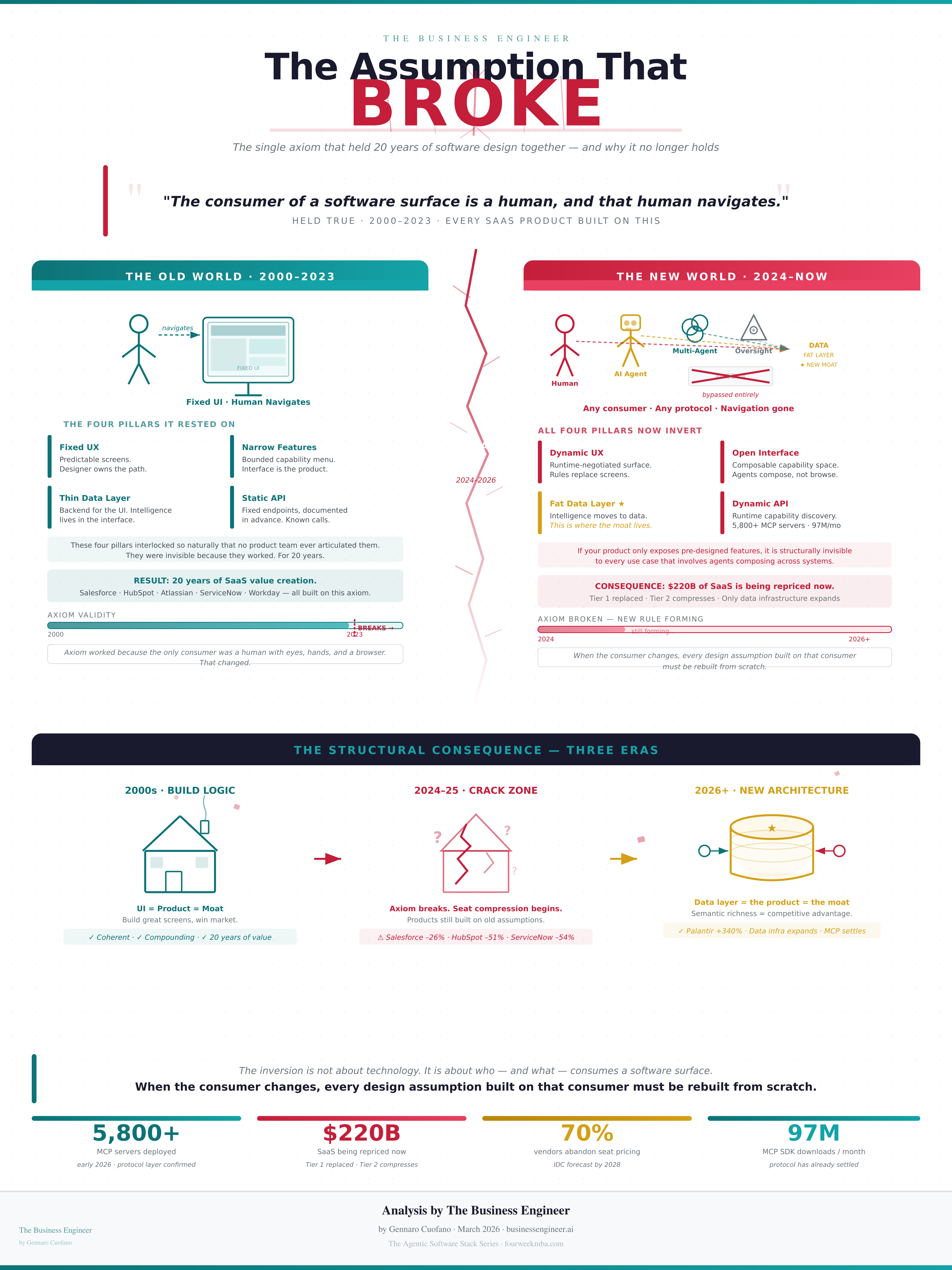
One assumption held the entire design logic together: the consumer of a software surface is a human, and that human navigates.
That assumption is now broken. In 2026, the consumer of a software surface may be a human navigating a dashboard in the traditional sense, an AI agent querying the product via an MCP (Model Context Protocol) server, a multi-agent system orchestrating tasks across five products simultaneously via A2A (Agent-to-Agent protocol), or an oversight layer monitoring autonomous agent behaviour through AG-UI.
You cannot design a fixed interface for a consumer you cannot predict. The consumer — human or agent — may query the product in ways the product team never anticipated, compose capabilities the product never intended to offer together, or bypass the interface entirely and call underlying systems directly. The fixed-UX assumption does not bend under this pressure. It breaks.
What’s the future of software?