

The SaaS industry is undergoing a permanent structural transformation. The traditional middle market, companies with $20-100K ACV, sales-assisted motions, and feature-based differentiation, is being crushed between two extremes.
This is not a cyclical trend. It is a fundamental restructuring driven by four forces that only intensify over time.

AI commoditization has collapsed the development timeline for functional capabilities to near-zero. Features that took two years to build now take two days to replicate. Any feature that can be described can be built by competitors—or by customers themselves using AI coding assistants.
Zero-marginal-cost economics means the cost to serve one additional user approaches zero. Cloud infrastructure costs continue to decline. AI handles customer support, onboarding, and code generation. Software pricing must now reflect near-zero marginal costs, which drives prices toward zero at the Floor, or forces companies to create value through irreversibility at the Ceiling.
Buyer sophistication has eliminated information asymmetry. Buyers benchmark, compare, and negotiate. Procurement teams now have access to the same AI tools that make alternatives cheap to build. “Good enough” no longer commands a premium.
The end of ZIRP means capital has a cost. The Rule of 40 is now the Rule of 50+. Investors demand profitability paths, not growth-at-all-costs narratives. Unit economics must work from early stages—companies cannot “grow into” profitability by raising more capital.

These forces are impersonal. They don’t negotiate. They don’t make exceptions for great teams, big markets, or compelling narratives.
The outcome space has collapsed into three possibilities: Floor, Ceiling, or death. Floor companies compete on viral growth, zero CAC, and massive scale at near-zero prices.
Ceiling companies compete on irreversibility, deep integration, compounding data gravity, and organizational embedding that make switching unthinkable. The middle, where most SaaS companies have historically lived, is structurally unviable.
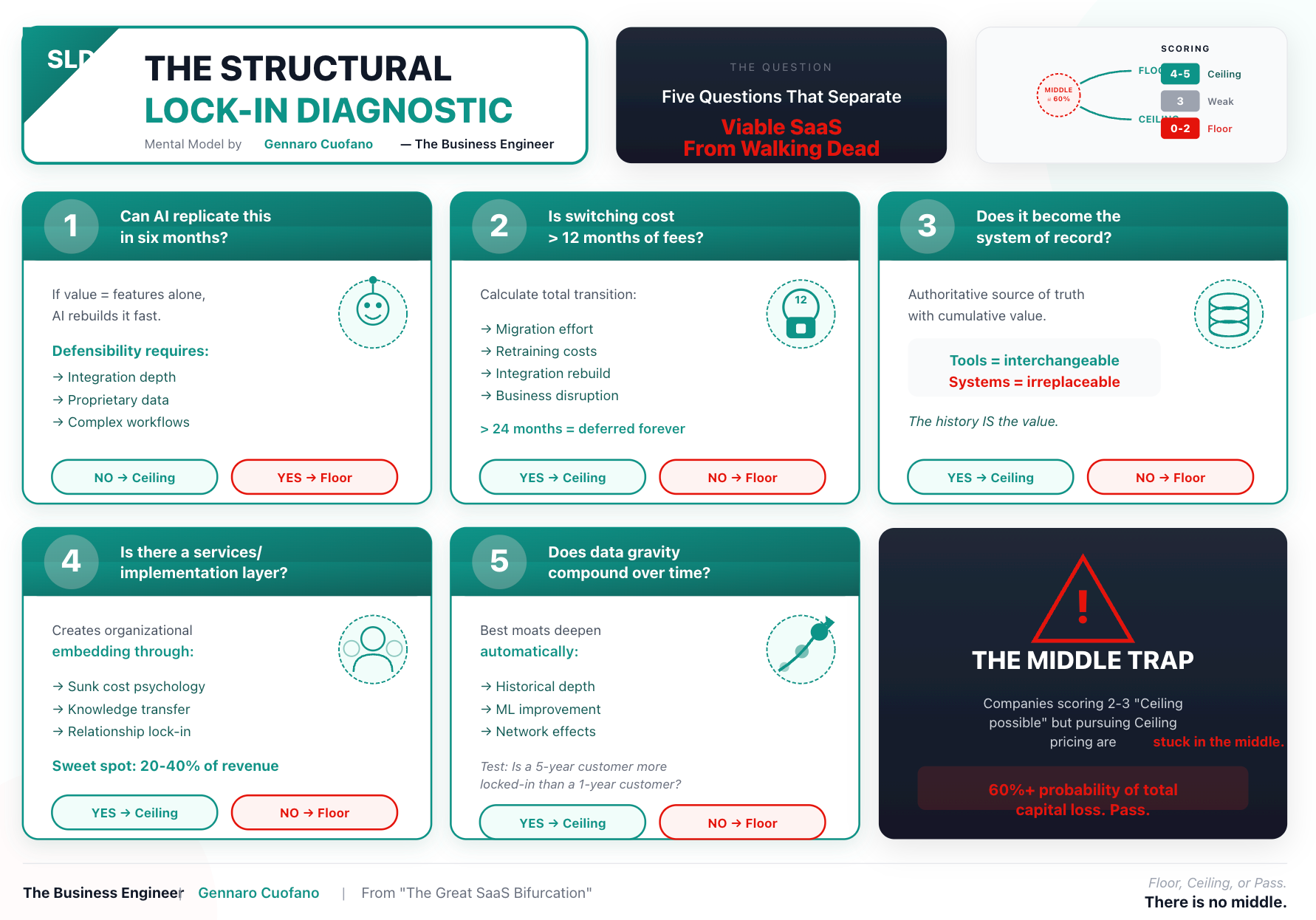
The Structural Lock-In Diagnostic exists to answer one question: Where does this company actually live? Not where management says it lives. Not where the pitch deck positions it. Where the physics of the business model place it.
Traditional due diligence focuses on growth rates, retention metrics, and market size. This diagnostic adds a critical structural layer. The five questions can be answered in 30 minutes. They should be asked in the first meeting, not after weeks of diligence. If the answers are ambiguous, it’s middle. Pass.
I sit down with you to understand what business goals you want to achieve in the coming months, then map out the use cases, and from there embed the BE Thinking OS into the memory layer of ChatGPT or Claude, for you to become what I call a Super Individual Contributor, Manager, Executive, or Solopreneur.

If you need more help in assessing whether this is for you, feel free to reply to this email and ask any questions!

You can also get it by joining our BE Thinking OS Coaching Program.

Read Also: