

Every paradigm shift produces a vocabulary problem before it produces a design problem. The practitioners who built the web had to stop saying “brochure” and start saying “homepage.” The practitioners who built mobile had to stop saying “website” and start saying “app.”
In each case, the new vocabulary was not cosmetic — it was load-bearing. The words encoded the new mental models that made the new work possible. Teams that kept the old vocabulary kept the old assumptions, built the wrong products, and wondered why users did not behave the way the roadmap predicted.
We are at that inflection point again — and this time the vocabulary gap is wider. The SaaS era produced a rich, settled lexicon: users, sessions, flows, features, dashboards, funnels, engagement. Every one of these terms encodes a specific assumption — that the system is passive, that the human navigates, that the human decides, that the human acts.
In an agentic system, the agent acts. The human specifies intent, validates proposals, and intervenes at escalation points. The old vocabulary does not have words for most of what matters in that interaction. Worse, the words it does have carry the wrong assumptions silently into every meeting, every spec, and every design review where they are used.
You will also find the downloadable vocabulary at the end of the piece!
The fifty terms that follow are organised into five clusters: the shift in what the product optimises for; the architecture of trust between human and agent; the interface primitives that make trust legible; the infrastructure that makes agents possible; and the measurement and commercial vocabulary that maps agentic value onto business outcomes.
The vocabulary is not decoration. It is the operating system for thinking.
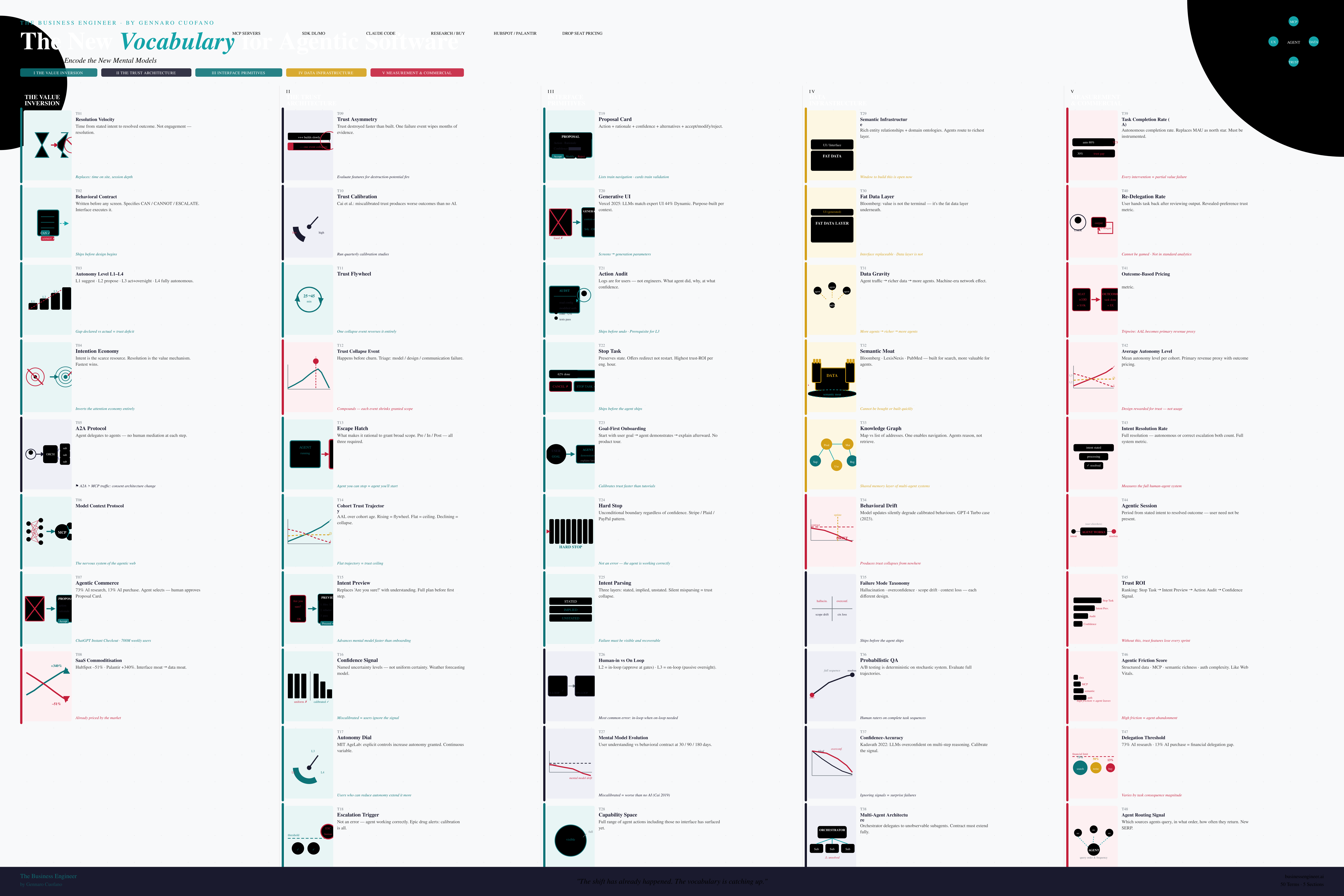
You will also find the downloadable vocabulary at the end of the piece!
What’s the future of software?